









What does your property’s electrical panel look like? If your home was built before the 1970s or 80s and you haven’t done any upgrades in a while, there’s a chance it might be outdated, deteriorating or unable to keep up with today’s power demands.
To understand how aging electrical systems affect homeowners, our team at MyChoice analyzed data from the Electrical Safety Authority’s 2024 Ontario Electrical Safety Report, Natural Resources Canada’s housing stock data, and underwriting requirements from home insurers across Canada. We also reviewed common insurance eligibility criteria related to electrical panels, wiring systems, and older homes to identify the electrical features most likely to affect home insurance coverage, inspections, and pricing.
Can an Old Electrical Panel Affect Your Home Insurance?
Yes, it can. While insurers do not automatically reject every older home, aging electrical systems often receive additional scrutiny during underwriting.
When you’re applying for or renewing your home insurance policy, it is standard for providers to ask you about the type of electrical panel in your home, as some older models run the risk of overload, which can cause electrical fires.
Certain panels may trigger inspection requests from the insurance company if they are older and higher risk. In these cases, an electrician may be asked to confirm whether the panels are safe, up to code or if they recommend any replacements or improvements.
The exact requirements vary by insurer, but homes with older electrical systems often have fewer insurance options available than homes with modern wiring and panels.
Read More: What to Do if You Have Been Rejected for Home Insurance
What Is an Electrical Panel?
The electrical panel in your home (also sometimes referred to as the ‘breaker box’) is responsible for receiving electricity from the main service line and distributing it throughout your home, while protecting against short circuits and overloads. These are generally located in the basement or a utility room, for example.
Warning Signs Your Electrical System May Need Attention
Consider having your electrical panel inspected by a professional if you notice the following:
- Flickering or dimming lights
- Warm outlets, switches, or panel components
- Buzzing or crackling sounds from breakers
- Burning smell near the panel itself
- A fuse box instead of a breaker panel
If your panel hasn’t been properly inspected in years, it’s generally a good idea to do so sooner rather than later.
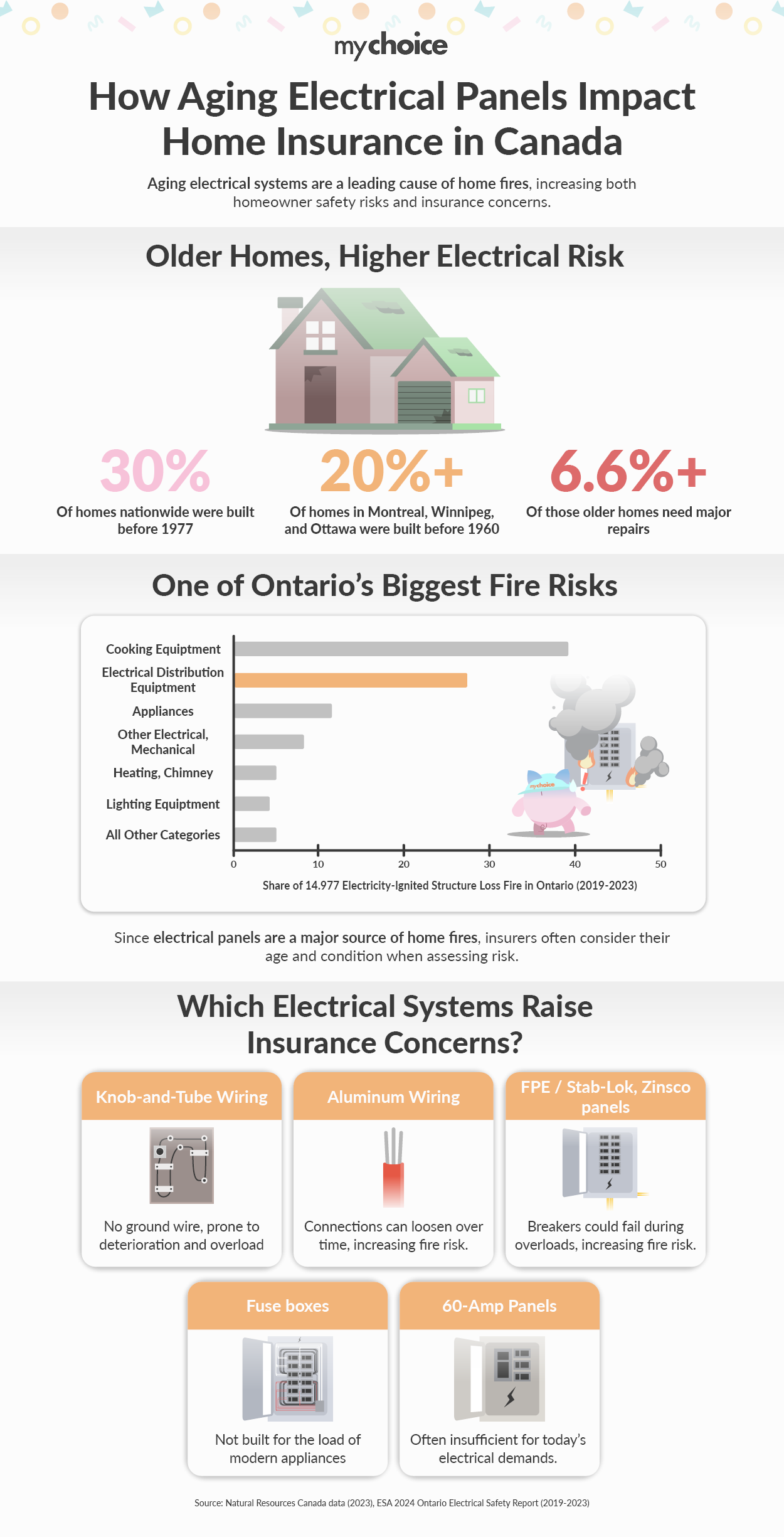
According to the Ontario Electrical Safety Report (OESR), electrical distribution equipment is responsible for roughly one fire every day in Ontario, making electrical maintenance an important home safety and insurance consideration.
Why Do Older Homes Face More Risk?
Canada boasts a significant number of older homes — as Natural Resources Canada data show, in 2023, just under 30% of the country’s residential housing stock was built before 1977. Some of those homes may be deferring essential maintenance in areas like electrical wiring or panel upgrades.
According to a MyChoice study, in cities like Montreal, Winnipeg and Ottawa, more than 20% of housing stock was built before 1960, with at least 6.6% of homes in need of major repairs.
Insurers are increasingly looking at the condition of properties over 50 years old when pricing your premium, says the study.
Although the cost of installing a new electrical panel can be several thousand dollars and new wiring even more, depending on square footage, upgrading old electrical wiring, whether knob-and-tube or aluminum, and making sure your electrical panel is modern and able to handle the demands of your home are key to reducing your risk profile related cases.
Electrical Distribution Equipment Fire Risk by the Numbers
In the five-year period between 2019 and 2023, the Ontario Fire Marshall identified more than 2,000 fires caused by electrical distribution equipment with electricity as the fuel of the ignition source, according to the 2024 Ontario Electrical Safety Report, including 367 fires in 2023, representing some 27% of all electricity ignited fires.
On a positive note, the number of electrical distribution equipment structure fires has decreased 18% since 2019.
| Ignition Source | Percentage of Structure-Loss Fires | Count |
|---|---|---|
| Cooking | 39% | 5,889 |
| Electrical distribution equipment | 27% | 4,013 |
| Appliances | 12% | 1,748 |
| Other electrical, mechanical | 8% | 1,264 |
| Heating, chimney | 5% | 801 |
| Lighting | 4% | 573 |
| Miscellaneous | 1% | 215 |
| Open flame | 1% | 123 |
| Processing equipment | 1% | 136 |
| Undetermined | 1% | 206 |
| Exposure | <1% | 9 |
Read More: How Residential Fires Change Across Canada
Which Electrical Systems Raise Insurance Concerns?
On the wiring side, knob-and-tube, which was widely used before the 1950s, is no longer considered safe, as it poses a fire hazard due to its lack of a ground wire and the likelihood of deterioration. It also can’t meet the electrical demands of today’s homes, which makes it vulnerable to overload.
Similarly, aluminum wiring from the 1960s and 70s is outdated as it expands and contracts, causing loose connections and fire risk.
Insurers have also raised concerns about homes with Federal Pacific Electric (also called Stab-Lok) or Zinsco panels, which were commonly installed between the 1950s and 1980s. These panels feature breakers that may malfunction or fail to trip during overloads, creating a fire hazard. Some insurers view fuse panels as higher-risk electrical systems and may require upgrades or inspections before providing coverage.
Panels that use 60-amps (rather than the 100-amp or even 200-amp that today’s residential homes require to support demands like air conditioning or home EV chargers) may also be vulnerable to overload.