









With more than 80% of Canadians choosing to charge their EVs at home, many are increasingly installing Level 2 chargers in their garages — a faster, more efficient charging option than the standard Level 1 plug-in, with some provinces offering a rebate for installing home chargers.
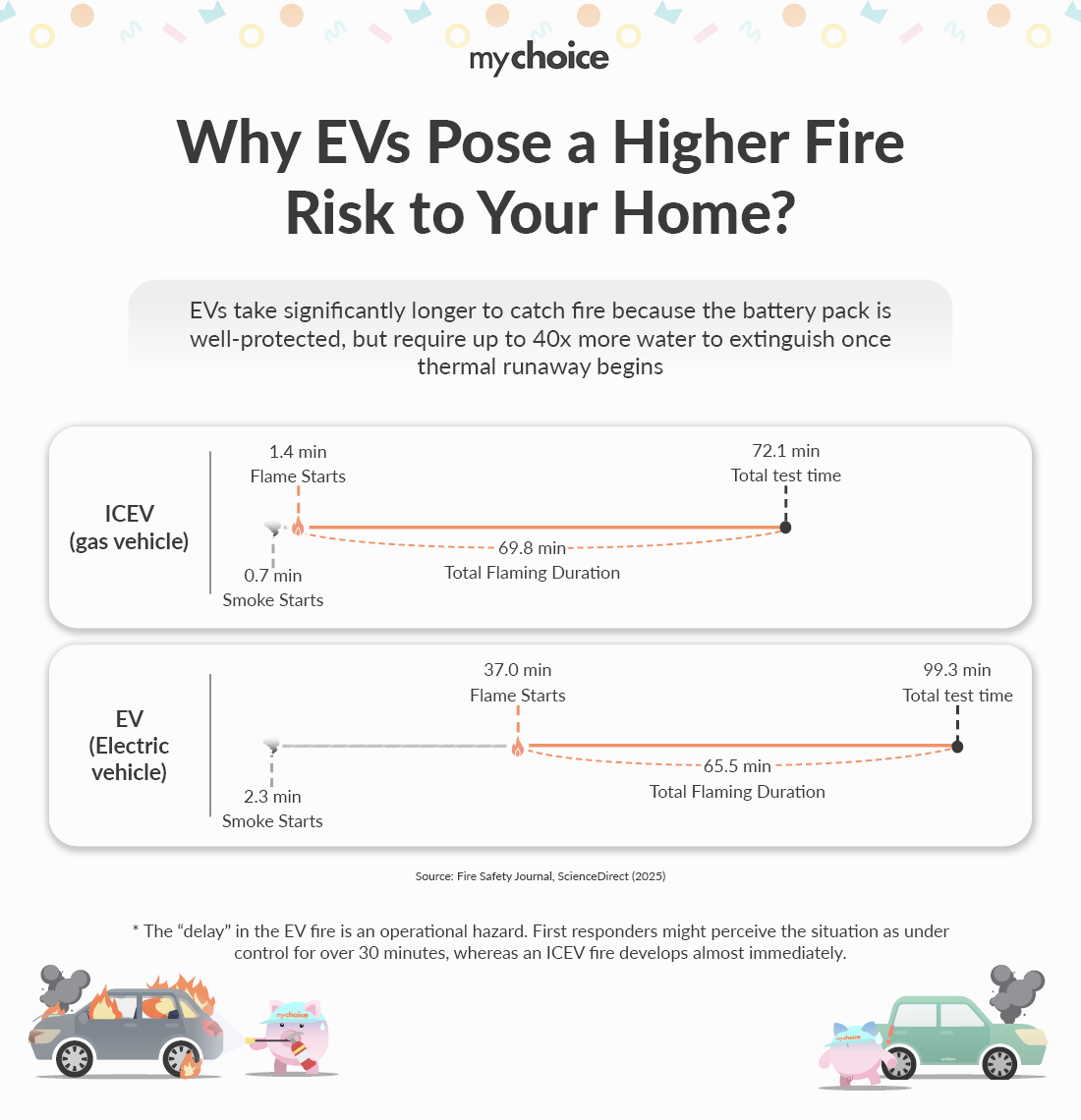
Understanding the EV Fire Risk Debate
While EVs are no more likely to catch fire than their gas-powered counterparts, if they do, the damage can be more severe and fires harder to contain.
There is no Canadian database on vehicle fires, including those involving EVs, says the National Research Council, but data from the U.S. National Fire Protection Association (NFPA) shows that while regular internal combustion engine (ICE) vehicles in the U.S. catch fire on average every two to three minutes. Meanwhile, there were only 511 verified EV battery fires globally between 2010 and June 2024, says EV FireSafe.
Verified global EV lithium-ion battery fires (2010-June 2024)
| Location: | Outside & Driving | Outside & Parked | Underground/e closed spaces | Unknown |
|---|---|---|---|---|
| 155 | 173 | 117 | 67 |
At the same time, when fires do involve EVs, they pose unique challenges for firefighters.
What Makes EV Fires More Serious?
Fires in lithium-ion batteries, including those in EVs, can happen for several reasons, says the NFPA, including physical damage, electrical damage such as overcharging or using charging equipment not designed for the battery and product defects.
When there is a fault in a lithium-ion battery, either caused by an internal or external factor, there is a risk that they can enter into an uncontrollable self-heating state called ‘thermal runaway,’ according to Underwriters Laboratories Inc. This can lead to extreme temperatures of 1000-1200℃, smoke and/or ejection of shrapnel or hydrogen fluoride gas and fires that can burn for hours or even days.
As batteries inside EVs are sealed in metal containers, says the NFPA, up to 40 times more water may be required to cool the metal casing to eventually stop thermal runaway.
In some Canadian cities, garage fires account for a notable percentage of residential fires — and because they often store flammable material such as paint, oily rags or propane tanks, they can spread faster and more uncontrollably.
If a fire is caused by thermal runaway, high, sustained temperatures can cause significant damage to a garage and the attached home, weakening the structural integrity of concrete and steel.
Do Level 2 Chargers Affect Home Insurance?
Most standard home insurance policies will cover damage caused by a Level 2 EV charger, but coverage details depend on the policy and how the charger was installed. Usually Level 2 chargers are covered under many home insurance policies, insurers require proof that the equipment is certified and installed correctly by licensed professionals.
The risk of fire while charging an EV is rare. According to research from EV FireSafe, approximately 15% of EV battery fires occur while connected to charging or within an hour of being disconnected from charging.
It is also a misconception that charging itself increases the risk of an EV battery fire, they note, especially while using an electrically compliant unit that has been professionally installed to standard.
Most charging-connected battery fires are caused by previous damage, whether collision, recall or exposure to another fire.
Fires that result from improperly installed Level 2 chargers or damage caused by misuse may result in denial of claims.
Key Advice from MyChoice:
- Ensure your Level 2 charger is approved by a recognized Canadian certification agency and installed by a licensed electrical contractor. In Ontario, for example, they’ll file a notification of work — also known as a permit — with the Electrical Standards Association before installing, according to the Electrical Safety Authority and provide you with an ESA Certificate of Acceptance when the work is completed and has been deemed compliant with the provincial electrical safety code.
- Tell your insurer about the installation of your Level 2 charger and provide them with records of both your permit and proof of inspection — confirm that your property has adequate coverage in case of any incidents.
- Make sure your electrical panel can handle the new charging load — Level 2 stations require a 240-volt outlet with a dedicated circuit.
- Inspect your charger frequently for any damage or wear and tear, and stay on top of any EV vehicle or charging equipment-related recalls.