







Insurance Costs Are Rising Faster in High-Risk Areas and Taking a Bigger Bite Out of Monthly Budgets
Flooding is becoming one of the most financially disruptive climate risks facing Ontario homeowners, and its impact is no longer limited to repair bills after a flood. In July 2024, flash floods across Toronto and southern Ontario caused over $940 million in insured damage, one of the costliest flood events in the province’s recent history.
Across Ontario, flood exposure is now being reflected in home insurance premiums, with higher-risk areas seeing faster increases. At the same time, home prices have declined, and mortgage rates have eased, suggesting improved affordability. But beneath the surface, a different trend is emerging. While homes may be cheaper to buy, they are becoming more expensive to own.
In a new joint study, our team at MyChoice partnered with Wahi, one of Canada’s leading real estate platforms, to analyze how flood risk is influencing the true cost of homeownership across Ontario. The analysis builds on our earlier work mapping flood exposure across the province, where we identified the cities most vulnerable to flooding using data from Natural Resources Canada and other federal sources. Each city was assigned a flood risk score on a scale of 1 to 5. By combining those risk insights with the RPS-Wahi Home Price Index data and our insurance datasets, we examined how premiums are evolving in higher-risk areas, and what that means for housing affordability.
Our Methodology
The report examined home insurance premiums across 39 Ontario cities and municipalities, comparing 2024 and 2026 data. For consistency, we focused on quotes reflecting a standardized homeowner profile: a 35-year-old male or female with a clean claim history, currently insured, non-smoker, living in a semi-detached or detached 3–4 bedroom home (2,000–2,500 sq. ft.). Each property was assumed to have monitored fire and burglar alarms, at least one fire extinguisher, a $1,000 deductible, $1,000,000 liability coverage, and an Enhanced Water Protection package.
This report combines an insurance dataset from MyChoice and the RPS Home Price Index maintained by Wahi to explore the influence of flood risk on home insurance rates and affordability in the following market: Ontario. We calculate the ratio of insurance-to-mortgage payment per month in each city using home values in a given city, average home insurance premiums, a 20% downpayment, a five-year fixed mortgage and the interest rates as seen in 2024 and 2026. These indicators help to understand how increased insurance rates are impacting homeowners’ monthly housing budgets.
Key Findings from the Study
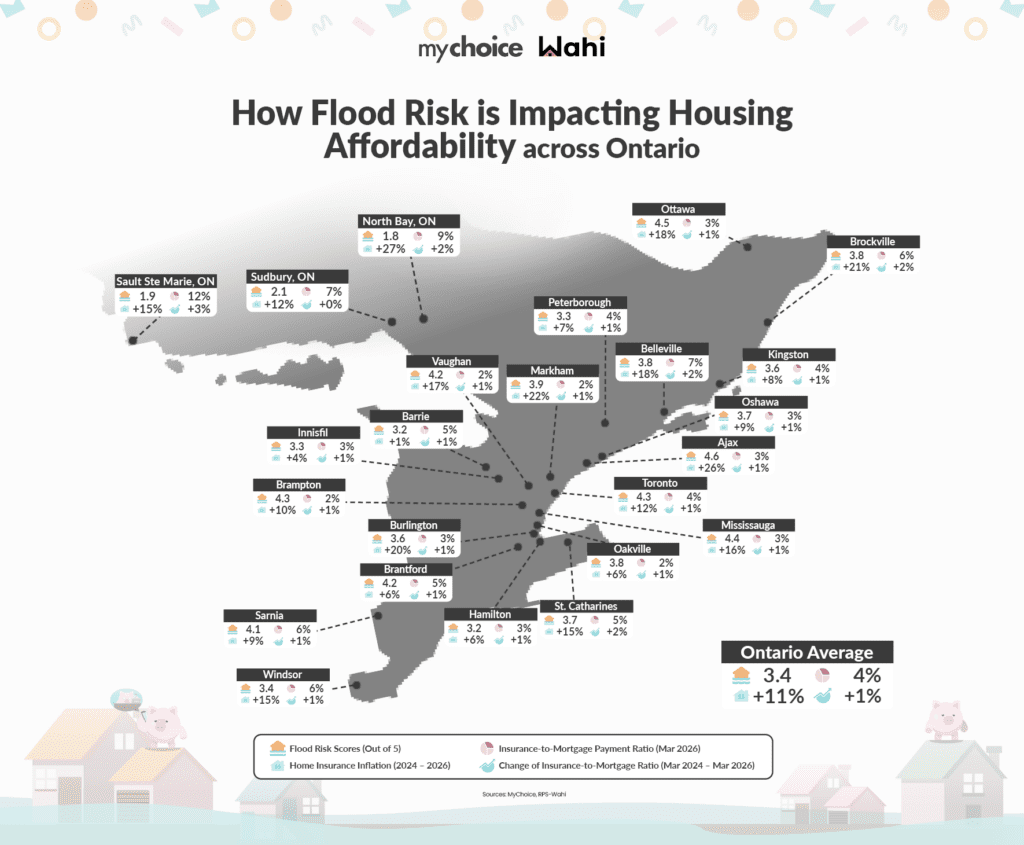
- Ajax (4.6/5), the province’s highest flood-risk city, saw premiums rise 26%, from $1,022 to $1,290. While insurance still represents a smaller share of mortgage payments at 3%, the rate of increase highlights how quickly affordability dynamics can shift in high-risk urban markets.
- Ottawa (4.5), Mississauga (4.4), and Toronto (4.3) also recorded steady premium increases ranging from 12% to 18%. However, higher home values in these markets continue to keep insurance-to-mortgage ratios relatively low, between 3% and 4%.
- Sarnia (4.1), presents a similar pattern, with insurance costs making up 6% of mortgage payments, despite more moderate premium growth (+9%). Brantford (4.2) and Brockville (3.8) also fall into this category, with insurance accounting for 5% to 6% of monthly costs.
- Ontario paints a divided picture. In more affordable markets, particularly in areas with higher flood risk, insurance accounts for a much greater share of monthly housing costs, but in higher-priced markets the impact of increasing insurance costs is mitigated by higher home prices.
- Interestingly, the average flood risk scores are lower in Northern Ontario. However, cities such as Thunder Bay, North Bay, and Sault Ste. Marie are seeing some of the fastest increases in insurance premiums and some of the highest insurance-to-mortgage cost ratios in the province.
A Growing Influence on Where People Can Afford to Live
Even as insurance makes up a smaller part of housing costs than mortgages, there’s little question about where insurance costs are going.
If insurance costs continue to rise, particularly in higher-risk areas, they may begin to influence where Canadians choose to buy homes.
In markets where insurance accounts for a larger share of monthly payments, buyers may face affordability constraints not from the purchase price itself, but from the ongoing cost of protecting their property.
“Affordability isn’t just about what you pay for a home anymore, it’s increasingly about what it costs to protect it,” says Aren Mirzaian, CEO of MyChoice. “What we’re seeing in flood-prone markets is that insurance is becoming a more material part of the monthly cost, particularly in areas that are traditionally viewed as more affordable.”
Flood Risk Challenges: A Look Ahead
Canada is not alone in experiencing increases in insurance costs associated with climate danger. In the United States, increased flood danger has already led to significant changes in the way insurance is provided.
The United States has a National Flood Insurance Program (NFIP). This federally-backed program was instituted in 1968, to offer an insurance system to provide coverage in high-risk areas where insurers are unwilling or unable to fully assume the risks. Millions of American homeowners rely on the NFIP for their flood coverage.
NFIP also shows the challenge of pricing climate risk appropriately. The program has worked to make sure insurance is available in all flood-prone areas. But in recent years it began adjusting insurance rates to better reflect risk, which drives up costs for many policyholders.
As of right now, a similar national program does not exist in Canada.
While private insurers began offering overland flood coverage in 2015, a significant portion of high-risk homes still face limited or prohibitively expensive options. To address this gap, the federal government has proposed a national flood insurance program that would work alongside private insurers and target households in the highest-risk areas.
However, despite receiving funds from the federal budget and continued support from industry partners, progress on the program has been slow and it was not fully implemented as of 2026.
The lack of a national backstop has important implications when coupled with increased flood risk over time, which leads to increased pressure for insurers and homeowners. In particular, increasing insurance prices in higher-risk areas worsens already-existing affordability issues.
What Homeowners Can Do to Protect Their Homes
Having the right home insurance coverage has never been more important. Beyond coverage, homeowners can take practical steps to reduce their exposure to flood damage and potentially limit long-term costs. Here’s what you can do:
- Install a sump pump with a battery backup to help prevent basement flooding during power outages.
- If your house is located on a slope in a way that water will flow towards the house rather than away, regrade the area.
- Seal window wells and cracks in the foundation to minimize the chance of allowing water into the building.
- Use water-resistant materials for basement construction, especially in flood-prone areas.
- Install smart water leak detection systems, which can alert you early and may qualify for insurance discounts
- If they are not included, you should add overland water and sewer backup coverage to your policy.
Taking these proactive steps, alongside ensuring you have the appropriate insurance coverage, can make a meaningful difference in protecting your home as flood risks continue to rise.
Full Dataset:
| City | Flood Risk Score (5/5) | Avg Home Insurance Premium (2026) | Home Insurance Inflation (2024–2026) | Monthly Insurance Payment as % of Mortgage (2026) | Wahi Home Value Estimate (2026) |
|---|---|---|---|---|---|
| Thunder Bay | 2.6 | $2,264 | 31% | 11% | $396,810 |
| North Bay | 1.8 | $1,713 | 27% | 9% | $403,750 |
| Ajax | 4.6 | $1,290 | 26% | 3% | $883,040 |
| Markham | 3.9 | $1,505 | 22% | 2% | $1,291,740 |
| Brockville | 3.8 | $1,288 | 21% | 6% | $438,400 |
| Burlington | 3.6 | $1,315 | 20% | 3% | $1,009,550 |
| Ottawa | 4.5 | $1,183 | 18% | 3% | $715,330 |
| Belleville | 3.8 | $1,723 | 18% | 7% | $471,820 |
| Vaughan | 4.2 | $1,362 | 17% | 2% | $1,308,820 |
| London | 2.3 | $1,660 | 16% | 5% | $605,800 |
| Mississauga | 4.4 | $1,553 | 16% | 3% | $985,000 |
| Windsor | 3.4 | $1,470 | 15% | 6% | $465,130 |
| St. Catharines | 3.7 | $1,484 | 15% | 5% | $558,330 |
| Sault Ste. Marie | 1.9 | $1,791 | 15% | 12% | $294,380 |
| Chatham | 2.7 | $1,206 | 13% | 6% | $424,450 |
| Toronto | 4.3 | $1,875 | 12% | 4% | $1,042,360 |
| Sudbury | 2.1 | $1,809 | 12% | 7% | $511,160 |
| Brampton | 4.3 | $1,136 | 10% | 2% | $929,050 |
| Orillia | 2.9 | $1,477 | 10% | 5% | $589,040 |
| Sarnia | 4.1 | $1,414 | 9% | 6% | $477,200 |
| Oshawa | 3.7 | $1,195 | 9% | 3% | $755,070 |
| Cornwall | 3.1 | $1,552 | 9% | 8% | $384,330 |
| Cambridge | 2.4 | $1,188 | 9% | 3% | $719,370 |
| Kingston | 3.6 | $1,170 | 8% | 4% | $619,230 |
| Peterborough | 3.3 | $1,244 | 7% | 4% | $574,440 |
| Aurora | 2.7 | $1,553 | 7% | 3% | $1,196,850 |
| Newmarket | 2.8 | $1,373 | 7% | 3% | $957,880 |
| Guelph | 2.1 | $1,363 | 7% | 3% | $787,490 |
| Hamilton | 3.2 | $1,277 | 6% | 3% | $762,200 |
| Brantford | 4.2 | $1,433 | 6% | 5% | $606,050 |
| Oakville | 3.8 | $1,473 | 6% | 2% | $1,437,490 |
| Milton | 2.3 | $1,484 | 5% | 3% | $968,790 |
| Welland | 2.2 | $1,320 | 4% | 5% | $535,330 |
| Kitchener | 2.2 | $1,021 | 3% | 3% | $733,660 |
| Collingwood | 2.0 | $1,118 | 2% | 3% | $697,620 |
| Barrie | 3.2 | $1,757 | 1% | 5% | $700,260 |
| Niagara Falls | 2.5 | $1,373 | 1% | 5% | $586,090 |
MyChoice, RPS-Wahi