







Home Insurance Inflation Rises 4.01% in Canada in 2026
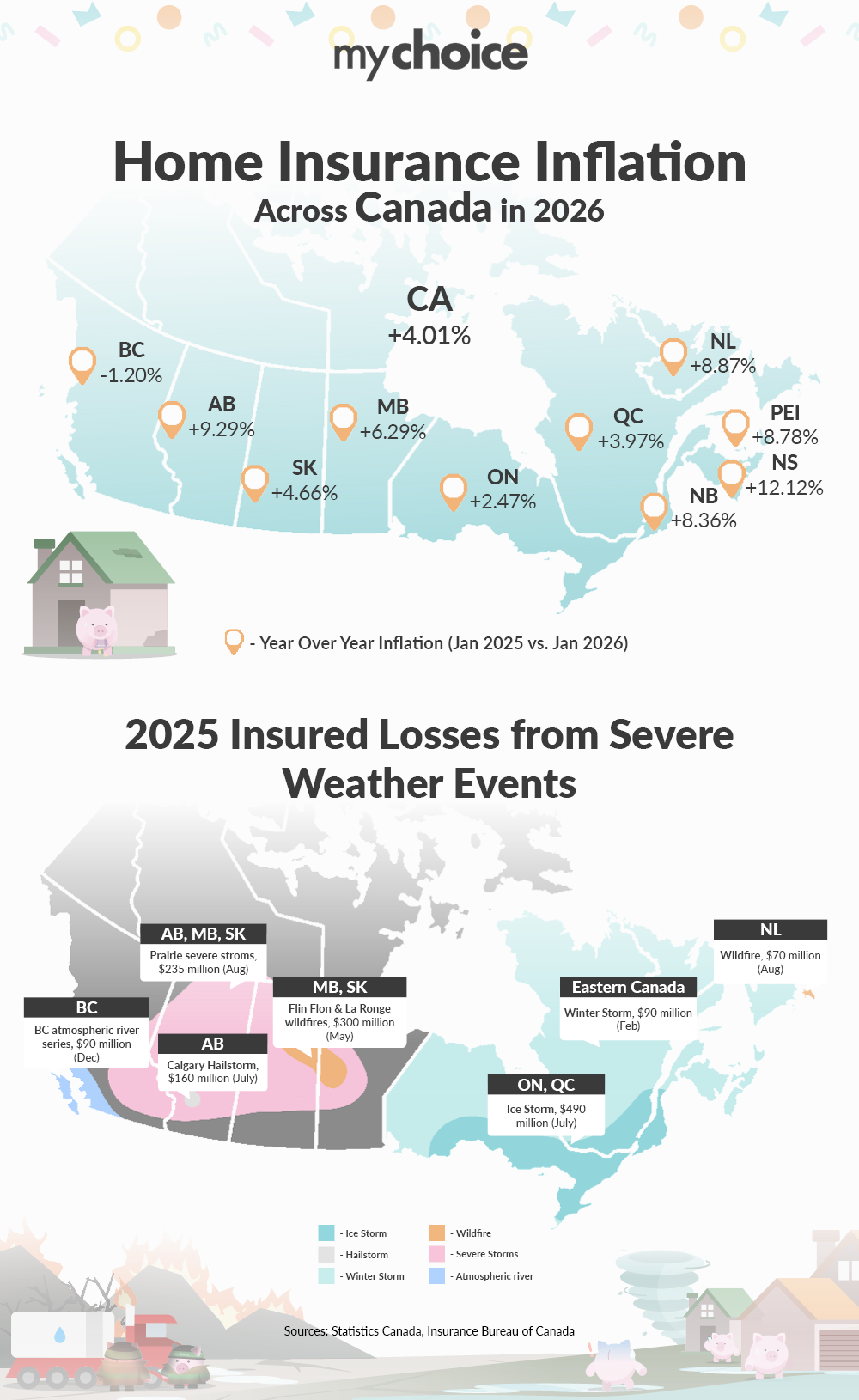
As we move into 2026, Canadian homeowners continue to face rising home insurance costs. National home insurance inflation came in at 4.01% year-over-year (January 2025 vs. January 2026), still well above the general inflation rate of 2.3%.
Homeowners’ insurance continues to face pressures from a persistent stream of weather-related losses, higher rebuild and repair costs and, increasingly, an aging housing stock in Canada, even as inflation has cooled in other parts of the economy.
In light of these trends, MyChoice conducted a nationwide analysis of home insurance inflation using our proprietary quote data, alongside the Shelter Consumer Price Index. We reviewed provincial trends, examined the impact of 2025’s major weather events, and assessed how structural risks, such as renovation costs and home condition, continue to shape pricing.
Key Findings from the Study
- Home insurance premiums in Canada increased by 4.01% in 2026, continuing a multi-year upward trend.
- The greatest increases were evident in Atlantic Canada: in Nova Scotia (+12.12%), Newfoundland and Labrador (+8.87%), PEI (+8.78%) and New Brunswick (+8.36%).
- Alberta remains one of the most volatile markets, with premiums rising 9.29% following another year of severe weather losses.
- Ontario premiums grew by +2.47% and Quebec +3.97%, a moderate increase despite the impact of what was one of this year’s most expensive weather events.
- However, risks remain high as British Columbia was the only province to show a decrease of -1.20%.
- 2025 weather-related insured losses exceeded $2.4 billion, marking another multi-billion-dollar year for catastrophic weather in Canada.
Atlantic Canada: A Region to Watch
One of the other notable changes in 2025 has been the increased risk profile associated with Atlantic Canada.
The Kingston wildfire in Newfoundland and Labrador, which caused over $70 million in insured damage, forced evacuations of more than 3,000 residents and impacted multiple communities. Historically considered a lower-risk region for wildfire, this event highlights how risk patterns are shifting geographically.
We see double-digit increases in premiums in several provinces because insurers have started to be more aggressive in terms of repricing the risk in those regions.
Beyond Weather: The Hidden Drivers of Insurance Inflation
But it’s not just climate-related disasters that are contributing to premium increases anymore, though those remain a significant contributing factor.
Repair and Rebuild Cost Inflation
Higher construction/renovation costs continue to be experienced throughout Canada impacting the increasing costs to settle claims. Our recent study has revealed 3%–6% annual increases in repair costs in a number of cities with increases being even higher in certain markets.
From an insurance perspective, this means that:
- Full rebuilds require significantly higher payouts
- A roof replacement costs more
- Water damage claims are more expensive
Even in years with fewer disasters, higher claim severity alone can push premiums upward.
Aging Housing Supply
Another major, often overlooked factor is Canada’s aging housing stock. As highlighted in the above-mentioned study on housing conditions and insurance pricing, many Canadian cities face a trifecta of a high share of homes built before 1960, rising rates of deferred maintenance, and rising renovation costs.
Older homes are also more vulnerable to structural issues, electrical problems and water damage, which increase the frequency and severity of insurance claims. When combined with increasing repair costs, these two factors create a compounding risk in cities like Winnipeg, Montreal, and Regina.
Escalating repair costs and neglected upkeep contribute to insurance rates as well. Matthew Roberts, MyChoice COO, says, “Insurance pricing is no longer just about location and weather. The condition of the home itself is becoming a key risk factor. When repair costs rise, and maintenance is delayed, insurers are forced to price in that additional risk.”
Government Response and Market Stability
One of the most significant proposed solutions from the government has been Canada’s National Flood Insurance Program, designed to provide affordable coverage to the roughly 1.5 million households at high risk of flooding, many of whom currently struggle to obtain insurance in the private market. However, despite being first proposed in 2019 and reiterated in multiple federal budgets, the program has yet to be fully implemented. Industry groups and policymakers have continued to push for progress, but as of 2026, there is still no clear rollout timeline, and momentum appears to have slowed following consultations and election cycles.
Governments also invest heavily in climate change adaptation infrastructure. Examples include the Disaster Mitigation and Adaptation Fund (DMAF), which funds infrastructure improvement projects such as flood defences and stormwater infrastructure to adapt to climate change. One example is a recent $6.4 million DMAF investment in Nova Scotia to reduce the risk of surface and basement flooding. Flooding is one of the most frequent and costly causes of insurance claims in Canada.
Wildfire resilience has also become a national priority. In 2025, federal and provincial governments jointly committed over $100 million to the FireSmart program, which focuses on reducing wildfire risk through community-level mitigation, vegetation management, and homeowner preparedness. The goal is not just to respond to fires, but to prevent them from causing large-scale insured losses in the first place.
What Can Canadian Homeowners Do Today
With several different factors pushing insurance rates higher, it’s important for homeowners to take steps to manage the cost of home insurance and keep expenses within reason.
With multiple forces pushing premiums upward, homeowners should take a more proactive approach to managing their insurance costs.
- Review Your Coverage. Make sure your policy includes:
- Overland water protection
- Sewer backup coverage
- Replacement cost coverage
- Maintain Your Home
- Address small repairs early
- Upgrade outdated systems (plumbing, wiring, roofing)
- Reduce risk where possible
- Compare and Bundle Your Policies. Insurance pricing varies significantly between providers. Comparing quotes through platforms like MyChoice can help identify savings opportunities.
Raw Provincial Data:
| Province | Home Insurance Inflation (2025-2026) | Average Annual Home Insurance Premium (2026) |
|---|---|---|
| British Columbia | -1.20% | $2,253 |
| Alberta | +9.29% | $2,283 |
| Saskatchewan | +4.66% | $1,347 |
| Manitoba | +6.29% | $1,167 |
| Ontario | +2.47% | $1,458 |
| Quebec | +3.97% | $1,284 |
| New Brunswick | +8.36% | $970 |
| Nova Scotia | +12.12% | $1,034 |
| Prince Edward Island | +8.78% | $894 |
| Newfoundland & Labrador | +8.87% | $937 |
| Canada (National Avg) | +4.01% | $1,343 |
Source: MyChoice Quote Database, Shelter Consumer Price Index Data