









Life insurance is an important part of financial planning, but choosing which type to get will depend on several factors. For example, many Canadians look into permanent (aka whole) life insurance for its lifelong coverage and cash value, but the high costs and complexity can make it less appealing than other options.
Is permanent life insurance the right choice for you? Keep reading to explore who benefits from permanent life insurance, its potential downsides, alternative options, and real-life case studies to help you decide.
Our MyChoice team reviewed the federal life-insurance guide, FSRA’s life-policy guide, CRA’s guide to capital property at death, and CISRO’s life-insurance replacement guidance. This guide compares permanent designs and their trade-offs and explains what to check before surrendering a policy.
Is Permanent Life Insurance A Bad Choice?
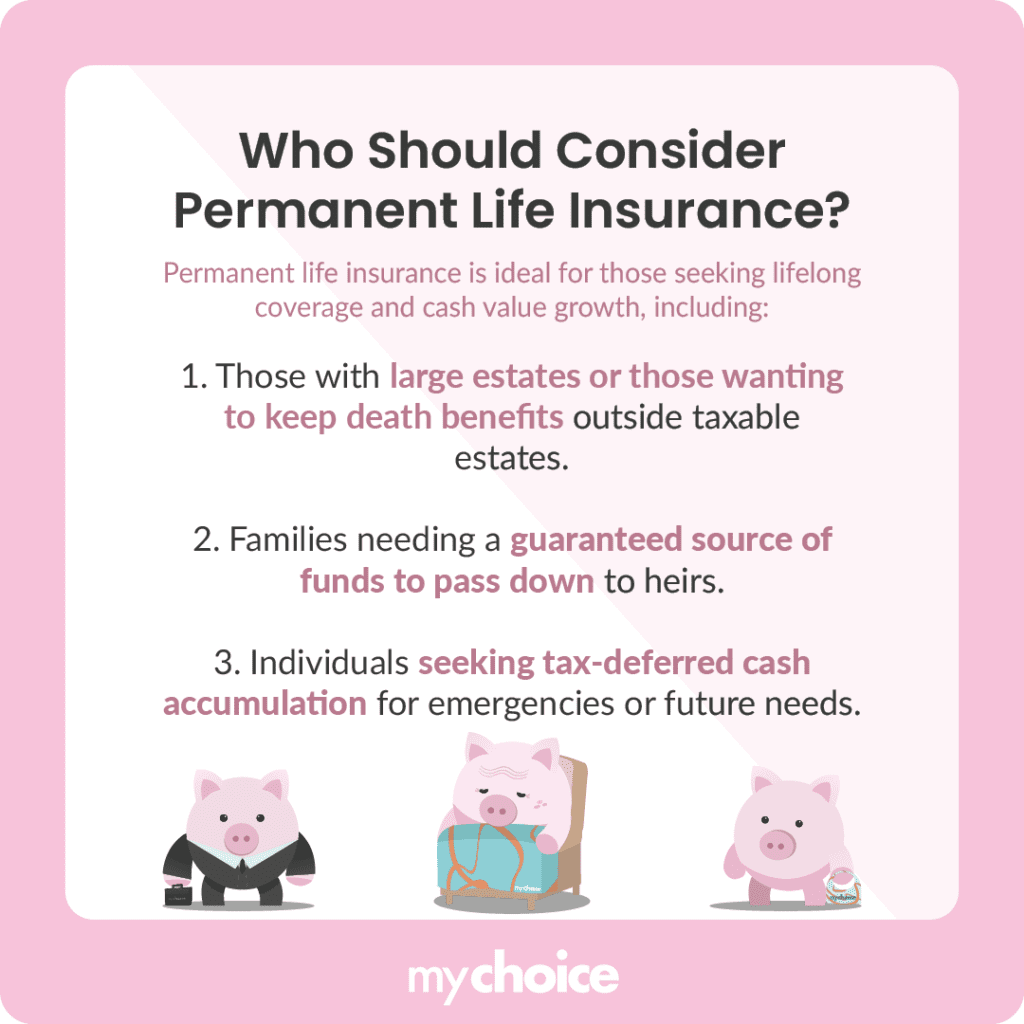
This really depends on your situation. Permanent life insurance is best suited for those who need lifelong coverage and want to build cash value as part of their long-term financial strategy, such as adding a return of premium to their policy.
Do a full cash flow analysis before making decisions. Don’t rely on an age-based rule, as insurance is a highly personal choice.
First, Identify The Permanent Product
| Design | Core structure | What to verify |
|---|---|---|
| Whole life | Provides lifetime protection with contractual guarantees; participating products may pay dividends. | Consider the length of premium payment, guarantees such as death benefit and cash value, dividend scales, and non-forfeiture options. |
| Universal life | Universal life combines lifetime insurance with an investment account and policy charges. | Verify the cost-of-insurance basis, deposit limits, investment options, charges and stress tests for higher costs or lower returns. |
| Simplified or guaranteed issue | This underwriting route may be attached to term or permanent coverage. | Verify health questions, amount, premium, graded benefit, exclusions and early-policy claim rules. |
Read More: Compare Whole Life and Universal Life Insurance
Who Is Permanent Life Insurance For?
| Possible lifelong need | Evidence to quantify | Other resources to compare |
|---|---|---|
| Support for a dependant who may need lifelong care | Key considerations include a care plan, resources for survivors, trust rules, benefit rules and timing. | Compare savings, trusts, public benefits, family support and a mix of term and permanent coverage. |
| Final expenses or a fixed legacy | Current local costs, desired amount and estate liquidity requirements. | Compare dedicated savings, existing insurance and a smaller permanent amount. |
| Tax or estate liquidity | Anticipated final tax, debts, probate expenses, asset ownership and rollover choices. | Compare liquid investments, borrowing, asset sales, a spousal rollover and legal planning. |
| Business succession or equalization | Quantify the agreement, valuation, ownership, tax treatment and funding date. | Compare business assets, financing, buy-sell funding and other insurance structures. |
| Charitable gift | Discuss the gift objective, policy ownership and tax advice. | A current gift, securities, donor-advised fund or an estate gift. |
Canada does not impose one general inheritance or estate tax. The deceased may owe taxes because they are deemed to have disposed of their capital property just before death. There may be exceptions or rollovers, but an individual may still realize capital gains on their final return.
This is separate from the proceeds of a permanent life insurance policy being paid to a named beneficiary.
Probate or estate-administration charges vary by province or territory.
What Are The Downsides Of Permanent Life Insurance?
High Premium Costs
Permanent policies have higher premiums than initial term policies for the same death benefit. You might find yourself underinsured, stuck in expensive debt, unable to build an emergency fund or forced to give up your policy because of a cash-flow squeeze.
Early Surrender And Limited Liquidity
Withdrawals, surrenders and loans against policies can reduce policy values. Also, in the early years of a policy, the cash value available on surrender can be much less than premiums paid. A withdrawal, surrender or policy loan may have tax consequences. Always ask your insurer for your policy’s adjusted cost basis, projected policy gain, applicable loan rate and the death benefit that would result before getting money from your policy.
Read More: See How Cash Value and Surrender Value Work
Complex Guarantees And Illustrations
Ask for downside scenarios. A whole-life illustration can show guaranteed values alongside non-guaranteed dividends, while a universal-life illustration relies on assumptions about returns, charges, and funding.
Ask for illustrations with lower investment returns or dividend rates, and determine the premium needed to keep the policy in force under each scenario.
Keep in mind that an illustration looking strong today does not make every future value a promise.
Opportunity Cost
Opportunity cost: Compare identical cash flows invested in all potential locations – paying off debt, emergency fund, TFSA or RRSP contributions where eligible, non-registered investing and permanent insurance. Factor in taxes, fees, risk, liquidity, and insurance value.
Read More: Review Whole Life Insurance as an Investment
Limited Flexibility
Before buying permanent insurance, it’s important to know which policy provisions can be changed, who controls changes, and which provisions are irreversible.
Some policies offer flexible premium deposits, variable death-benefit options, a paid-up insurance option or non-forfeiture options; some don’t.
Flexibility is not always a good thing. A universal policy with lower funding or poor investment performance, for example, can mean bigger deposits down the road.
What Are The Alternatives?
- Use term insurance for a temporary need, then save or invest separately with a realistic contribution plan instead of assuming every premium difference will be invested.
- Buy a smaller permanent layer for a lifelong need, then add term insurance for the larger temporary shortfall.
- Lower the permanent face amount, change the premium-payment period or compare a no-cash-value permanent design when the contract and need support it.
- Pay a modest final expense from savings or other estate assets when the timing, liquidity and risk work for you.
Read More: Compare Keeping Permanent Life Insurance With Cashing It Out