









If you’ve been weighing purchasing an annuity or buying life insurance, it’s important to ask yourself these key questions: are you looking for financial protection for your family after you die, do you want guaranteed income while you’re alive, or are you seeking a combination of both?
Determining your financial goals along with your projected retirement income while factoring in dependants, estate goals, health, liquidity needs and other assets can help you decide which product or combination of products may be appropriate for your needs.
The Difference Between Annuities and Life Insurance
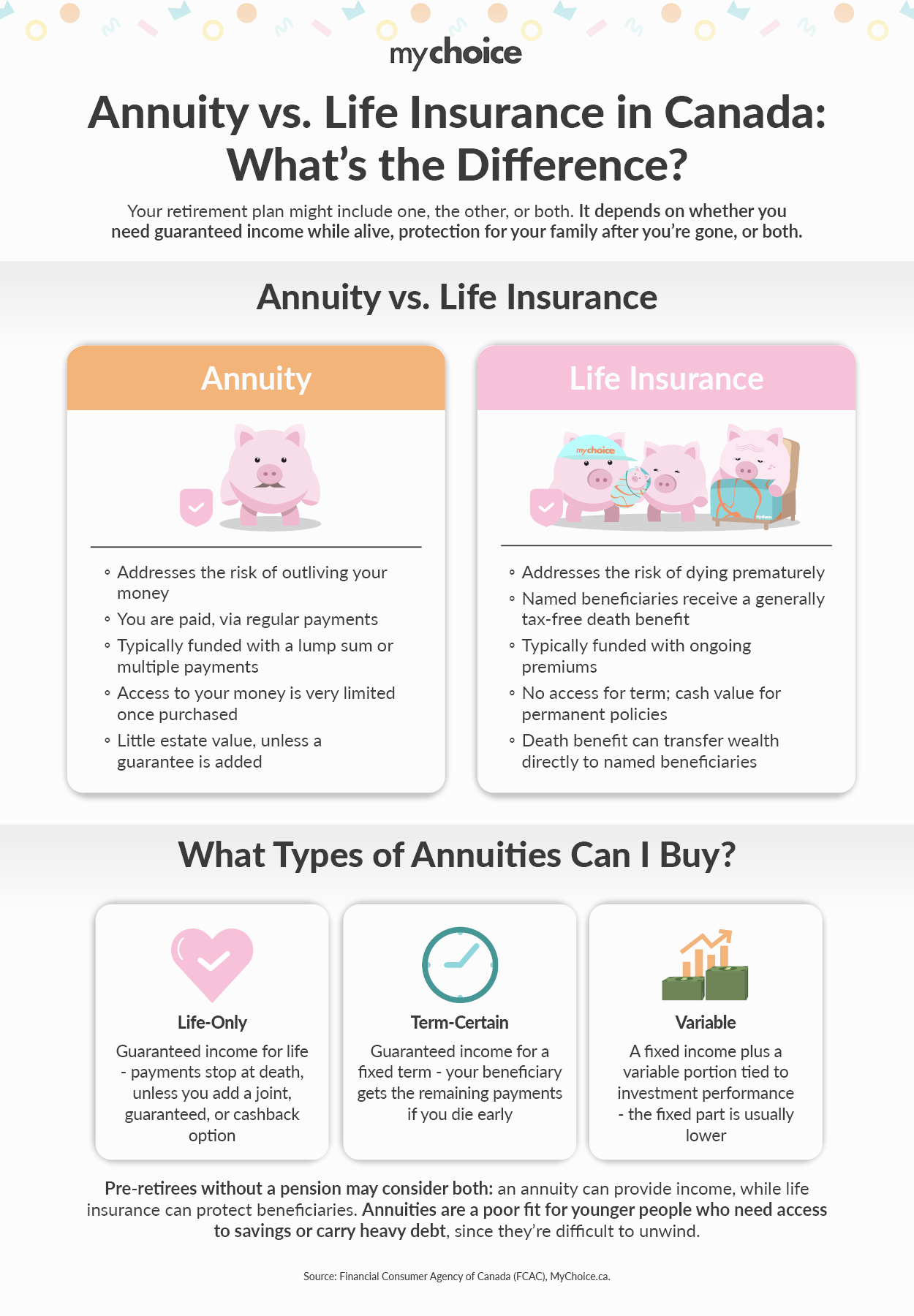
An annuity is intended to provide guaranteed regular income during your lifetime, while life insurance is primarily designed to provide a death benefit to beneficiaries.
| Annuity | Life Insurance | |
|---|---|---|
| Primary purpose | Provides guaranteed regular income, often during retirement | Provides financial protection after death to a beneficiary |
| Who receives the money? | Usually the annuitant through regular payments | Named beneficiaries generally receive the death benefit, which is usually not taxable as income |
| Typical funding | Usually a lump sum or multiple payments | Premiums paid monthly, quarterly, semi annually or annually |
| Main risk addressed | Outliving your money | Dying prematurely |
| Payments | Regular payments for life or a fixed period | Usually a lump-sum death benefit |
| Access to money | Generally very limited once the annuity is purchased | Depends on the policy; term life insurance has no cash value, while permanent life insurance, such as whole life or universal life, can build cash value that may be accessed by the policyholder while they’re alive |
| Estate value | May be little or nothing with a life-only annuity; a guarantee option can preserve payments | A death benefit can transfer wealth to beneficiaries; permanent policies may also have cash value |
Read More: How to Pick Between Term and Whole Life Insurance
How Does an Annuity Work?
An annuity is usually purchased to provide guaranteed income while the annuitant is alive. It provides payments over time that are a combination of interest, a return of your capital and a transfer of capital from annuity holders who died earlier than expected. You can opt for monthly payments, payments every three or six months or annual payments. Tax treatment depends largely on whether the annuity was purchased with registered or non-registered funds.
How much you receive will depend on:
- your gender
- health
- age
- how much you invest
- the type of annuity you purchase
- whether you choose an annuity that makes payments to a beneficiary after your death
- the length of time you request payments
- the rate of interest at the time of purchase
- the provider that sold you the annuity
What Types of Annuities Can I Buy?
There are a number of annuities to consider:
- Life-only annuity: This product provides you with a guaranteed income for life. When you die, payments generally stop. However, there are options to have payments continue after you die. These options can be combined, but each feature lowers the amount of your payments:
- A joint-and-survivor option: With two annuitants named, payments continue as long as one of the annuitants is alive.
- A guaranteed option: If you die within a set period, payments will continue to be made to your beneficiary or estate.
- A cashback provision: This provides a one-time payment to a beneficiary or estate if you die before receiving a pre-set amount of money. It’s usually based on the amount paid for the annuity.
- Term-certain annuity: This annuity provides guaranteed income for a fixed term. If you die before the term is up, your beneficiary or estate may receive regular payments until it ends or a one-time lump-sum payment.
- Variable annuity: This type of annuity invests money in products with variable returns, such as equities. You receive a fixed income plus a variable income based on the performance of the investments. The fixed income is usually lower than with a non-variable annuity, while the variable portion can increase or decrease depending on investment performance.
How Life Insurance Creates a Benefit for Beneficiaries
Life insurance protects your dependants and estate after your death. Unlike an annuity, traditional life insurance does not provide guaranteed retirement income while you’re alive.
The death benefit provided to beneficiaries is also generally tax-free. However, if your policy, such as whole life or universal life, offers cash value and you decide to borrow some of the money, there may be tax consequences. Unpaid loans will also reduce the final death benefit.
Read More: How to Use Life Insurance While Alive in Canada
Can I Buy an Annuity and Life Insurance?
Yes. You can buy both and have them at the same time. While an annuity can help you avoid running out of money while you’re alive, life insurance can protect your children and spouse after you’re gone. Some people pair a life-only annuity with life insurance to increase their annuity payment while preserving a death benefit for their beneficiaries. Whether this strategy is appropriate depends on factors such as health, premiums, taxes, liquidity needs and estate goals.
Who Should Consider Buying Both an Annuity and Life Insurance?
If you’re pre-retirement or recently retired without a pension, you might want to consider whether an annuity and life insurance will work with your retirement plans and estate planning. This may reduce your reliance on government benefits and help manage the risk of outliving your personal savings—the annuity will provide regular payments and the life insurance will protect your beneficiaries.
When Might Buying Both Not Be Appropriate?
Annuities may not be ideal for younger people who need access to their savings, carry a heavy debt load or have a longer investment horizon. Because annuities can be difficult and expensive to change or unwind, you should consider your need for cash before purchasing one.
Those with financial dependants may still consider a life insurance policy, as premiums are generally lower when you are younger and healthy, and your beneficiaries are protected should you die.
How Do You Choose an Annuity, a Registered Retirement Income Fund or Life Insurance?
A registered retirement income fund (RRIF) is an extension of your RRSP in which your retirement savings stay invested while you withdraw annual minimum amounts that are taxed. RRIFs allow you to withdraw more than the minimum amount, but the investments remain subject to market performance and the account balance can decrease as withdrawals are made.
Annuities can provide guaranteed income for a set term or for life, while life insurance generally provides a death benefit to beneficiaries that is not taxable as income. A RRIF prioritizes flexibility and continued investment growth, an annuity prioritizes guaranteed income, and life insurance prioritizes financial protection for beneficiaries. Depending on your needs, your financial plan may include more than one.our needs, your financial plan may include more than one.