









Supporting a child with a disability can require a significant amount of financial backing. Depending on their individual support needs, they may need mobility and communication aids, help with daily tasks, assistance with budgeting and travel support. Others may require full-time caregiving at home or group living. These services, which may be partially or fully subsidized, can still require a significant financial outlay from the family.
When a parent passes away, the adult child continues to require these services. At that point, it’s critical to have a solid financial plan that can address these needs without affecting government financial assistance programs. Means-tested benefits require those on disability to have financial assets and income that fall below certain levels. If an individual’s income or non-exempt assets rise above these limits, they may lose provincial disability benefits.
Read More: Benefits of Buying Life Insurance for Adult Children
How Life Insurance Can Fill the Gap
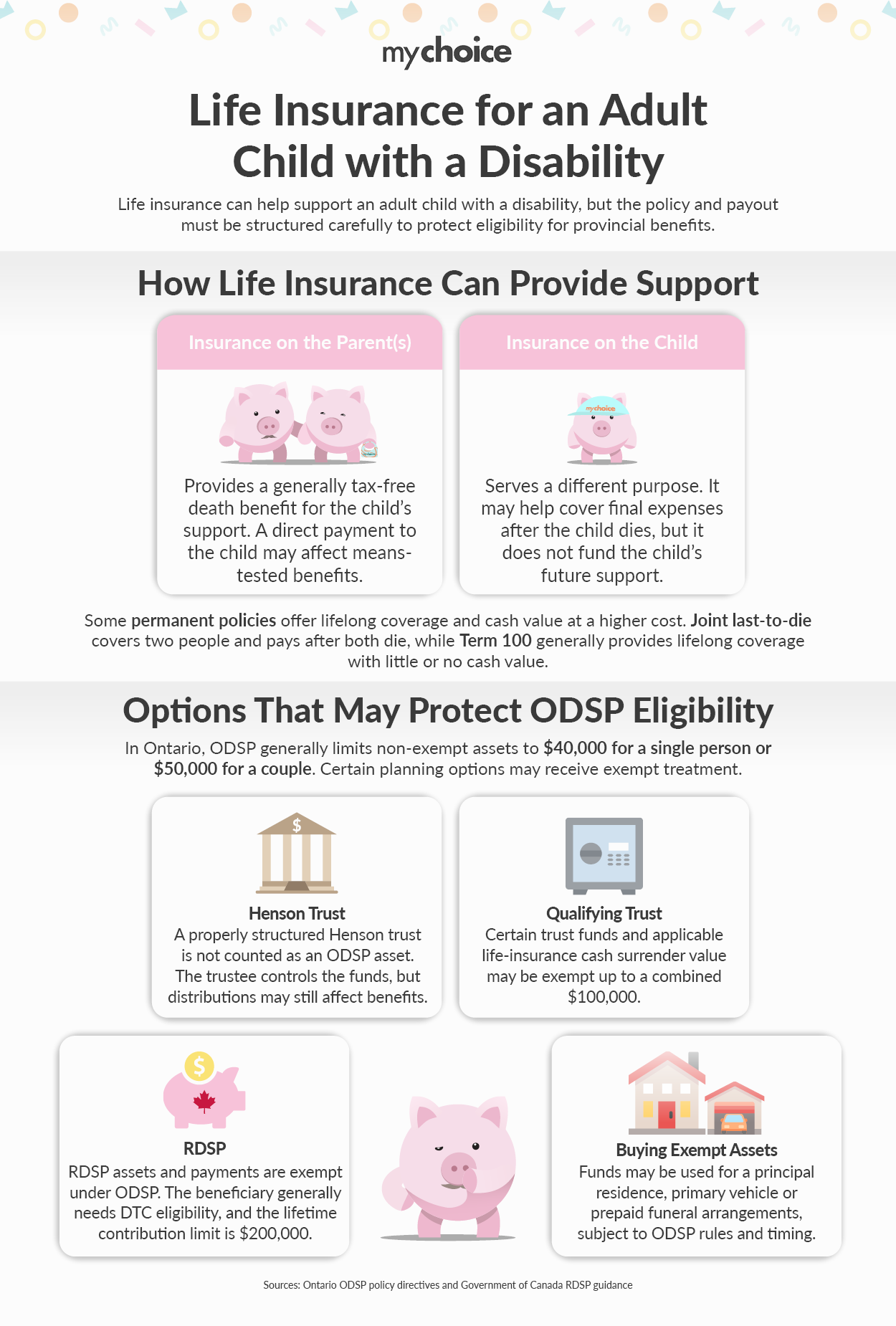
If you’re the caregiver of an adult child with a disability, life insurance on you, your partner or both can provide financial support after a parent dies. Insurance on the child serves a different purpose.
- Buying life insurance as a parent can provide a lump sum for your child’s benefit that can be used to fund their care. Life insurance death benefits are usually paid to beneficiaries tax-free for income-tax purposes. However, if they are paid directly to an adult child receiving means-tested benefits, the money may affect their eligibility for provincial benefits. In Ontario, for example, a life insurance payment received directly can generally be treated as income in the month it is received.
- Buying life insurance on an adult child serves a different purpose. Its death benefit may help pay for end-of-life expenses such as the funeral, burial and final legal expenses without putting a strain on the family’s financial situation, but it does not fund the child’s own future support. Availability and cost will depend on the insurer’s underwriting requirements.
How Much Life Insurance Could You Need?
When starting the life insurance application process, it’s important to take stock of how much support your adult child may require. This requires a careful analysis of what their care costs now, how their care will evolve over time and the impact of inflation.
The MyChoice Life Insurance Calculator can help you determine how much life insurance you’ll need to take out on yourself and/or your partner. It looks at income replacement, outstanding debts, future expenses, final expenses and existing assets.
Types of Life Insurance for Families of Adult Children with Disabilities
Families may consider several permanent life insurance structures:
- Permanent Life Insurance: While this provides lifelong coverage and some policies also build cash value, it is generally the most expensive to buy.
- Joint Last-to-Die or Survivorship Insurance: This type of permanent policy can cover you and your spouse and only pays out the death benefit after both of you have passed away. It may cost less than purchasing two comparable individual permanent policies.
- Term 100 Insurance: Despite its name, Term 100 is a form of permanent insurance. It lasts for your entire life as long as the required premiums are paid and typically has little or no cash value. Under many policies, premiums stop at age 100 while coverage continues.
Read More: How Whole Life Insurance Works in Canada
How Life Insurance Payouts Are Treated
In Canada, life insurance and disability benefits can be treated differently depending on the province and how the policy and any related trust are structured. What disability benefits the adult child receives may be affected by assets or income while you own the policy versus what the policy pays out after death.
Each province in Canada handles these benefits differently. In Ontario, means-testing involves looking at income and assets.
- Income includes wages, dividends or certain lump-sum payments. If an adult child with a disability exceeds applicable income limits, this may affect the provincial supports they receive.
- Assets include cash, stocks or investments, as well as vehicles, trust funds or Registered Retirement Savings Plans. The ODSP has limits on the amount of non-exempt assets you can own and still be eligible for income support. The asset limits are $40,000 for a single person and $50,000 for a couple.
When you or your partner pass away, how the money will be treated by provincial agencies depends on how your life insurance policy is set up and how the funds are received.
For example, if your adult child is the direct beneficiary, the death benefit may affect their eligibility for means-tested benefits.
How to Protect Life Insurance Payouts to Prevent Benefits Clawbacks
There are a variety of ways to structure a life insurance policy so that an adult child can receive financial support without negatively affecting provincial disability benefits. It all depends on what province you live in, the type of trust or account used and how the money is distributed.
- Setting up a Henson Trust: This trust can be established through a will and is designed so that the beneficiary does not have direct control over the trust assets. Instead, a trustee chosen by the family decides how the money is used. In Ontario, a properly structured Henson trust is not considered an asset for ODSP purposes and therefore does not have the $100,000 asset limit that applies to certain other trusts. However, how the trust is set up is key and payments from the trust can still affect benefits depending on how they are used.
- Creating a self-established trust: Ontario allows a combined total of up to $100,000 in certain trust funds and applicable life insurance cash surrender value to be exempt as an asset. The rules around this type of trust depend on where the money came from, when the trust was established and the terms of the trust.
- Setting up a Registered Disability Savings Plan (RDSP): An RDSP, a federal long-term savings plan intended to help people with disabilities, is fully exempt from ODSP rules. The beneficiary must generally qualify for the Disability Tax Credit. It has a $200,000 federal lifetime contribution limit, and other people may contribute with the plan holder’s permission.
- Buying exempt assets: In Ontario, a life insurance payout may be used to purchase assets that are exempt from ODSP asset testing, such as a principal residence, a primary vehicle or prepaid funeral arrangements. The timing and use of the money matter.
Using a life insurance policy to fund an adult child’s future care can be a great way of assuring their financial future. But it is a complex process that requires careful planning and the guidance of an insurance advisor or lawyer to ensure an adult child’s eligibility in provincial benefits programs is not unintentionally affected.
Read More: How Life Insurance Trusts Work