







Should Your Corporation Own Your Life Insurance?

3 minutes can save you hundreds. Enter your postal code below and join thousands of Canadians saving on life insurance.

Secure. No Spam. No Fees.

Why Use MyChoice

MyChoice.ca is an independent platform that helps Canadians find their best insurance options and make informed financial decisions. Our service is free to use. We may earn a commission from some providers when you buy a policy, but it never affects the price you pay or how products are reviewed. To help ensure accuracy, our content is researched and reviewed by licensed insurance professionals before publication.

First published on August 18, 2026

2 minute read

Updated By Vitalii Starov on August 18, 2026

MyChoice follows a strict content review process designed to ensure reliable and unbiased information.

When a corporation owns a life insurance policy and is named as the beneficiary, the death benefit is generally paid to the corporation tax-free. Depending on the policy’s adjusted cost basis, some or most of those proceeds can also be added to the corporation’s capital dividend account (CDA). That can let the company pay out tax-free capital dividends to Canadian-resident shareholders.

What is Corporate-Owned Life Insurance?

Corporate-owned life insurance is a policy purchased and owned by a corporation, with the business owner or a key person insured under the policy.

Read More: How Key Person Insurance Works

Corporate-owned life insurance is mainly used to cover business needs. Common uses include replacing a key person, funding a shareholder agreement, paying off debts, or providing cash after an owner dies. Depending on how the policy and estate plan are set up, the proceeds can also end up benefiting the owner’s family or estate.

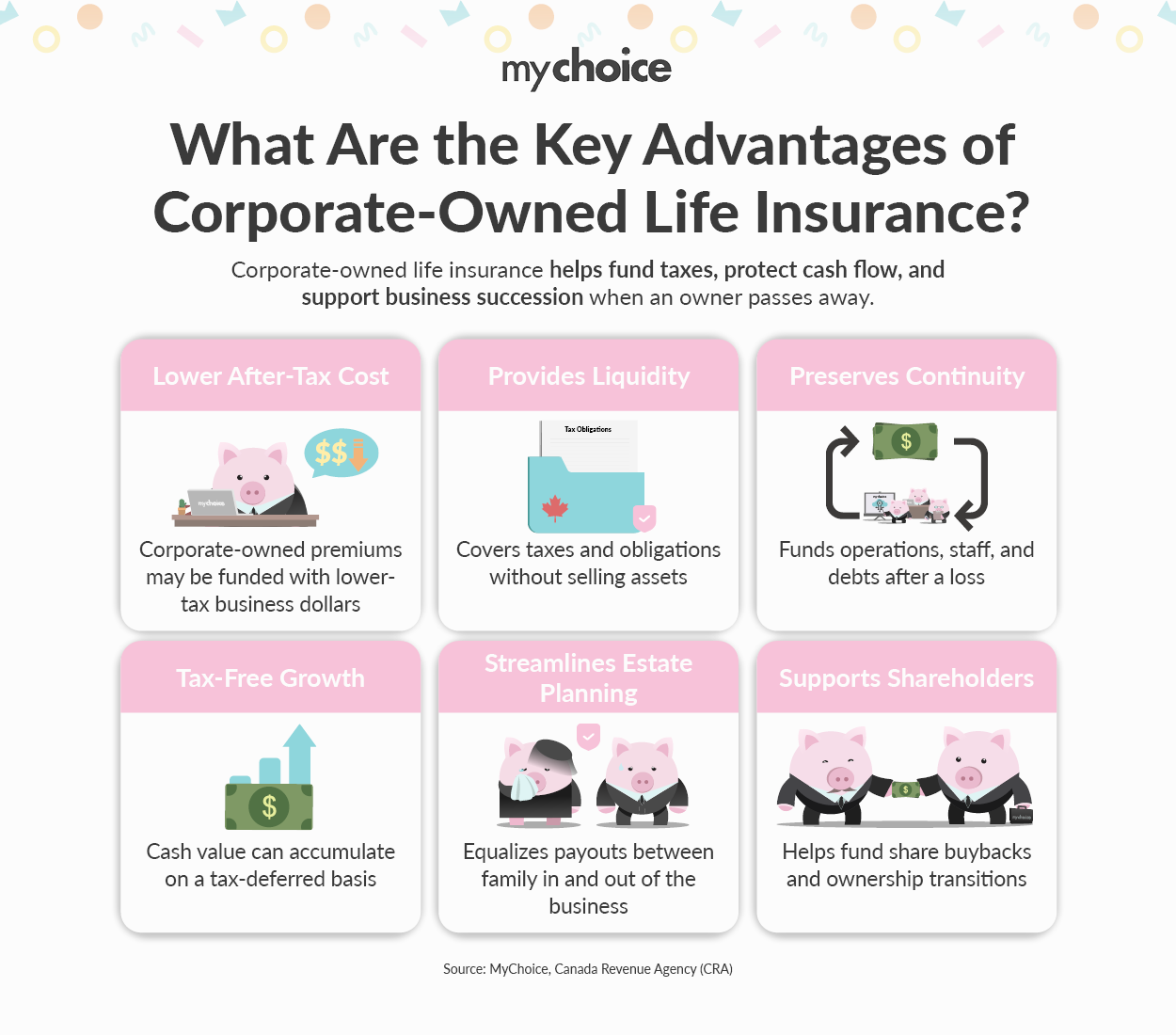
What are the Key Benefits of Corporate-Owned Life Insurance?

Offers a lower after-tax cost

Life insurance premiums are often lower when purchased by your corporation rather than individually, as the corporation’s tax rate is generally lower than your personal tax rate.

Provides liquidity

When a shareholder dies, their shares are usually treated as sold at fair market value just before death. That can trigger a capital gain on the deceased’s final tax return. Corporate-owned life insurance can supply the cash needed to fund succession plans and cover other financial obligations that come up after the owner dies.

Preserves business continuity

When a business owner dies, this can dramatically affect operations. A corporate-owned life insurance policy can help fund ongoing operations, retain staff, pay off debts and ensure the business continues to run smoothly.

Provides tax-free investment growth

Many permanent life insurance policies allow cash value to accumulate on a tax-deferred basis. This cash value can grow through guaranteed interest, dividends or investment options, and may be accessed by the owner for business purchases.

Streamlines estate planning

Corporate-owned life insurance can help with fair distribution of assets among beneficiaries. This is because it can equalize payouts to your beneficiaries in cases where some are involved in the business and some are not. For example, family members involved in the business can inherit ownership interests, while other beneficiaries can receive equivalent value through the life insurance proceeds—reducing the need to sell business assets.

Supports shareholders

If you pass away, other shareholders can buy back your shares using funds provided by the corporate-owned life insurance policy. This helps pave the way for a smooth transition of ownership and ongoing business stability.

What Are the Key Advantages of Corporate-Owned Life Insurance

What Happens During a Business Exit?

If you pass away as the owner of a corporation, your business does not die—it continues to exist as a separate legal entity. The Canada Revenue Agency will treat your passing as a “deemed disposition”,  meaning that you as owner will be considered as having sold all of your shares in the corporation at fair market value. This will lead to a capital gains tax on these shares. If the shareholders within the corporation want to buy back your shares, there will be a need for cash flow within the corporation. Corporate-owned life insurance can help pay both the taxes and the buy-back of these shares. 

Read More: Life Insurance Strategies for High-Net-Worth Canadians

What Types of Corporate-Owned Life Insurance Should I Choose?

Corporate-owned life insurance is available in two categories: Term Life Insurance and Permanent Life Insurance.

Term Life: 

  • covers the business owner for a set period of five, 10, or 20 years;
  • is typically less expensive than permanent life insurance;
  • helps protect the business by covering liabilities if the business owner dies during the term; 
  • offers premiums that generally remain unchanged throughout the coverage period. 

Permanent Life Insurance:

  • provides coverage for life as long as the policy stays in force;
  • can offer guaranteed premiums and death benefits, depending on the product;
  • builds cash value on a tax-advantaged basis inside the policy (subject to Canadian tax rules);
  • may allow access to that value through withdrawals or policy loans (these can have tax and policy effects);
  • can supply long-term cash for estate and business succession planning.

When is Corporate-Owned Life Insurance Not a fit?

Corporate ownership may not be the right choice for you if the business has limited cash flow, the insurance need is mainly personal, or there is a real chance the corporation could be sold, dissolved, or targeted by creditors. Tax results also depend on the corporation, how the policy is structured, and how the proceeds are eventually paid out. Ownership decisions should be reviewed with an insurance, tax, and legal professional.

With over 20 years of experience in business, finance, and insurance writing, Anna specializes in translating complex topics into clear, reader-friendly content that helps consumers make informed financial decisions.

Congratulations! You made it to the end!

Now, here is the easy part: complete your quote in under 2 minutes

Discover More About

July 31, 2026
Learn when parents can buy life insurance for an adult child, who owns the policy, when consent is required, and the benefits of buying coverage early.
July 16, 2026
Learn how sleep apnea affects life insurance approval and underwriting in Canada. Find out what insurers look for and how treatment can improve your options.
June 24, 2026
Compare life insurance costs across G7 countries and see why Canadians may be paying less than they think despite the country’s protection gap.