









Life insurance has a reputation for being expensive, but for a healthy 35-year-old, the cost of substantial coverage can be surprisingly small. Our team at MyChoice analyzed internal rates from our database of life insurance quotes and compared them with something many Canadians already buy every day: coffee.
If you’re a typical Canadian, you drink a lot of coffee. Seventy-one per cent of Canadians have a coffee every day, with 45 per cent opting for a traditional coffee while 29 per cent enjoy an espresso -based drink. And in hubs like Toronto, which boasts thousands of local shops, buying a daily coffee is part of the lifestyle.
We wanted to see how far the comparison goes, from a basic Tim Hortons coffee to a daily Starbucks latte, and whether cutting even part of that spending could cover meaningful life insurance protection.
Key Findings
The coffee comparison below applies primarily to term insurance. Permanent products such as whole and universal life cost substantially more.
- $1 million in 20-year term life insurance costs less than one small Tim Hortons coffee per day for the 35-year-old profiles we analyzed.
- $500,000 in coverage costs less than $1 per day, about $0.74 for a woman and $0.96 for a man.
- A small daily Tim Hortons coffee costs $602.64 a year, compared with $378 for $1 million in coverage for a woman and $518.40 for a man.
- Cutting a daily Starbucks Grande habit in half frees up $74.25 a month, enough to cover $500,000 of 35-year term insurance for either profile in our data.
Read More: How Much Life Insurance Costs Vary by Policy Type
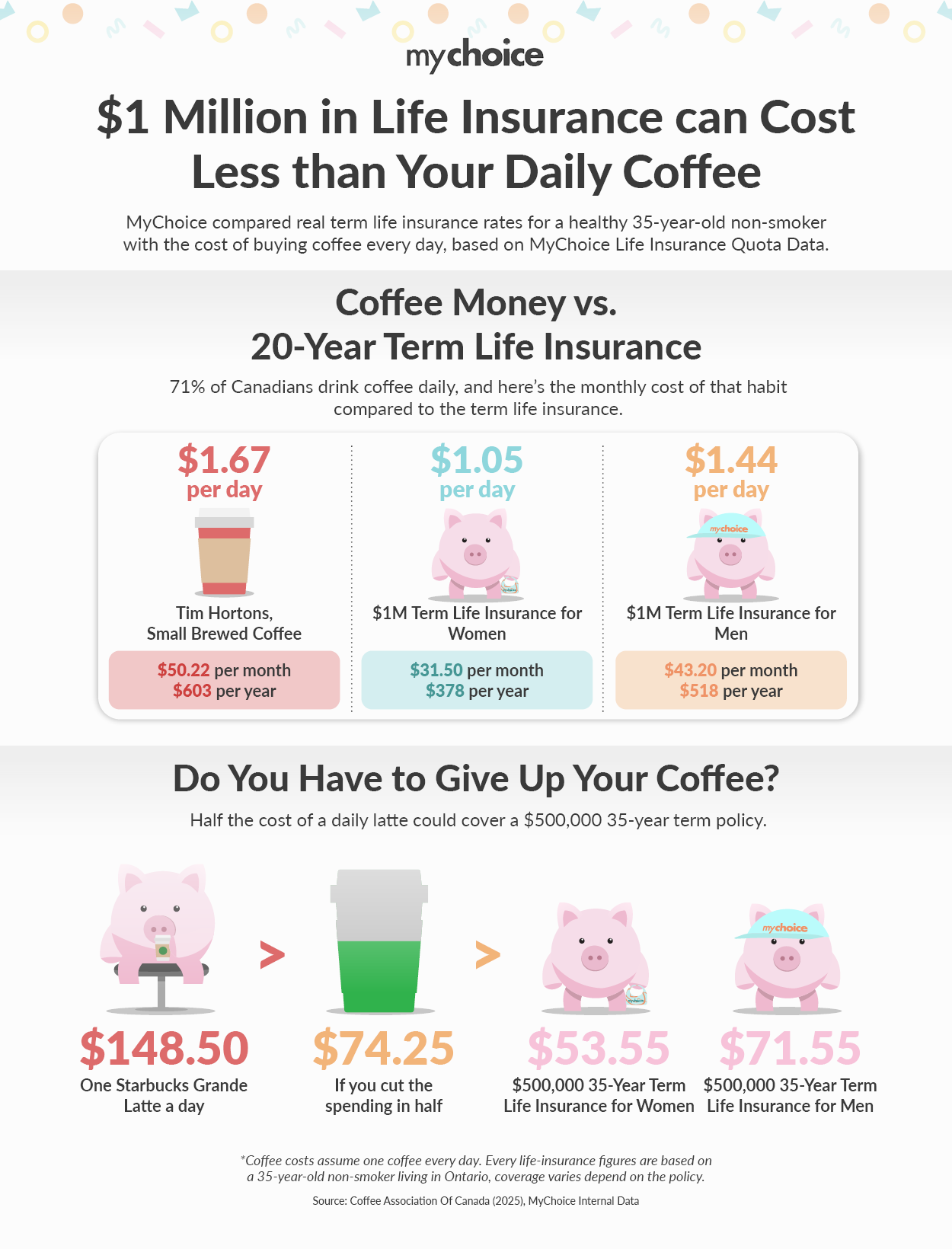
A Million Dollars of Coverage for Less Than a Daily Coffee
| Monthly | Daily | Annual | |
|---|---|---|---|
| $1M term – Woman | $31.50 | $1.05 | $378.00 |
| $1M term – Man | $43.20 | $1.44 | $518.40 |
| Tim Hortons Small Daily | $50.22 | $1.67 | $602.64 |
For the male profile, buying one small Tim Hortons coffee every day costs about $84 more per year than $1 million of coverage. For the female profile, the difference is approximately $225.
That doesn’t mean coffee and life insurance serve comparable purposes. The point is affordability: an expense many people think of as substantial can cost less than a relatively small daily purchase.
What If You Cut Your Coffee Spending in Half?
The comparison doesn’t have to be “coffee or life insurance.” Even cutting the coffee budgets in our analysis by 50% can free up enough money to cover substantial term insurance.
| Coffee Habit | Monthly Cost | Saving if Cut 50% | What the Saving Covers |
|---|---|---|---|
| Tim Hortons Small | $50.22 | $25.11 | $500K/20-year term – woman |
| Tim Hortons Medium | $59.52 | $29.76 | $500K/20-year term – man |
| Tim Hortons Large | $66.96 | $33.48 | $1M/20-year term – woman |
| Starbucks Grande | $148.50 | $74.25 | $500K/35-year term – either profile |
Someone who halves their daily Starbucks Grande habit would free up enough money to cover $500,000 of term life insurance for 35 years under either of our standardized profiles.
Read More: How 20-Year Term Life Insurance Works in Canada
The Fine Print: This Doesn’t Apply to Every Life Insurance Policy
The above comparison works because term insurance is designed to provide coverage for a fixed period without the cash-value features found in permanent insurance.
For the same 35-year-old profile, whole life costs approximately $276–$322 per month and universal life approximately $242–$278. Those products serve different purposes and cost considerably more than a daily coffee.
| Coffee | Monthly | Life Insurance | Female | Male |
|---|---|---|---|---|
| Starbucks Grande Latte | $148.50 | Whole Life | $276.30 | $322.20 |
| Starbucks Venti Latte | $163.50 | Universal Life | $241.75 | $278.00 |
Life-insurance figures are based on a 35-year-old non-smoker living in Ontario.
So the finding isn’t that all life insurance is cheaper than coffee. It’s that substantial term life insurance coverage can be far less expensive than many consumers might expect.
What This Means for Canadians
The comparison isn’t an argument to stop drinking coffee. It demonstrates how difficult it can be to judge an unfamiliar financial product without putting the price into context.
For the healthy 35-year-old profiles in our analysis, $500,000 in term life insurance costs less than $1 per day, and even $1 million costs less than buying one small Tim Hortons coffee every day.
The bigger affordability issue may therefore be perception, particularly for younger consumers who assume life insurance requires another large monthly commitment.
Our Methodology
MyChoice team analyzed rates from its database of thousnads of life insurance quotes. Our primary comparison uses a 35-year-old non-smoker living in Toronto, in standard good health, purchasing $500,000 or $1 million of coverage for a 20-year term.
When comparing coverage amounts, term lengths or policy types, the other profile characteristics are held constant. Coffee costs assume one purchased coffee per day and exclude tax and tip.
The examples represent quoted premiums for the standardized profiles and are not estimates of what every applicant will pay. Actual life insurance premiums depend on factors including age, health, smoking status, coverage, term and underwriting.