









Many people buy life insurance to replace income they would have earned in their job as it’s a sensible move to protect their family members.
But if you’re a stay-at-home parent who currently isn’t employed and bringing in income, you might also want to consider purchasing life insurance. Although you don’t have an income, your unpaid work in the home is highly valuable. Should something happen to you, your family would face a significant financial burden.
Your partner would have to immediately hire someone who can take over your tasks – the shopping, cooking, cleaning, laundry and childcare. And hiring a nanny or housekeeper — one who might need to have a driver’s license, to run errands or drive kids to soccer practice – is not inexpensive. It’s a reality families really shouldn’t overlook.
Read More: We’re Having a Child. Is It Time to Get Life Insurance?
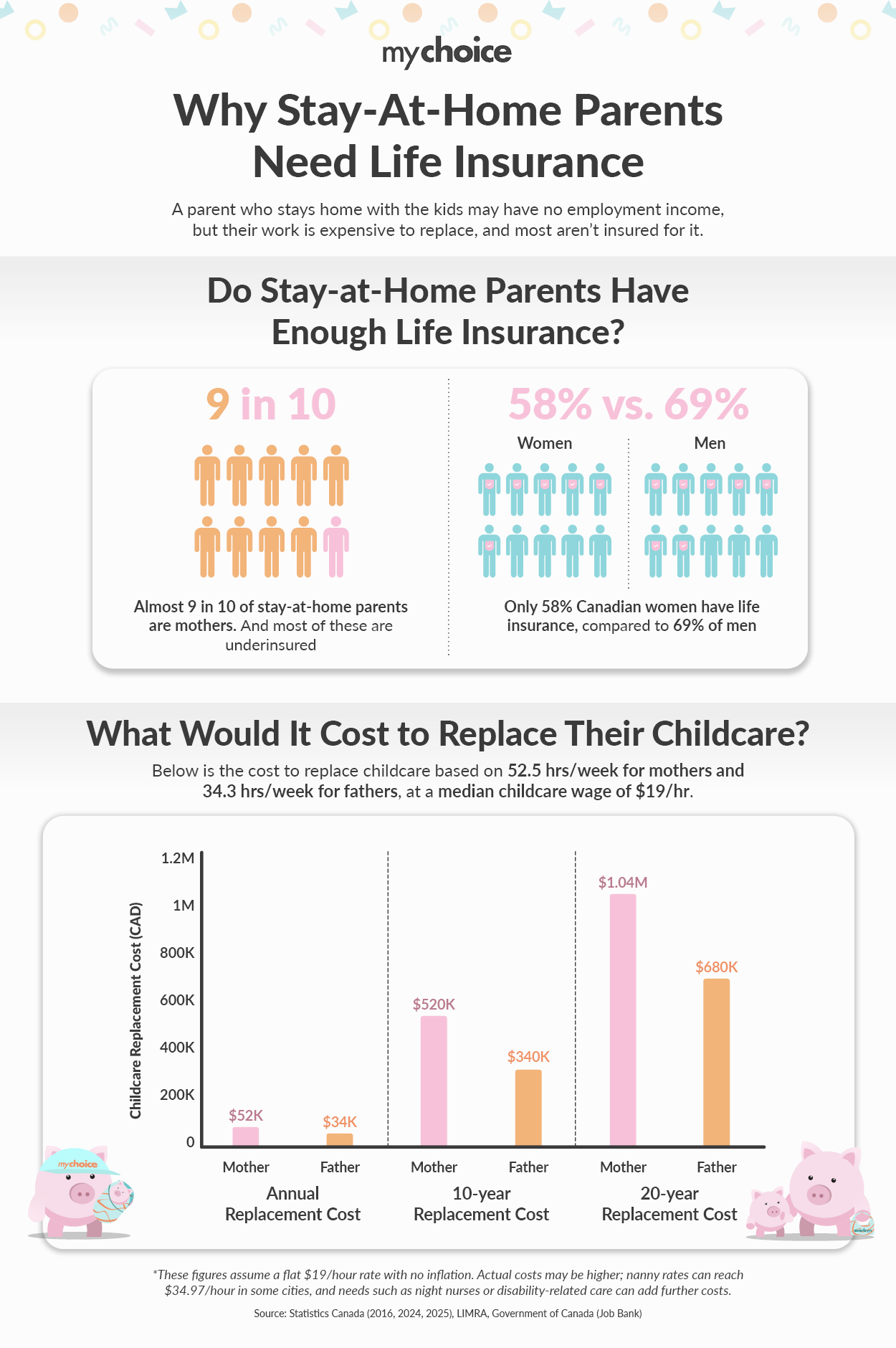
Do Stay-at-Home Parents Have Enough Life Insurance?
No. Almost 89% of stay-at-home parents are mothers. And most of these are underinsured. Only 58% Canadian women have life insurance, compared to 69% of men, according to the Life Insurance and Market Research Association. Women also insure themselves 25% lower than men.
How Much Time Do Parents Spend Caring For Children?
Women and men spend a lot of time caring for their children. According to Statistics Canada, the average woman spends 52.5 hours a week on childcare.
The average man, on the other hand spends 34.3 hours a week looking after children.
What Would It Cost to Replace Childcare?
When MyChoice looked at the average pay a home child care worker receives, we found that the median is $19/hr, according to the Government of Canada.
If we divide 52.5 hours and 34.3 hours per week, This averages out to:
| Mother | 7.5hours/day x $19/hr x 365 days= $52,000/year |
| Father | 4.9 hours/day x $19/hr x 365 days=$34,000/year |
At $19 an hour, replacing a mother’s household labour could cost about $52,000 a year, while replacing a father’s could cost about $34,000 a year.
Read More: How Much Life Insurance Do I Need in Canada?
The Cost of Replacing Childcare over the Long-Term
Replacing childcare is not simple math—it needs to factor in the age of the children, how many years the childcare would actually be required, the rate of inflation, a spouse’s income, whether one or both partners have employer-sponsored benefits, and other costs. For example, a baby might require nighttime feedings and the hiring of a night nurse to allow for the other parent to sleep. Or a disabled child may require additional care, being driven to medical appointments and home learning.
As well, while the median hourly rate for a nanny is $19, nannies can command up to $34.97/hr in some Canadian cities.
Nonetheless, using the data above can paint a very vivid picture of what those annual childcare costs might look like over a 10-year and 20-year period.
If you’ve got babies at home, you might be looking at a 20-year childcare replacement figure. For older children, those aged 8-10 years, you might only require childcare replacement for 10 years.
| Parent | Household Work per Day | Annual Childcare Replacement Cost | 10-Year Replacement Cost | 20-Year Replacement Cost |
|---|---|---|---|---|
| Mother | 7.5 hours | $52,000 | $520,000 | $1.04 million |
| Father | 4.9 hours | $34,000 | $340,000 | $680,000 |
How Much Life Insurance is Needed for Childcare?
Over time, the cost of replacing a parent in the home is substantial. And the surviving parent may not be able to earn enough money to pay for a childcare provider and additional services the other parent provided. A life insurance policy for each parent that factors in childcare expenses can help ensure that financial hardship doesn’t get in the way of raising a family.
Why Childcare Isn’t the Full Replacement Cost
Keep in mind that these figures only represent childcare – and that not all childcare providers agree to provide the full spectrum of services performed by mothers or fathers. For example, a nanny might refuse to cook or clean, leaving the surviving parent to pay for those services additionally.
The Challenge of Finding Childcare
In addition to the cost of replacing a parent with a childcare provider, it’s challenging to find one. The proportion of parents who used child care and who reported having difficulty finding it increased from 46% in 2023 to 50% in 2025. In situations where both parents are adequately insured, the death benefit provided by a life insurance policy can allow a parent to take time off from work to look for a childcare provider.
Ultimately, the death of a parent can have a major financial impact on a family. If you’re a stay-at-home parent, considering a life insurance policy can help fund childcare and create a much-needed safety net for your family.
Read More: Explore Your Life Insurance Options