









Life insurance plays a natural role in planning for the future, especially for recently married couples or those entering a common-law relationship. However, life insurance can also factor into a prenuptial agreement, especially in separation, divorce, or death.
We reviewed Ontario’s property-division guide, Ontario’s Insurance Act, the Financial Consumer Agency of Canada’s life-insurance guide, and section 148 of the Income Tax Act regarding life insurance surrenders or transfers.
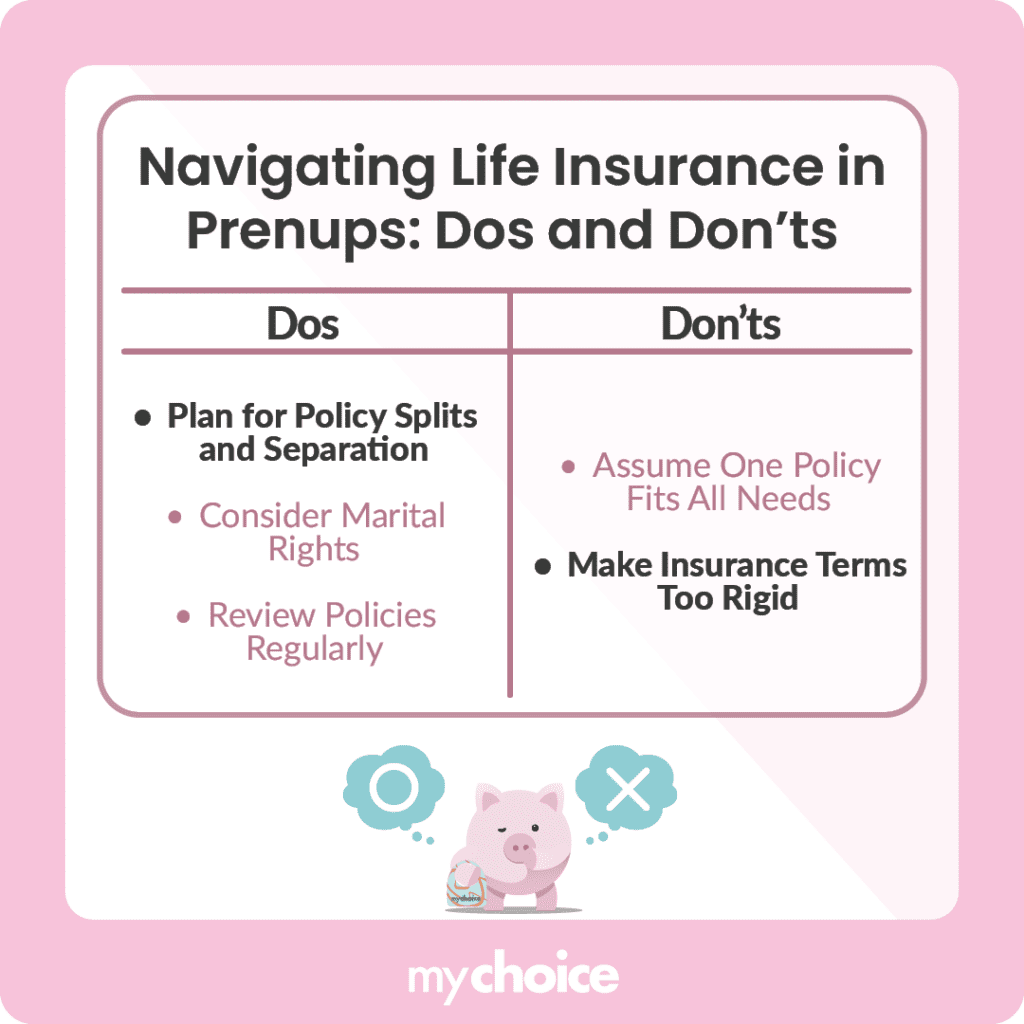
By understanding the dos and don’ts of navigating life insurance in prenups, you and your spouse can secure your financial future. Here’s what you should consider when working a life insurance policy into your prenuptial agreement.
How Should Life Insurance Be Addressed In A Prenup?
The agreement should describe what it’s for, how much insurance is needed, how long it’s required, who’s responsible for paying premiums, who the beneficiary or trust should be, how they’ll know it was done, what can be changed, and what happens if it’s not kept in force.
Depending on the agreement, you’ll need to complete ownership, beneficiary, assignment, or trustee forms with the insurer.
The Intersection Of Prenups And Life Insurance
Domestic contracts can be used to deal with life insurance at different times during a relationship, after separation and on death. Examples include using life insurance to secure a child or spousal support obligation, fund a business buyout, and provide for children of a former relationship. Contracts can also address the value of an existing permanent life insurance policy and how it is allocated.
In Ontario, married spouses generally equalize the value of property accumulated during marriage, while common-law partners are not automatically subject to the same property-sharing regime. The value that has been built up in a permanent life insurance policy during a relationship may matter in that calculation, notwithstanding that the insurance has not been paid out. Life insurance is not necessarily ‘non-divisible.’
What You Should Do
Do: Inventory Every Policy
| Policy fact | Why it matters |
|---|---|
| Owner and life insured | Do not confuse owner and insured, because whoever owns the life insurance policy controls it, subject to any assignment and irrevocable rights. |
| Coverage amount and term end | Your obligation may outlast your current coverage. |
| Primary, contingent and irrevocable beneficiaries | Some changes may require additional consents or forms from the insurer. It’s important to know the difference between a primary, contingent, or irrevocable beneficiary. |
| Cash surrender value, ACB and loans | Cash surrender value, ACB and loans affect potential tax as well as net value. |
| Collateral assignment | A lender may have priority over some proceeds under the collateral assignment. |
| Group conversion or portability rights | Employment coverage may end after a job change. Conversion and portability rights may be an issue. |
Do: Define The Insurance Obligation Precisely
- Purpose: Specify what obligation the insurance secures and who will benefit from coverage.
- Amount: Specify a particular dollar amount or formula for coverage linked to the amount of an underlying obligation, and, if a formula is used, the date(s) the obligation will be calculated.
- Duration: Specify when the obligation begins and ends. For example, the end of support, retirement, a child’s independence or remarriage.
- Control: Identify the policy owner. Specify whether a party can borrow against, assign, modify the beneficiaries of, surrender, or replace the policy.
- Proof: Specify what information must be provided to verify compliance with the insurance provision, such as policy statements, evidence of premium payments, or beneficiary confirmations, but protect confidential health information.
- Failure: Describe the process to give notice of lapse, the time available to cure, and remedies if coverage lapses, is reduced or cannot be replaced.
Read More: Estimate How Much Life Insurance You Need
Do: Confirm What The Insurer Can Actually Do
Ask the insurer in writing to confirm that their policy allows the proposed ownership, beneficiary, trustee, assignment and proof arrangement. It may be helpful, where appropriate, to attach a specimen form as well as your drafting instructions.
Do: Check Beneficiary Rights
A revocable beneficiary may be changed by the policyowner, usually subject to the provisions of the policy and applicable law. However, an irrevocable beneficiary works differently.
In Ontario, an adult irrevocable beneficiary’s consent is usually required before the owner can change, assign, or surrender the policy.
Read More: Review Beneficiary Rights in Life Insurance
Do: Review After A Defined Event
While some couples will want to meet with their lawyers annually, it’s not necessary for everyone. Instead, couples may wish to specify that their agreements can or should be reviewed after the birth or adoption of a child, a material change in income, the sale of a business, a job change, a move to another province, separation, or reconciliation. Specify who can initiate a review, and who is responsible for the cost.
Read More: See How Divorce Can Affect a Life Insurance Policy
What You Shouldn’t Do
Don’t: Assume Separation Changes The Beneficiary
Just because your relationship is over doesn’t mean that your insurer knows that. You may still be contractually obligated to name your ex-spouse or child as beneficiary. Rules differ by province, so compare the agreement, court orders, will, and policy designation before requesting a change.
Don’t: Promise Coverage That May Be Unavailable
An agreement can’t promise continued insurability or affordable replacement insurance. Include provisions for what happens if an insurance application is rejected, the amount of insurance is reduced, coverage is converted, or the premium exceeds a certain amount. A health change may make existing coverage more valuable than assumed.
Don’t: Treat Cash Value And Death Proceeds As The Same Asset
Cash surrender value belongs to the policyowner during the policyowner’s life, subject to the terms of the underlying insurance contract, any assignments, irrevocable rights, etc.
The death benefit becomes payable after the insured dies. Your agreement should specify who will receive the death proceeds.
Address valuation/equalization for cash value separately from who receives death proceeds.
Don’t: Prescribe Separate Or Joint Policies For Everyone
Separate policies can help because it’s clear who owns what, but they’re not necessarily better than joint, group, or even business coverage.
Sometimes these other coverage options serve a defined purpose.
Before recommending that policies be replaced, consider purpose, cost, control, conversion, and insurability.
Read More: Compare Joint and Separate Life Insurance for Couples
Tax Implications: What You Need To Know
Do not assume that the amount of taxable policy gain is simply the amount of cash you receive, less premiums you’ve paid. The calculation is more complicated, as the Income Tax Act refers to the policy’s adjusted cost basis (ACB) and proceeds of disposition (POD). Ask the insurer for these numbers before completing a surrender, transfer or policy loan.
Not all divisions, conversions, surrenders and other types of disposition of a life insurance policy are tax-free. For example, Section 148 generally deems a transfer to a spouse, common-law partner, or former spouse or common-law partner in settlement of relationship rights to occur at adjusted cost basis, unless an election is made. Confirm that all requirements are met before proceeding, including residence, consideration, ownership, and tax reporting.