









Some types of permanent life insurance policies can provide access to some of your money. However, the amount that’s available to you isn’t easily calculated from the amount of premiums you’ve paid.
To calculate how much money you have available, you need to know your insurance company’s current values, any loan provisions and your adjusted cost basis.
To learn more about this topic, we looked at the federal life-insurance guide, FSRA’s policy-type guide, section 148 of the Income Tax Act, and CRA’s archived policyholder interpretation bulletin. By the end of this guide, you’ll be able to:
- Understand your life-insurance policy statement
- Figure out how much money you’d get if you surrendered your policy, without double-counting fees
- Compare policy loans and policy withdrawals
- Get the tax figures you’ll need in Canada before taking action.
How Do You Calculate And Withdraw Cash Value?
Watch out. It’s a common error to calculate the tax by subtracting the amount of premiums paid from the amount of cash received. The adjusted cost basis (ACB) is calculated differently. See section 148 of the Income Tax Act, which shows the additions and subtractions to calculate the ACB.
Ask your insurer for an up-to-date in-force illustration or statement. It should show the cash value and cash surrender value, surrender charges, any loan and interest owing on the policy, maximum amount that can be withdrawn or borrowed, death benefit after withdrawal, your ACB and any tax that would be reported if the withdrawal or loan is made. Ask for an illustration showing the effect of a withdrawal of the amount you want at the time you want to make it.
For a full surrender of the policy, a rough idea of the amount you’ll receive is the cash surrender value quoted by the insurer, minus surrender charges if not already deducted, loan balance, interest on loan, any premiums owing and any other deductions. The insurer should be able to tell you the ACB and the policy gain that would be reported. Review a material transaction with a tax professional.
Cash Value Life Insurance Explained
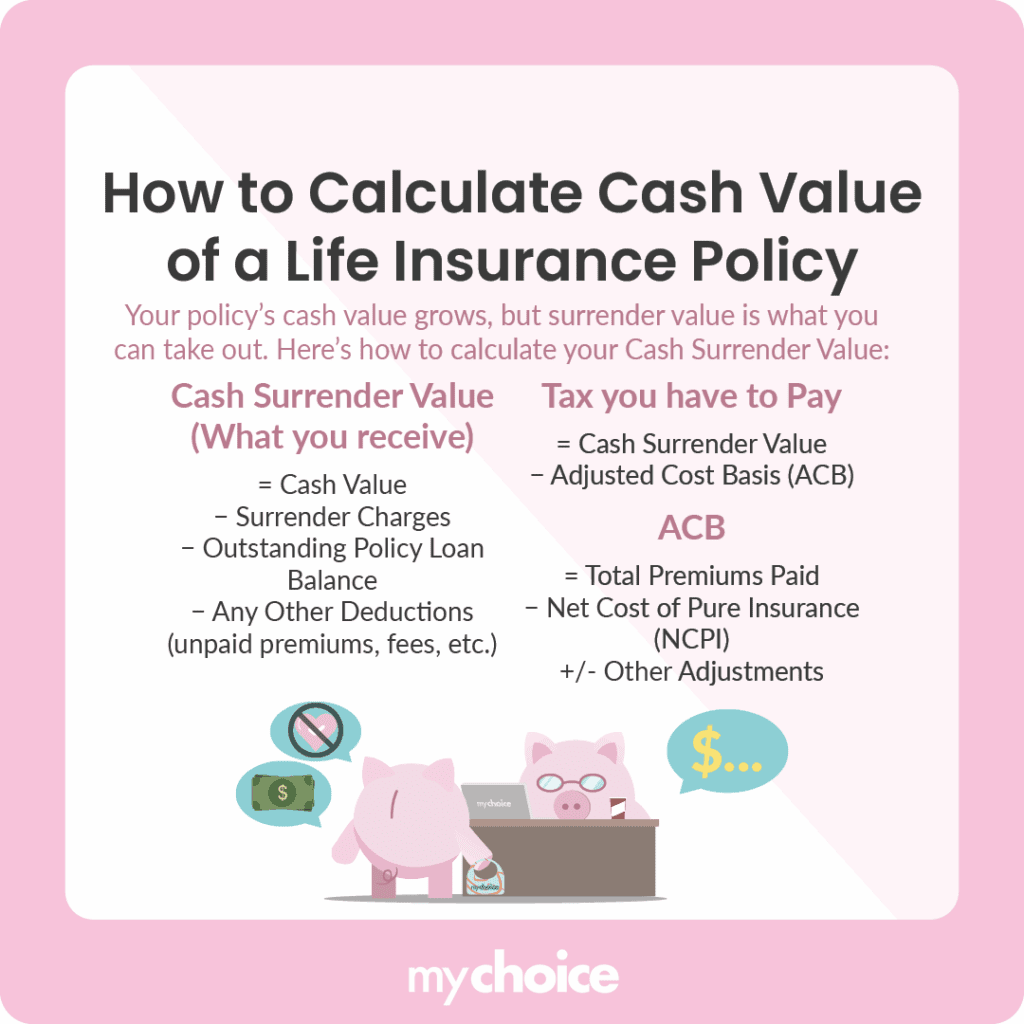
Some types of permanent life insurance policies accumulate a cash value.
Cash surrender value is the amount determined under the contract when the policyowner surrenders the policy, before or after other deductions as the statement defines them.
In-force illustrations show how guaranteed and non-guaranteed cash values may develop over time as long as the policy stays in force.
Generally, a policyowner can access the cash value unless there are legal restrictions, such as if the policy is assigned, owned by a trust, subject to lender interest or has an irrevocable beneficiary. Neither the life insured nor the beneficiary has an automatic right to the funds unless they are the policyowner.
Read These Numbers Before You Calculate
| Statement item | What it tells you | Why it can change the decision |
|---|---|---|
| Cash value or fund value | The gross value accumulated under the policy, sometimes called the fund value. | Cash value and fund value may not necessarily be the amount you’ll get if you surrender the policy. |
| Cash surrender value | Cash surrender value is the value (as defined by your insurer) payable under the contract upon surrender. | Cash surrender value may affect decision. Cash surrender values may include early surrender charges and may take into consideration adjustments based on current market conditions. |
| Policy loan plus accrued interest | Debt owed to the insurer, including accrued interest | It can reduce net value and death proceeds; large loans with interest can cause the policy to lapse. |
| Adjusted cost basis | Adjusted cost basis is a tax amount determined by calculation under the Income Tax Act. | Is needed to find policy gain and it can change over time which may change the decision. |
| Guaranteed and current columns | Contract guarantees versus illustrated assumptions. The guaranteed columns show guarantees of the policy contract. Current columns show assumptions and are NOT contract guarantees. | Judging the current dividends or returns alone can result in an overstatement of future value. |
| Death benefit after transaction | The amount of insurance coverage remaining for beneficiaries | If you make withdrawal from a policy, surrender a policy, or have an unpaid loan, it may reduce or eliminate the policy’s death benefit. |
A Simple Net-Cash Example
Say that your current cash surrender value is $45,000 and you have a $5,000 policy loan with interest. Absent other charges, your net-cash estimate would be a cheque for $40,000. Keep in mind that if that $45,000 is your policy’s gross cash value and not its cash surrender value, you’ll also need to factor in surrender charges or market adjustments.
Note that this calculation won’t tell you how much of the cheque would be taxable. For that, you’ll need to know a number of things that only your company can tell you, including the policy’s adjusted cost basis (ACB) immediately before the transaction, the policy gain that will be reported, how loan repayment is treated, and a post-transaction illustration. Different figures will apply for loans and partial surrenders as opposed to full surrenders.
How To Withdraw From The Cash Value
| Access route | What happens | Main risks and checks |
|---|---|---|
| Policy Loans: | The insurer makes cash advances under the policy, charging interest. | Policy loans may reduce proceeds and/or result in the policy lapsing when debt is unpaid. Also, policy loans are dispositions for Canadian tax purposes. |
| Withdrawals: | A partial surrender permanently removes value and may reduce coverage | For a withdrawal, ACB is prorated. Ask about tax reporting, remaining guarantees and future premium needs. |
| Paying Premiums: | The terms of the contract may allow dividends, policy value, or an automatic premium loan to pay a premium. | This may use non-guaranteed value, add loan interest or shorten how long the policy can support itself |
| Collateral bank loan | With a collateral bank loan, a lender advances funds in return for a collateral assignment of the policy. | Unlike the policy loan from your insurer, a collateral bank loan: Requires credit approval from the bank. Costs money (interest charges). Is subject to a collateral call by the lender. Is controlled by the lender. |
| Full surrender | The owner will receive the net value on cancellation of the contract. | A full surrender may incur a surrender charge and a policy gain may be taxable. Also, coverage ends. |
Policy Loans:
A life insurance policy loan may not have a set consumer-loan repayment schedule. Keep in mind that any outstanding balance will continue to build interest and reduce your death benefit or surrender value over time. Too much debt can result in your policy lapsing.
Ask about interest rates and how interest is compounded, the maximum amount you can borrow, the annual monitoring trigger, and your policy’s current adjusted cost basis (ACB).
Don’t fall for generalities about getting money from your life insurance policy tax-free. Ask for specifics. The Income Tax Act includes a policy loan made after March 31, 1978 in the definition of a policy disposition. Ask the insurer what amount, if any, will be reported and how later repayment affects your ACB.
Read More: See How Policy Loans and Collateral Loans Work
Withdrawals:
Always get illustrations showing what happens before and after partial surrenders or withdrawals as death benefits, cash value, guarantees, etc., can change as can the premium.
Partial surrenders are not tax-free up to premiums paid or policy ACB. The policy ACB has to be prorated for the portion of the policy being surrendered as required by section 148.
Read More: Review Canadian Tax Rules for Life Insurance Withdrawals
Paying Premiums:
Paying premiums with your policy’s value depends on your contract. Check that you know whether premiums are being paid with dividends, a universal-life account, a premium loan or some other non-forfeiture option, whether interest charges apply, how long policy values will pay premiums under guaranteed assumptions, and what kind of advance notice you’ll get before your policy lapses. Don’t assume that internal payment options are free and will last forever.
Surrendering A Policy For Cash Value
When a policy is fully surrendered, the death benefit is eliminated. Reversing the decision may be expensive or difficult, particularly if the insured is older or in different health at the time.
Before signing the surrender form, weigh the tax and other consequences and net payout against alternative options. Alternatives may include reduced paid-up insurance, a lower death benefit, a policy loan, a partial surrender, or continuing the policy. Not all contracts offer the same alternatives.
Read More: Compare Surrendering Life Insurance With Keeping the Policy
Different Kinds Of Life Insurance With Cash Value
| Canadian policy type | Value structure | What to request |
|---|---|---|
| Non-participating whole life | May have guaranteed values spelled out in the contract. | Guaranteed cash-value and premium schedule |
| Participating whole life | guaranteed value + non-guaranteed dividends. | When requesting Participating whole life illustrations ask for a current dividend option and lower-dividend illustration. |
| Universal life | Consists of charges for insurance + your chosen investment account(s). | Fund value, surrender value; how the cost of insurance is calculated; ask for illustration based on low-return projection. |
| Simplified or guaranteed-issue permanent | May have graded death benefits and modest or delayed initial cash value buildup, as with simplified or guaranteed-issue permanent insurance. | If considering simplified or guaranteed-issue permanent insurance, ask for the exact cash-value schedule, waiting period and full terms of surrender. |
Read More: See How Whole Life Insurance Works
Transaction Checklist
- Who is the owner, life insured
- Cash value, cash surrender value, including surrender charges and market value adjustments
- Beneficiaries, irrevocable beneficiaries, assignments
- Policy loan, including current balance, interest, loan interest rate, repayment treatment, lapse threshold
- Death benefit, premium requirement and guaranteed values after the transaction
- What are some alternatives, such as reducing coverage, converting to paid-up insurance, or doing nothing
- Adjusted cost basis (ACB) immediately before the transaction
- Expected tax slip or policy-gain amount