









Before you agree to replace your current life insurance, make sure you understand what you have. We reviewed the Financial Consumer Agency of Canada’s life-insurance guide, FCAC’s guide to getting and maintaining insurance, FSRA’s Life Insurance Replacement Declaration, and FSRA’s life-and-health insurance consumer rights guide.
Here’s what we learned about the seven life events that might signal it’s time to revisit your life insurance coverage, how to determine whether you have a shortfall, what to look for in your contract before you replace your policy, and how to protect yourself from losing valuable guarantees.
When Should You Review Your Life Insurance Coverage?
Reviewing your life insurance doesn’t automatically mean you need to purchase a new policy. It might mean increasing or decreasing your coverage, changing certain features or leaving everything as-is.
It’s time to review your policy if there have been changes in whom you’re providing for, how much responsibility you’re taking on or how long you need to be covered, or before the conversion or renewal dates of term policies.
You should also review permanent insurance when the annual statement indicates poor performance, a larger policy loan or higher payments to keep it in force.
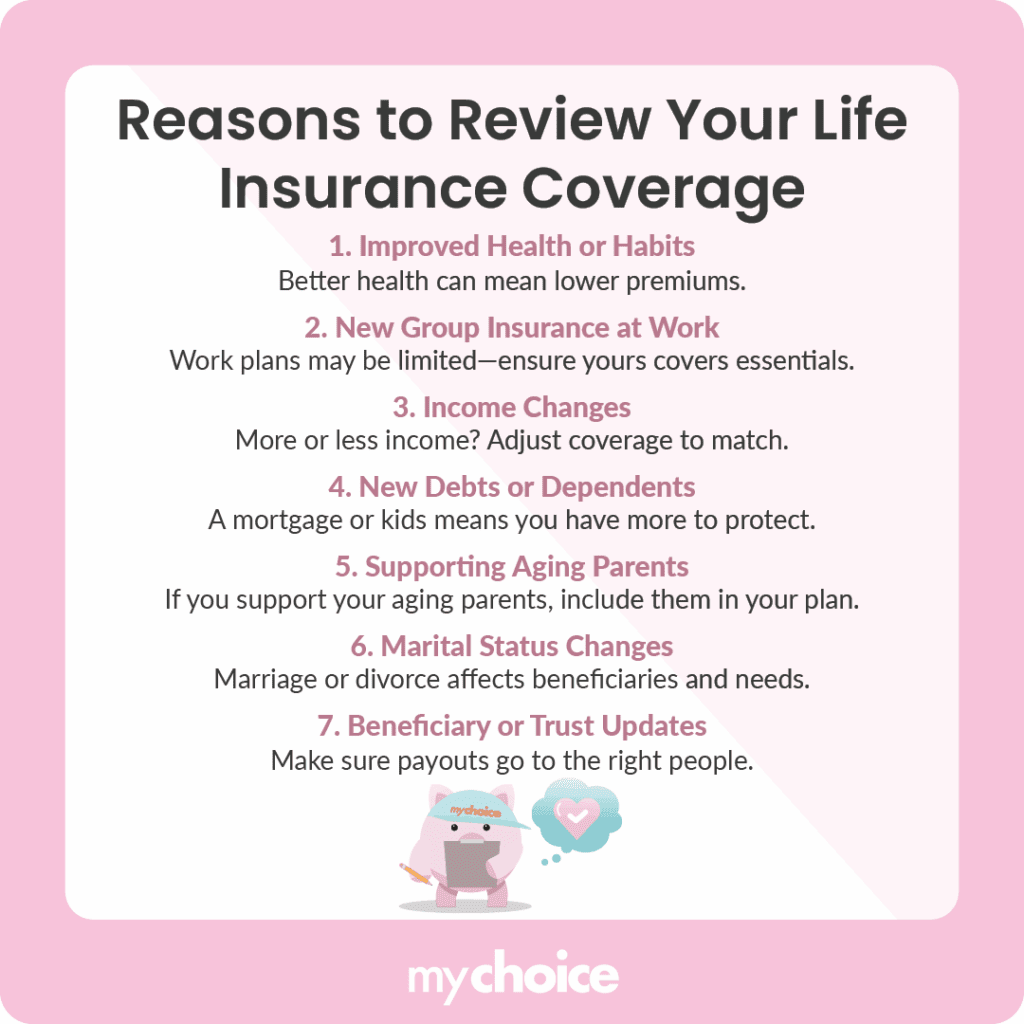
Reason 1: You’ve Improved Your Health or Lifestyle
Check with your insurer to see whether its contract allows adjustments if you stop smoking or improve other rating factors. Requirements and responses vary.
A reduced premium isn’t guaranteed. You might need to purchase a new policy. Before accepting a better underwriting offer, consider replacement risks, guarantees, cash value, riders, remaining term and other features of your policy.
Read More: See How Life Insurance Underwriting Works
Reason 2: You’ve Joined a Group Insurance Plan at Work
Note what kind of benefit it is, who pays the premium, the age at which coverage will terminate and what happens to coverage if you leave the job, retire or become disabled.
FCAC notes that coverage may terminate when you leave the group or reach a particular age. Be aware that a group benefit is only one layer of coverage. Don’t automatically assume your group benefits can replace your personal insurance.
Read More: Learn Whether Group Life Insurance Is Enough
Reason 3: Your Income Changed
It is not necessarily wise to drop coverage just to save money, especially if your health worsens and you can’t get a policy at an affordable price. Likewise, getting a raise does not necessarily mean you need more insurance.
Determine how much income your household would need from you and for how many years. Then determine which household expenses would not continue if you died.
Reason 4: You Have New Financial Obligations
Mortgages, loans, education costs and business obligations may influence the amount and end date of the need.
Decide which debts should be settled immediately and which you want to keep paying as needed.
Reason 5: You’re Now Supporting Ageing Parents
Think about what support you provide to your parent, such as help with housing, food, medications, transportation or paid help, and for how long. Then subtract any help your parent could get from family or other sources, private or government benefits, and assets.
By figuring out what support would be lost and what support would be available, you’ll be able to determine how much coverage you need instead of relying on broad, national caregiver statistics.
Read More: Read the Life Insurance Guide for Parents
Reason 6: Your Marital Status Has Changed
Marriage, separation, divorce or widowhood can affect who owns the insurance, who pays for it, who the beneficiary is and how much coverage you need.
Generally, the policy owner can change a revocable beneficiary without the consent of others. However, written consent may be required to make changes to an irrevocable beneficiary. FCAC also notes that in Quebec, if the beneficiary is a spouse, the designation is considered irrevocable unless specified otherwise.
Update beneficiary designations if they contradict your separation agreement, divorce or support order, will or business agreement. Get legal advice if rights are contested.
Read More: See How Divorce Can Affect Life Insurance
Reason 7: You Want to Reevaluate Beneficiaries and Trust Designations
Remember that if you designate an estate as the beneficiary, any proceeds may be subject to the claims of creditors.
FCAC points out that, depending on provincial or territorial rules around who can control a minor’s funds, you may need to appoint an administrator or trustee.
Consult with a lawyer and a tax advisor before establishing a trust, an irrevocable beneficiary designation or a legal entity, such as a corporation.
Check primary and contingent beneficiaries on all contracts.
Calculate the Current Coverage Gap
Instead of using a multiple of your salary, perform a needs calculation:
Immediate needs + debts + income or care needs + education, estate or business needs − liquid assets designated for survivors − dependable insurance = estimated coverage gap.
Make sure all assumptions are stated.
Read More: Recalculate How Much Life Insurance You Need
Before Replacing an Existing Policy
Keep a copy of the written comparison in your policy file along with copies of each policy. Understand what may be lost by replacing a policy. Replacing a policy can:
- Restart contestability and suicide provisions
- Lose riders and guarantees
- Result in a surrender charge
- Have tax implications
- Be underwritten at your current age
FSRA’s replacement declaration states that you should not cancel a current policy until a replacement policy is issued and accepted.
The Life Insurance Review Checklist
Key documents you should have in hand:
- Policy contract
- Most recent annual statement
- Beneficiary designation confirmation
- Premium payment schedule
You should also find out when a term policy can be renewed or converted. Find out what happens to group insurance at retirement or job change.
If replacing a policy, keep the old one in force until the new one is accepted and in force.