









A permanent life insurance policy can accumulate cash value over time. While there are different ways to access the cash value of your life insurance policy, education savings is just one option.
For this comparison, we reviewed the federal RESP and education-savings hub, the CRA’s RESP guide, the Financial Consumer Agency of Canada’s life-insurance guide, and section 148 of the Income Tax Act.
Life Insurance as a Savings Tool
Most people equate life insurance strictly with death benefits. But with a participating whole life insurance policy, each premium you pay does two things:
- Pays for coverage: Guarantees a death benefit
- Contributes to cash value: This is a cash value component within the policy that may grow over time on a tax-deferred basis while the policy remains active.
Your insurer invests the cash value on your behalf. If the participating account performs well, the insurer may pay dividends. You can use these dividends to buy additional insurance (increasing the death benefit and cash value), reduce premiums, accumulate them within the policy, or take them as cash. The earlier you start, the more time the cash value has to grow and the more options your child will have down the road.
Read More: See How Cash Value Can Help Fund Education
RESP Vs. Life Insurance For Education
| Decision factor | RESP | Permanent life insurance |
|---|---|---|
| Primary purpose | Education saving after high school. | Lifelong insurance, with cash value in some policies. |
| Government support | CESG and possibly CLB or provincial benefits, if eligible. | No education grant. |
| Growth | Growth depends on the investments selected. | Guaranteed values depend on the contract; dividends or investment results may not be guaranteed. |
| Access | Education assistance payments follow eligible-study rules; contributions can generally be returned. | Withdrawals, policy loans and collateral loans each have different consequences. |
| If the child does not attend | Contributions can generally be returned; grants must usually be repaid. Earnings may have transfer or withdrawal options, subject to conditions and tax. | Although cash value is controlled by the rules of the policy, it can be used for other things. |
| Cost comparison | Compare plan fees and investment costs. | Compare premiums, insurance cost, commissions, surrender charges, loan interest and possible tax. |
Read More: See How Borrowing Against Life Insurance Works
When Life Insurance Might Make Sense For Education
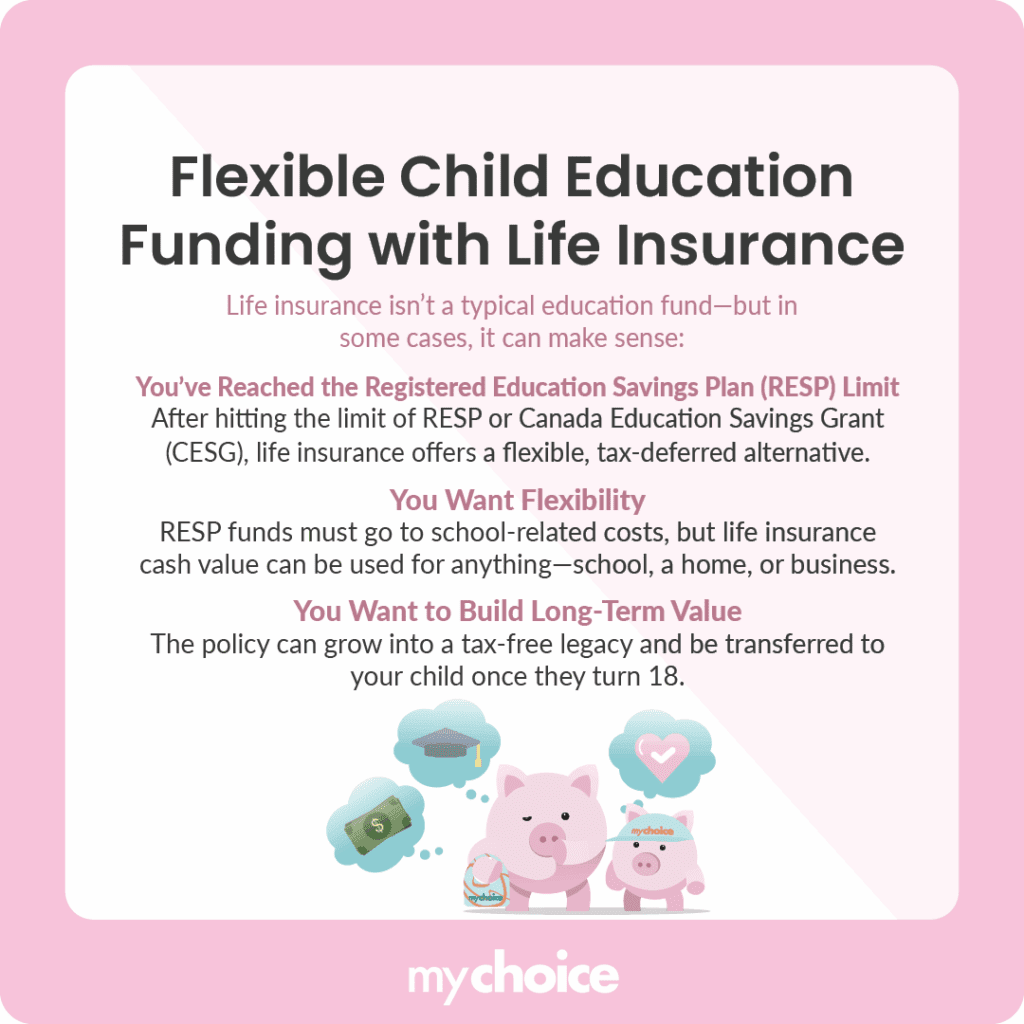
Using life insurance to pay for education isn’t right in all situations, but it might make sense in some.
You’ve Reached RESP Contribution Or Grant Limits:
If you have reached the $50,000 RESP lifetime contribution limit for a beneficiary, or no longer have CESG room, do not automatically consider permanent insurance. Check whether you need permanent insurance, and compare its net value to a TFSA, your registered investments as parents, or non-registered investments.
You Want More Flexibility:
RESPs can cover more than tuition. Eligible expenses include rent, books, tools, transportation, etc. If your beneficiary doesn’t continue their education, the CRA has outlined what can happen.
Policy cash may seem flexible because it has no restriction on use for education. However, there may be costs involved, such as a value reduction, interest, a taxable event, etc.
You Want Intergenerational Wealth Transfer:
If you’re interested in intergenerational wealth transfer by transferring your child’s policy when they turn 18, be aware that the transfer is not necessarily tax-free. Before transferring, check:
- who owns the policy
- who’s the beneficiary
- the age of majority in your province
- tax implications.
Note that a policyholder gets special treatment under the Income Tax Act (see subsection 148(8)) when a policyholder transfers an interest for no consideration to a child and the life insured is a child of the policyholder or transferee.