








How to Pick Between Term vs Whole Life Insurance

3 minutes can save you hundreds. Enter your postal code below and join thousands of Canadians saving on life insurance.

Secure. No Spam. No Fees.

Why You Can Trust MyChoice

MyChoice serves as an independent intermediary between you, financial institutions and licensed professionals without any additional charge to our users. In the interest of transparency, we disclose that we partner with some of the providers we write about – we also list many financial services without any financial gain. MyChoice does not operate a financial institution or brokerage and to ensure accuracy, our content is reviewed by licensed professionals. Our unique position means that we hold no recurring stake in your policy, ensuring our mission to help Canadians make better financial decisions is free of bias or discrimination. 

Last updated on March 16, 2026

6 minute read

MyChoice follows a strict content review process designed to ensure reliable and unbiased information.

Term vs Whole Life Insurance at a Glance

  • Term life insurance covers you for a set period, usually 10 to 30 years. It has lower, fixed premiums, so it’s a budget-friendly choice for short-term needs.
  • Whole life insurance lasts your entire life and builds cash value, but its premiums are much higher than those for term policies.
  • Term policies pay only a death benefit. Whole life policies include both a death benefit and a savings or investment feature.
  • Whole life premiums are often much higher than term insurance, even for younger people. This is because they offer lifetime coverage and build cash value.
  • Renewing term life insurance usually costs more, especially as you get older or if your health changes.
  • Whole life policies offer stable coverage and guaranteed payouts. Term policies are more flexible and often let you switch to permanent coverage later.
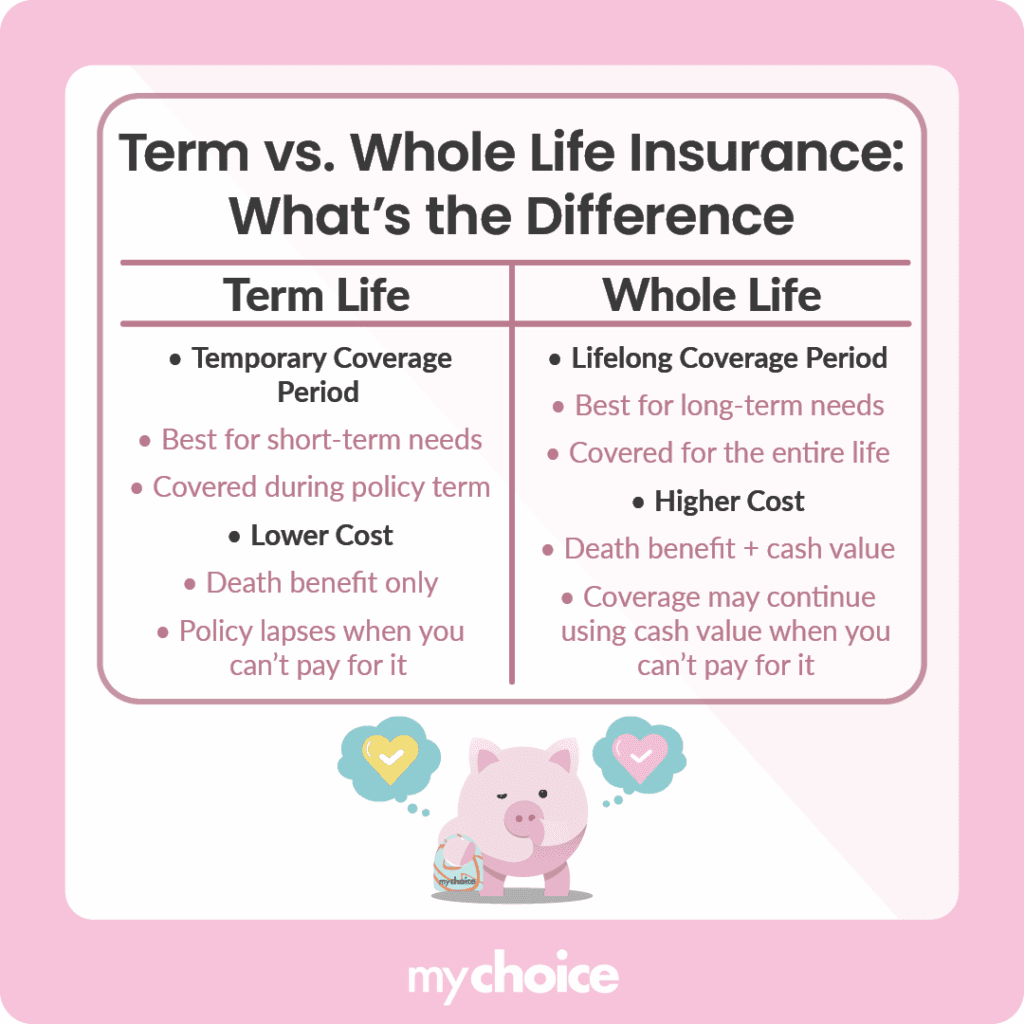
Term vs. Whole Life Insurance - What’s the Difference

What Is Term Life Insurance?

Term life insurance is an insurance policy that covers you for a specific time period. Common coverage periods include 10, 20, and 30 years.

Your premium is typically fixed for the duration of the term, but it may increase if you renew the policy afterward. But it may increase if you choose to renew the policy once it ends.

Pros of Term Life Insurance

The main benefit of term life insurance is its simplicity. Term policies are usually easier to understand – you’re covered for a set number of years, then the policy expires. You need to renew the policy if you want protection beyond the term.

Term policy costs are also more affordable and predictable. Your premiums are guaranteed to stay the same for the entire term. A term policy is also very flexible because you can either renew it with another term policy or convert it into a permanent policy during the term (before it expires), depending on your insurer.

Cons of Term Life Insurance

The most prominent disadvantage of term life insurance is its temporary coverage. You lose the protection when the term ends, and you don’t renew. You might also get higher premiums when renewing the policy due to age and any health issues you may have developed since you took the policy.

Another disadvantage of term life insurance is that it doesn’t build value. You get nothing but your policy’s death coverage while the policy is active. Contrast this with permanent or whole life insurance that builds value as you pay premiums.

When to Take Term Life Insurance

Term life insurance is best if you have temporary needs to cover. Temporary needs can be anything from paying off your mortgage to funding your child’s education.

Term policies are also great if you want to save money. They’re usually cheaper than whole-life policies because of their temporary nature. But the lower costs now might translate into more expensive renewal later because you’ll be older and potentially less healthy.

Can’t decide which type of policy to get, but still want insurance? Term policies give you flexibility in that regard. Your insurer may allow you to convert a term policy into a permanent policy when it expires.

What Is Whole Life Insurance?

Whole life insurance is a type of permanent life insurance that covers you until you pass away. Your protection won’t expire as long as you continue to pay premiums.

Lifelong coverage isn’t the only feature of whole life insurance. Most permanent policies also have a cash value component. This means part of your premium payment is reinvested to generate this cash value. You can then use this cash value as a source of funds or loan collateral whenever you need money.

Due to the long protection period and cash value retention, permanent policies are usually more expensive than term policies.

Universal life insurance is another type of permanent life insurance, alongside whole life. Learn how universal policies compare to whole-life policies.

Pros of Whole Life Insurance

The main benefit of a permanent policy is its whole-life coverage. You’re guaranteed death benefits when you pass away as long as you keep paying premiums.

These death benefits aren’t taxable, so your loved ones will receive them in full. However, there are some cases where your death benefit might be subject to tax. Check our guide on the tax consequences of life insurance in Canada for more details.

Another important benefit is its cash value. As you pay premiums, your policy’s cash value will increase. Once you have enough built up, you can borrow against this cash value or withdraw it as an extra source of funds.

Curious about how life insurance can be an investment vehicle? Learn more about investing with life insurance.

You can still benefit even if you don’t use the policy’s cash value. If you have enough cash value in your policy, you can convert it to a paid-up policy. This means you don’t need to pay any more premiums, as you may be able to convert your policy into a paid-up policy using accumulated cash value or dividends, depending on the policy

Cons of Whole Life Insurance

The most prominent disadvantage of whole life insurance is its high costs compared to term policies. Whole life policy premiums are higher because you pay for your insurance coverage and the cash value.

Another disadvantage is opportunity cost. Whole-life policies build up cash value through investments, but the returns may be modest compared to other investing methods. For instance, you might get more returns by taking a term life policy and investing the remaining money into stocks or real estate.

When to Take Whole Life Insurance

Permanent life insurance is a better option if you want whole life insurance coverage or to take advantage of its investment component. Permanent policies are also a good way to cover your funeral costs. You don’t want to leave your loved ones with a large bill when they find out you passed away, after all.

Permanent life insurance premiums are more expensive, but it comes with better peace of mind because you have lifelong protection. That means you don’t have to worry about re-qualifying at a higher price when your policy term expires.

Some investment vehicles have higher returns, but some whole life policies offer guaranteed cash value growth, while others (like universal life) depend on investment performance. It’s the right choice if you prefer a hands-off approach to investing. The gains from your policy’s cash value aren’t just useful for you – the cash value is typically absorbed into the death benefit paid to beneficiaries.

You also have a way out if you’re having second thoughts about permanent life insurance. You can surrender the policy and lose your protection to gain a certain amount of cash based on how much value your policy has accumulated.

Term vs Whole Life Insurance: What’s the Difference?

There are many differences between term and whole life insurance, as we’ve covered above. We’ll summarize most of the prominent distinctions in this table:

Term life insuranceWhole life insurance
Coverage periodTemporaryLifelong
Best forTemporary needs like mortgage or child’s educationPermanent needs like estate planning and retirement income
Guaranteed level premiumsPolicy termEntire life
CostLowerHigher
BenefitsDeath benefit onlyDeath benefit and cash value
Coverage after non-paymentLapses after one monthmay continue if sufficient cash
value exists (depending on policy
structure)

Term vs Whole Life Insurance: Cost Comparisons

Cost is one of the primary concerns for insurance shoppers. As we’ve outlined, whole life insurance is significantly more expensive than term life insurance, but seeing the numbers side by side puts that difference into perspective.

Here’s a cost comparison between term 20 and whole life insurance for $500,000 coverage for a non-smoking individual across different age groups. Note that these rates don’t represent any one insurance company, and you should check with your insurer for detailed rate information.

AgeGenderTerm-20
Life Insurance
Whole
Life Insurance
25Male$27.00$209.25
Female$19.80$176.40
35Male$28.80$322.20
Female$22.05$276.30
45Male$63.45$522.00
Female$48.60$436.05
55Male$161.10$830.70
Female$115.20$663.75

Even from a young age, the cost of whole life insurance is already significantly higher than term life insurance, often several times more expensive depending on the payment structure. Taking a permanent policy is a major financial commitment, so be sure you’re financially ready to pay the premiums if you do.

Meanwhile, term life premiums are low when purchased at a younger age and remain fixed during the term, but new policies become more expensive as you age. That said, we recommend getting insurance at a young age to secure lower rates and save money.

Which Type of Insurance Is Right for Me?

There’s no one type of life insurance that’s right for everyone. The right insurance policy for you is the one that best suits your needs.

If you’re looking to get temporary insurance, then a term life policy is best for you. If you don’t mind shelling out more for lifelong protection and the investment component, whole life insurance is better for you.

Which Companies Offer Term and Whole Life Insurance in Canada?

Most Canadian companies offer term and whole life insurance. Ask your local insurance broker for more information about which company is the best for you. According to our most recent research on the top life insurance companies in Canada, Sun Life is popular for whole life insurance policies, while Primerica is famous for its term offerings.

Term vs Whole Life Insurance: The Bottom Line

Term life insurance and whole life insurance have their unique benefits and drawbacks. The most important thing when looking for life insurance is to choose the policy type that suits your needs.

Key Advice from MyChoice

  • Pick term life insurance if you need coverage for things like a mortgage, replacing your income, or paying for your child’s education.
  • It’s smart to buy life insurance early, since both term and whole life policies get much more expensive as you age.
  • If you want to maximize returns, consider getting term life insurance and investing the money you save elsewhere rather than building cash value in a policy.

Congratulations! You made it to the end!

Now, here is the easy part: complete your quote in under 2 minutes

Discover More About

March 6, 2026
Learn how rising multigenerational housing in Canada can create life insurance coverage gaps and why adult children may need their own policy.
February 20, 2026
Canada’s opioid crisis continues to reshape life insurance risk. Learn how sobriety timelines and underwriting rules affect your coverage options.
February 6, 2026
Canada’s obesity rates rose 10.9% since 2020. Learn how BMI affects life insurance eligibility, premiums, and why applying earlier can lock in lower rates.