









Based on the Financial Consumer Agency of Canada’s life insurance guide, FCAC’s guide to optional credit and loan insurance, the Financial Services Regulatory Authority of Ontario’s policy-type guide, and FSRA’s policy-reading checklist, our editorial team created this guide to help you learn more about level and decreasing term insurance and how they work.
We’ll discuss the main differences between the two types of insurance, including the structure of the death benefit for each. We’ll also distinguish them from creditor mortgage insurance and help you determine which best fits your particular financial obligation.
Should You Choose Level or Decreasing Term Life Insurance?
Decreasing term life insurance is NOT the same thing as creditor insurance offered by a bank or other mortgage company. These policies are different in several respects, including beneficiary designation, portability, underwriting approach and claim conditions.
Level term makes sense if your family will need a set amount of money to cover living expenses, child care, schooling, etc., or if you have several debts to consider.
A decreasing term makes sense if the debt you need to cover decreases over time.
Level Term vs Decreasing Term Life Insurance: Side-by-Side Comparison
| Feature | Level term | Decreasing term |
|---|---|---|
| Coverage amount | Stays constant during the term | Falls under the policy’s stated schedule |
| Premiums | Usually fixed for the selected term | Be aware that premiums may remain constant while coverage decreases. Check your contract. |
| Best fit | Income replacement, education, childcare or several obligations | A debt or obligation expected to decline over a similar period |
| Beneficiary | Generally, the policyowner chooses the beneficiary | Generally, the policyowner chooses the beneficiary |
| Value over time | Death benefit remains level | Death benefit diminishes |
| Flexibility | May include renewal and/or conversion rights | Availability, timing and options vary by insurer |
Do Not Confuse Decreasing Term with Creditor Mortgage Insurance
Credit or loan insurance is an optional form of insurance that can be sold at the time a debt is incurred. Insurance proceeds are usually paid to your lender to reduce or eliminate any remaining debt.
Check the insurance certificate before signing up to understand any limitations, maximum payout, exclusions, filing deadlines, minimum or maximum ages, and eligibility requirements.
| Question | Individually owned term policy | Creditor mortgage or loan insurance |
|---|---|---|
| Who receives the benefit? | The named beneficiary, subject to the policy | Usually the lender, against the insured balance |
| What happens after a lender change? | The policy can usually stay with the insured person | Coverage may end or need replacement; check the certificate |
| When is health assessed? | Usually during application underwriting | Procedures may vary by situation. The certificate will dictate eligibility determinations and claim reviews. |
| Can the family use extra money? | A level benefit may exceed the amount you owe on your mortgage. The beneficiary can decide what to do with any remaining funds. | Payments are based on the amount of your covered debt, up to the maximum allowed on your product. |
Read More: Compare Mortgage Insurance and Life Insurance
Pros and Cons of Level Term Life Insurance
Cons:
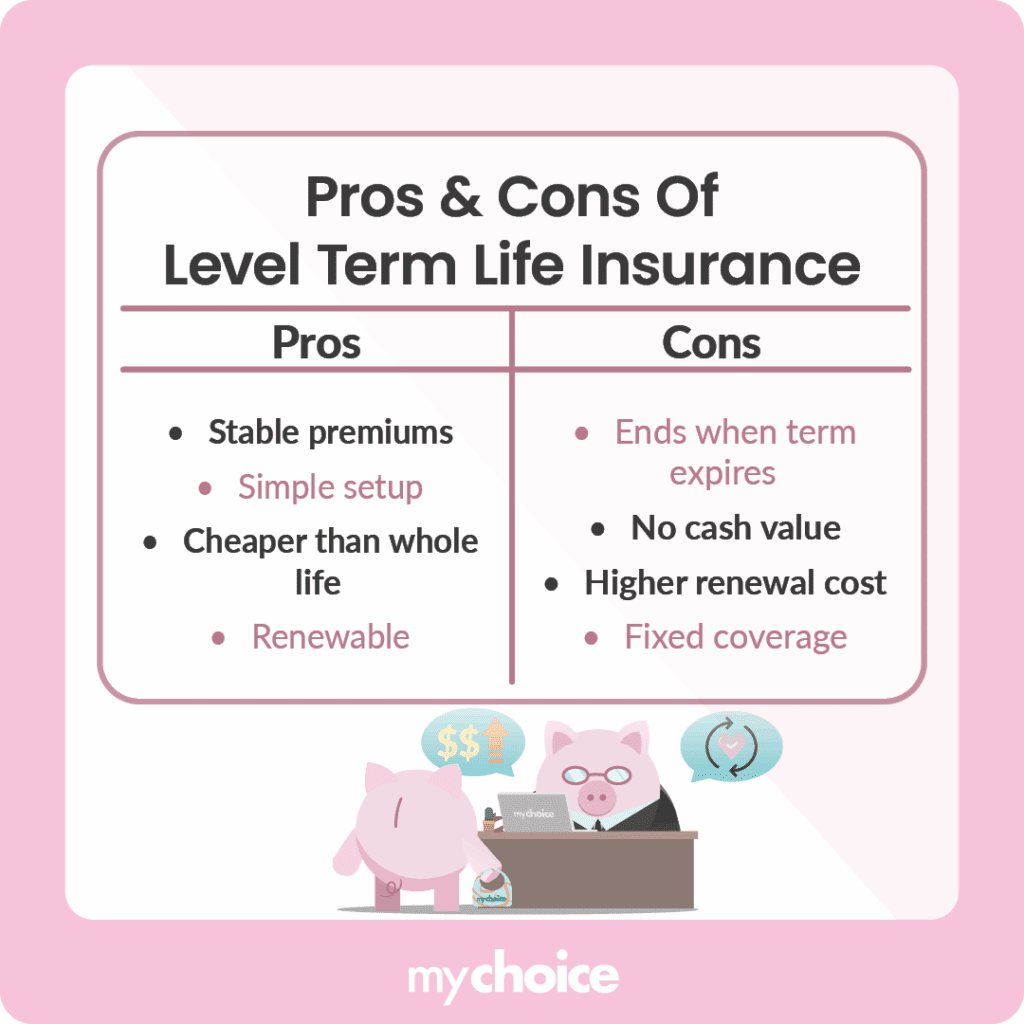
It may not meet your needs. Your coverage amount may be too high or too low if your responsibilities change. Renewals may be more costly. If it isn’t renewed, you’ll have to qualify for insurance, which isn’t guaranteed because of age and health. Finally, a level term policy has a stated expiration date, a predictable benefit and no cash-value component.
Pros:
According to FCAC, a level term policy may be less expensive than a permanent insurance policy. You can adjust the amount of insurance to match an appropriate replacement-income level. Your beneficiary can use the benefit for living costs, mortgage payments or any number of competing responsibilities.
Pros and Cons of Decreasing Term Life Insurance
Cons:
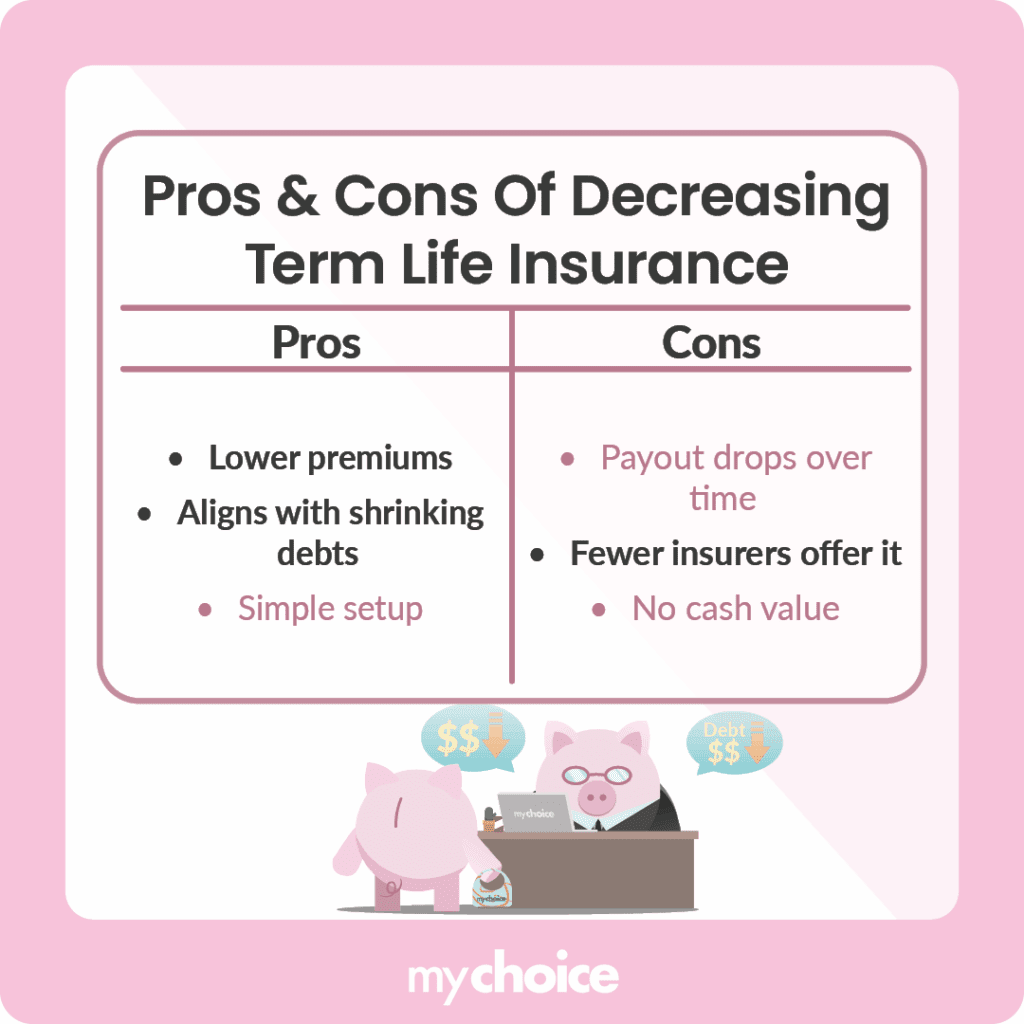
The decreasing amount may not track well with your mortgage, particularly in situations like paying the mortgage off faster, refinancing and renewals.
Pros:
A decreasing term policy can make sense when you know what your financial obligations are, since you’re not paying to keep the same death benefit throughout the term. However, it may not make sense if you need life insurance for other purposes, like income replacement and child care, that may not be adequately addressed by a decreasing death benefit.
Which One Should I Choose?
First, what is the basic requirement: What do you need? How much of it? By when? With these parameters defined, imagine likely changes in circumstances and use them to stress-test the product.
| If this changes | Question to test | Why it matters |
|---|---|---|
| Your health changes | Can the policy renew or convert, and until what age? Some policies can be renewed when they expire and/or converted to another type of coverage. Find out what those options are and what age limits apply. | A new application may cost more or may not be available. |
| The mortgage falls faster | Is this benefit based on the actual balance, or is it based on a different schedule? | You may be paying for a pattern that isn’t the pattern of the debt. |
| A child or spouse still depends on income | Once all of their debts are paid, will there be enough benefit remaining to cover their needs? | Covering mortgage payments may not be the same as having cash flow. |
Read More: Compare Renewable and Convertible Term Life Insurance
When You Might Need Level Term Life Insurance
Level term can cover income replacement needs, fund a child’s education, pay for childcare and cover several liabilities.
Be aware that provincial rules affect who can receive and manage the money. It’s best to ask about appointing an administrator or trustee to manage the funds for a minor, so you don’t assume the funds can be paid out to a child.
Read More: Explore Term Life Insurance Options
When You Might Need Decreasing Term Life Insurance
Compare with a smaller level policy, as price and coverage implications could lead to unexpected results. Decreasing term may be a good idea when the debt has a predictable falling balance, matching the insurer’s decline schedule with the loan’s amortization schedule, and when you don’t need the protection of a fixed benefit for your family.
Term Life Insurance Alternatives
Renewable term allows you to renew coverage at specific rates without providing evidence of insurability. Convertible term allows you to convert your term coverage to a permanent insurance product, usually by a certain date.
Keep in mind that not all term policies are renewable or convertible. When considering convertible term insurance, look at the amount you can convert, which policies you can convert to and the age when conversion expires.
Read More: Compare Term and Whole Life Insurance