









Life insurance is not like investing.
Life insurance can help you manage the financial risk of death while you’re covered. Investments help you build assets to use while you’re alive, though investment values go up and down. As a result, it’s important to recognize that investments and life insurance serve different purposes.
To compare the two choices without treating them as substitutes, our editorial team reviewed the Financial Consumer Agency of Canada’s insurance-needs guide, its life insurance guide, its investing basics guide, and FSRA’s explanation of term and permanent policies.
- how to assess your protection gap before looking at products;
- how term insurance with investments compares with permanent insurance;
- how to make sense of the guaranteed and non-guaranteed values of insurance; and
- how to avoid comparing investment and insurance using biased assumptions about returns.
Should You Buy Life Insurance Or Invest In The Market?
Generally, if others would have a hard time paying their living expenses, paying off debts or fulfilling financial obligations if you died, life insurance should be a higher priority. The main reason is that life insurance provides a death benefit when others need it most, something investments cannot provide.
Investing, on the other hand, builds wealth, but over a longer timeframe. So, investing may be the higher priority if others aren’t financially dependent on you and you have enough assets to cover estate expenses, final expenses, and debts.
This doesn’t have to be a black-and-white decision, however. For example, you could get a permanent life insurance policy or get a less expensive term policy and invest the difference. To make an apple-to-apple comparison, use the same death benefit, timeframe, fees, tax considerations and a realistic assumption for investment returns.
Estimate The Insurance Need Before Comparing Returns
Start with outstanding debts that must be paid, add death-related expenses, expenses to cover education and other care and support needs and income needed to keep your household running for an appropriate number of years. Then, subtract assets set aside to meet financial obligations and insurance that will continue in force. Use this number to help with your planning, as it is not necessarily the amount of insurance you need to buy.
Read More: Estimate How Much Life Insurance You Need
Can Permanent Life Insurance Be Used To Build Value?
Policyholders can generally access some of the cash value in the form of withdrawals and/or loans.
However, taking money out of a permanent life insurance policy is very different from making withdrawals from an investment or bank account. For example, whole life policies may pay non-guaranteed dividends and offer guaranteed cash values. Universal life insurance policies have an investment component and include insurance charges. Values go up or down based on deposits, investment performance, fees, etc.
Loans accrue interest. Loans, withdrawals, and policy surrenders reduce policy values. Outstanding loans reduce the death benefit. Loans, withdrawals, and policy surrenders may have tax consequences.
Read More: See When Whole Life Insurance May or May Not Be a Good Investment
Example: Term Insurance Plus Market Investing
| Assumed annual return | Annual amount invested | Value after 30 years |
|---|---|---|
| 3% | $4,500 | About $214,089 |
| 5% | $4,500 | About $298,975 |
| 7% | $4,500 | About $425,074 |
Suppose that you could save $5,000 at the end of every year for 30 years. If the quote for the required term insurance costs $500 a year, $4,500 could be saved in an investment account each year.
The table shows three assumed annual returns before fees and taxes. It is not a forecast. It also does not attempt to put a dollar value on the term insurance’s death benefit. To complete the illustration, you need to know what type of investment account it would be, which returns to use after fees, whether the term policy’s premium would increase when it renews, and, if so, how long you could continue to invest.
List the same items in your analysis of a permanent insurance policy at years 10, 20, and 30: total premiums, guaranteed and non-guaranteed cash values (surrender values), guaranteed death benefit, illustrated death benefit. Keep in mind that a 4% illustrated scale is not a guaranteed interest rate. Illustrated cash values and death benefits will not grow the way a deposit would at a single interest rate. Finally, show at least one illustration based on lower-than-illustrated investment and dividend scales.
Read More: Compare Term and Whole Life Insurance Before Investing the Difference
When Does Buying Life Insurance Make More Sense Than Investing?
Insurance is a priority when a person’s immediate death would leave a measurable shortfall because their assets are insufficient. This might include situations where there is a significant temporary obligation best suited to term insurance or a significant ongoing obligation best suited to permanent insurance, such as end-of-life expenses, liquidity for an estate, lifelong support of a dependant, or a buy-sell agreement, assuming the owner can continue paying on it.
Not all legacy or inheritance goals are best addressed with permanent insurance. Determining the value of permanent insurance involves comparing its benefits and costs, such as guaranteed death benefit and ongoing premiums, with an equivalent investment strategy, including growth potential and fees, taxes, liquidity, and lapse.
Is Investing Always Better If You Plan To Leave An Inheritance?
For inheritance, which is better, life insurance or investments?
There is no right answer – life insurance offers certain benefits from day one, and investments have the potential to grow. More importantly, assets don’t necessarily go through an estate. Investments may be made payable on death, held in joint tenancy or pass by way of a will. Life insurance may be paid directly to a beneficiary or to the estate.
The amount and tax implications of investments are dependent upon the type of investment and account. Life insurance proceeds depend on the policy terms and a valid claim.
Investments are generally more liquid, but life insurance requires premiums and offers a certain amount from day one.
Effective tax and estate planning is built around the types of assets, so never make assumptions based on types of financial products.
Main Reasons People Combine Insurance & Market Investments
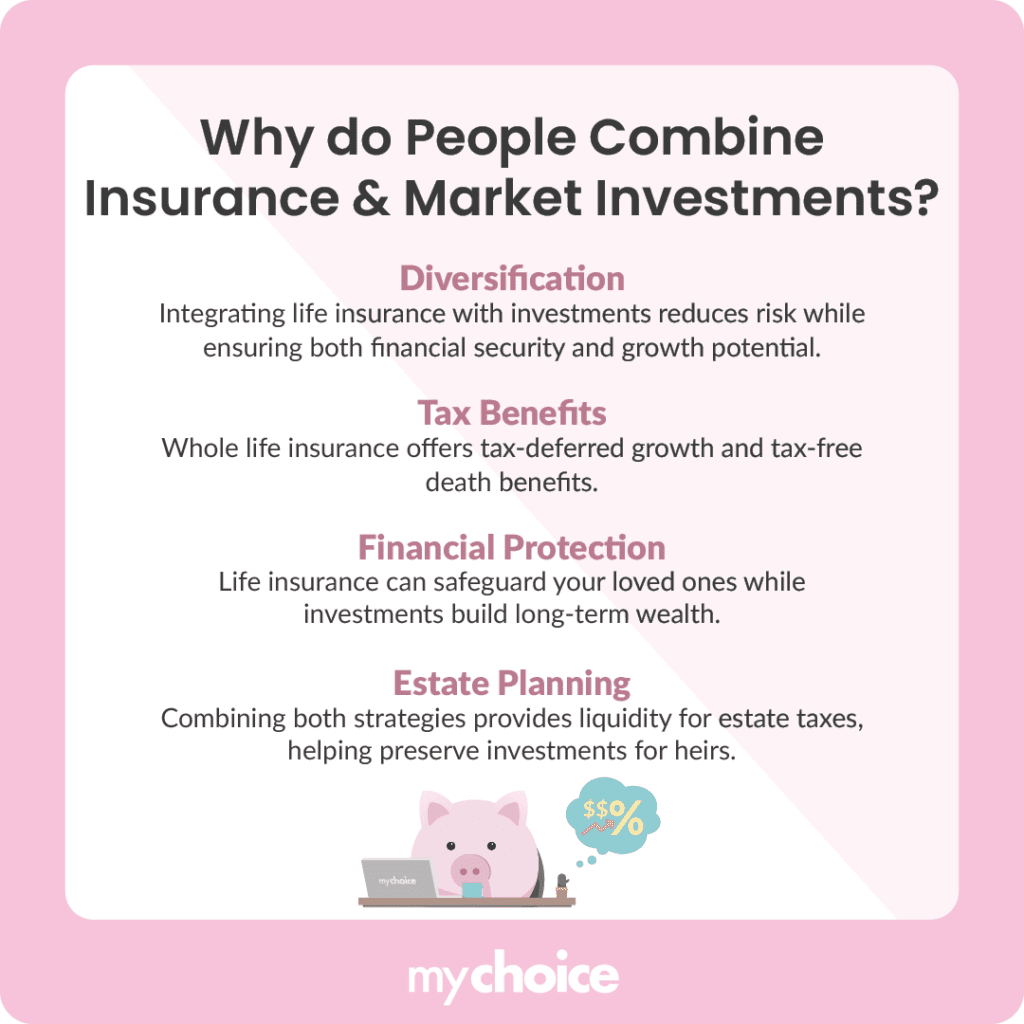
Many people need to insure mortality risk to a certain amount but also have savings or investment goals, such as retirement, education, legacy, etc. A common approach is to purchase term life insurance for the amount of protection needed and invest in markets for any other goals. Some people like to buy a small amount of permanent life insurance relative to their total financial goals and pair it with some level of market investing. There’s no right ratio for blending the two. Each person’s ratio would be unique. In general, make sure you have enough life insurance to cover your protection gap, and don’t reduce your protection just to make room to invest.
When comparing options, don’t just look at investment performance; also consider fees/charges for investment management, taxes, liquidity, etc. Revisit your strategy over time, for example, once kids are on their own, once the house is paid off, if you sell the business, if you want to increase the legacy component, etc.
Questions To Ask Before Choosing
- How much money would be needed because of your immediate death that isn’t provided for by current insurance or assets?
- Is the need for insurance temporary, permanent, or likely to change? When should it be reviewed?
- Which features are guaranteed, such as death benefit, cash value, or premiums? Which ones depend on a rate of return that isn’t guaranteed (dividends, investments)?
- How do the features compare to other types of insurance or investments? What fees will you pay for investments? How are returns taxed? What rate-of-return assumptions were used?
- What happens if you stop paying, borrow against it, take money out, replace it with another product, or cancel (surrender) it?
- If the product is being pitched to you by an advisor, do they have a license for the type of insurance or securities they’re recommending? How does the person who recommends this product get paid?