









In this guide, we’ve incorporated information from the federal health-insurance guide as well as the federal life-insurance guide. We’ve also referenced CRA’s current private health services plan guidance as well as CRA’s health spending account warning.
Life insurance and private health insurance both provide financial protection against different gaps. It’s important to remember that not everyone requires both of these insurance policies as some costs are covered by your provincial programs and/or any workplace insurance provided by your employer. Both policies also have different ways of providing payments. Before you buy additional coverage, identify which risks, such as death, treatment, or income-loss, are not adequately covered in your province or through work.
Do Canadians Need Both Life And Health Insurance?
Should all Canadians have life and private health insurance? Not necessarily. Carrying both types when you do not need them costs extra without closing a gap.
If you have dependants, final expenses or debts that would not be covered when you die, life insurance makes sense.
Private health insurance makes sense when prescription drugs, dental, vision, medical equipment, paramedical or travel costs are not adequately covered by a territorial, provincial, workplace or partner’s plan.
Life Insurance Vs Health Insurance: Key Differences
| Coverage | Risk addressed | How payment usually works | Limits to check |
|---|---|---|---|
| Provincial or territorial health plan | Medical services that are eligible for public insurance. | The public plan pays certain services under provincial rules. | Check eligibility criteria, waiting periods and excluded services. |
| Workplace or personal supplementary health | Eligible health expenses may not be fully covered by public healthcare. | Payment goes to the insured as reimbursement or to the provider, depending on the plan. | Check deductibles, coinsurance, annual maximums, exclusions and network restrictions. |
| Life insurance | Addresses the financial implications of the insured person’s death. | Life insurance pays a lump-sum death benefit to the beneficiary while the policy is in force. | Check the coverage amount, term, exclusions, beneficiary and premium. |
| Disability insurance | Replaces employment income lost because of disability. | Benefits are paid periodically after the policy definition and waiting period are met. | Check the occupation definition, percentage, offsets, exclusions and benefit period. |
| Critical illness insurance | Addresses the financial implications of a specifically defined diagnosis. | A lump sum is paid if the covered definition and contract conditions are met. | Check the illness definition, severity, survival period, exclusions and partial benefits. |
Private health insurance does not necessarily pay for all of the costs of medical treatment. Some plans pay a certain percentage of costs; some impose a deductible or cap the amount that can be reimbursed during the year. Some will not pay for a drug, condition, provider or service.
Map The Gap Before You Buy
| Risk | Resources you already have | Remaining shortfall |
|---|---|---|
| Death of you or your partner | When you’re reviewing life insurance, tally your savings, life insurance through work, survivor income, pensions and individual policies you already have. | Before buying coverage, identify the gap by adding debts, final expenses, income needs and caregiving needs. |
| Prescription, dental, vision or equipment expense | Your resources may include a public plan, workplace plan, your partner’s plan and a health spending account. | Calculate the eligible cost you expect to pay after deductibles, coinsurance and annual maximums. |
| Unable to work | Map all sources of income protection, including employer sick leave, a disability plan, EI sickness benefits and emergency savings. | Identify your monthly income gap and how long you expect it to last. |
| Covered critical diagnosis | Look at your savings, health plan and disability coverage. Where are the gaps in your protection? | What one-time costs do you foresee for leave, travel, care or home modifications? |
| Long-term care need | Before buying, consider all sources of help, including public programs, savings and family support. | Consider the care setting, eligibility, waiting time and monthly cost before buying. |
Read More: Compare Accident Insurance With Life Insurance
How Life And Health Insurance Work Together In Real Life
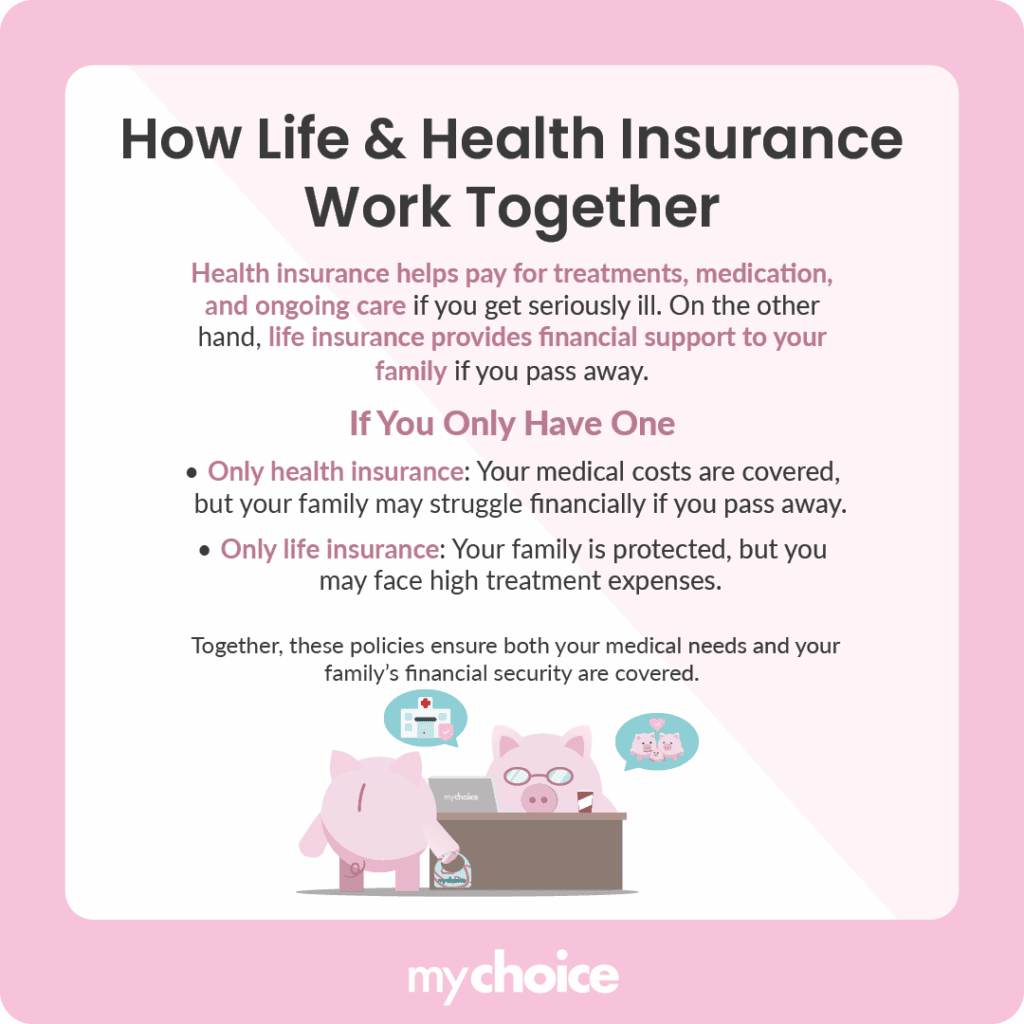
For example, say your workplace health insurance plan covers prescription drugs. If you fill a covered prescription, your plan may reimburse you for a portion of the cost after the deductible and coinsurance. However, health insurance doesn’t cover lost income if you’re unable to go to work because of an illness. That’s where disability insurance can help.
Read More: Compare Life Insurance Options
Say your household has one dependant and a mortgage. If you die while a life insurance policy is active, the beneficiary can use the death benefit to continue making mortgage payments and pay household expenses. How the beneficiary uses the death benefit is up to them. Life insurers typically don’t pay the mortgage.
How Your Needs Change
| Change | Check life coverage | Check health and income coverage |
|---|---|---|
| First job or job change | Group amount, portability, conversion options and dependant needs can all change over time. | Review drug, dental, vision, disability and coordination rules as your needs change. |
| New dependant | Income, caregiving, education and term duration | Changes in your needs may affect dependant eligibility. Check the enrolment deadline and out-of-pocket care costs. |
| Mortgage or major debt | Review the survivor repayment plan against available assets as needs change over time. | Check disability benefits and emergency funds available for payments while you’re alive. |
| Self-employment | As your situation changes, so might your insurance needs. Sometimes, that means a personal policy replacing employer life. | Consider individual health and disability coverage, along with a valid PHSP structure. |
| Retirement | As needs change over time, review remaining dependant, tax and estate needs, and any final-expense shortfall. | You won’t have the same benefits from work. Think about how your needs for drugs, dental, travel, and other types of care will change. |
Age by itself doesn’t determine the appropriateness of different kinds of insurance. Appropriate types of term, permanent, health, critical-illness and long-term-care insurance depend on need, eligibility, contract terms and affordability.
The Overlap Products Worth Considering
Critical Illness Insurance
Critical illness insurance is not ordinary health insurance that reimburses medical costs. It can pay a lump-sum benefit after diagnosis only if the condition matches the policy’s definition and any survival period is met.
Read More: See How Critical-Illness Insurance Works
Disability Insurance
It may replace part of your employment income if you meet the conditions of the policy’s definition of disability. Check the waiting period, benefit period, occupation definition, offsets, exclusions and tax treatment.
Accelerated Or Living Benefit
Some life insurance policies let you receive an advance in narrowly defined circumstances, such as terminal illness. These options are not universal.
An advance reduces the amount of life insurance left on the policy. Check your policy’s accelerated-benefit rider and ask whether interest, fees or creditor issues apply.
Read More: See How Life Insurance May Be Used While Alive
Health Spending Account
Depending on the design of the plan, employment situation, and the eligible medical expenses involved, a health care spending account may be a component of a valid private health services plan.
However, the CRA warns taxpayers that arrangements marketed to sole proprietors without arm’s-length employees do not qualify as private health services plans. Seek independent tax advice before treating reimbursements or costs as tax-free or deductible.
Questions To Ask Before Buying
- What cost or loss of income are you protecting against, and how wide is the gap?
- Which benefits are already available through your provincial, workplace and partner’s plans?
- Which deductibles, coinsurance, annual maximums, waiting periods, exclusions and pre-existing-condition rules apply?
- Can you combine benefits with another plan, and which one pays first?
- Does coverage continue if you leave work, retire or move to another province?