









‘Accident insurance’ refers to more than one type of insurance. Examples include AD&D, fixed-benefit personal accident plans and accident and sickness plans. Accident insurance differs from life insurance, which pays a death benefit under the terms of the insurance contract, and from disability insurance. In this guide, we’ll compare accident insurance to life insurance and disability insurance.
We referred to the Financial Consumer Agency of Canada’s life-insurance guide, the Financial Consumer Agency of Canada’s disability-insurance guide, FSRA’s guide to reading a life or health policy and FSRA’s statutory insurance-class definitions as we prepared this guide.
What Is the Difference Between Accident Insurance and Life Insurance?
Life insurance pays your beneficiary when the insured dies while the policy is in force, assuming no exclusions or policy terms prevent a payout.
Accident policies pay out only if an accident leads to certain results. The results could be accidental death, loss of a limb or body function, hospitalization, medical expenses or some other specific, often fixed payment.
Accidental Death and Dismemberment (AD&D) coverage, which pays out specific sums for specific losses, is not disability coverage that replaces some of your income when illness or injury prevents you from working.
Ask for the benefit schedule and definition of accident. Don’t be fooled by policy titles.
Accident Insurance vs Life Insurance: Key Differences
| Product | Main trigger | Who receives money | Main limitation |
|---|---|---|---|
| Life insurance | Pays if death occurs while the policy is in force, subject to its terms. | Named beneficiary or estate | Payment under a policy is not required simply because the insured was injured. |
| AD&D | Means accidental death, dismemberment, loss, or paralysis as specified. | Beneficiary in case of death or the insured in case of a qualifying injury. | Illness and unspecified injuries do not meet the main trigger. |
| Fixed-benefit accident plan | Covers a scheduled accident, injury, medical treatment or hospitalisation, as applicable. | Usually the insured person | Payment of the applicable scheduled benefit does not necessarily pay the total expense or loss of income. |
| Disability insurance | Means illness or injury which results in incapacity to work as defined in the policy. | The insured person | The terms are subject to waiting periods, offsets, maximums and benefit periods. |
How the Products Can Respond in Common Scenarios
| Scenario | Policy to check first | Important limit |
|---|---|---|
| Death from cancer | Life insurance | Claims resulting from illness are not payable under AD&D or accident-only death insurance. |
| Death in a covered vehicle collision | Life insurance and any AD&D coverage | All contracts must be in force, and the event must meet the definition of accident under each contract. |
| Broken leg with no time off work | Fixed-benefit accident plan, if listed | Receiving a benefit is not guaranteed, and the benefit may be less than the costs actually incurred. |
| Unable to work after an injury | Short-term disability or long-term disability coverage | Payments are subject to the definition of disability, a waiting period and offsets. |
| Medical and rehabilitation costs after an auto collision | Applicable provincial auto accident benefits, workplace plans and/or health plans | A personal accident policy is not a substitute for automobile insurance required by the rules of various provinces. |
Read More: Compare AD&D Insurance With Other Protection
How Premiums and Benefits Differ
Accident-only protection may be less costly because it is triggered by a more limited circumstance. The amount, length of time, and other benefit terms should be similar before making a cost comparison. Exclusions must be similar, as well. In addition, not all accident insurance replaces income.
Don’t assume high-risk activities automatically raise the cost of life and accident insurance. Life insurance is rated by policy type, health, coverage amount, smoking status, and age. Accident insurance is rated by benefit type, age, occupation, activities, etc. Rather than charging more for risky hobbies, some carriers exclude the activity, limit the benefit or may decline to insure. Ask the carrier and get their response in writing.
How to Choose the Right Coverage
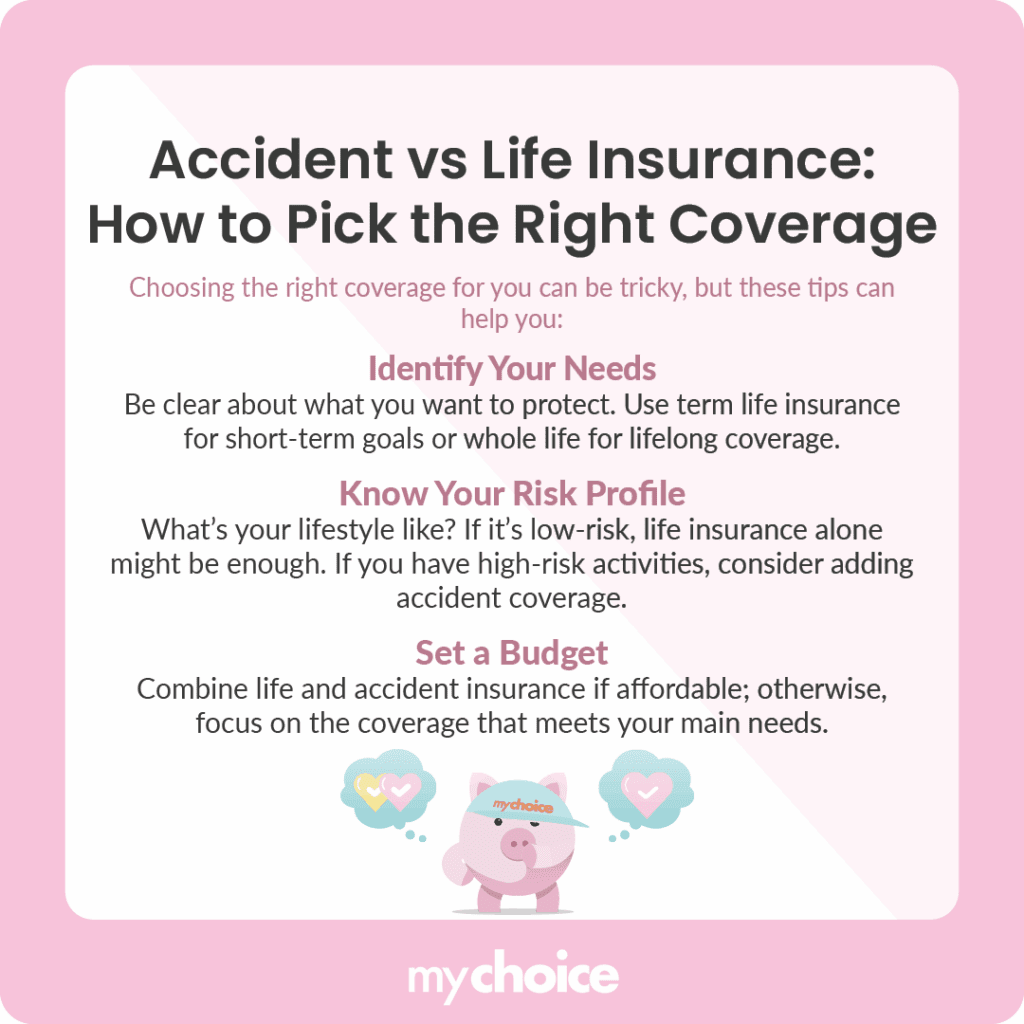
Identify Your Insurance Protection Needs
Life insurance is for needs at death, such as income replacement, providing for your dependants, debts, final expenses, and liquidity.
However, you may well have large financial needs if you’re injured and alive: medical expenses, home care, lost income, etc.
Understand Your Risk Profile
List the types of coverage you have from other sources, such as from your employer, provincial workplace benefits, or auto accident benefits, noting any benefits that may be lost when you change jobs. Read your policies, noting exclusions and the policy’s definition of an accident. Consider your job and personal risks, including work-related duties, hobbies, sports, and travel.
Set a Budget
Always focus on the size of the gap rather than the price of the insurance.
If someone supports their family with their income, adequate disability and life insurance may provide more protection than accident insurance.
Have enough cash on hand to pay waiting periods, deductibles and uncovered expenses.
When Might You Want Both?
If an accident causes expenses that aren’t covered by your health insurance, auto insurance, workplace benefits or disability policies, and if the accident and injuries are covered, accident insurance can help.
However, AD&D insurance isn’t a replacement for death benefits under a life insurance policy that your family counts on no matter how you die. If you die from a covered accident, AD&D insurance and life insurance can both pay benefits, depending on the terms of the insurance contracts.
Read More: See Whether Critical Illness Insurance Is Worth It
How AD&D Fits Within Accident Coverage
Accident policies have similar-sounding names. For example, insurers market AD&D as accident insurance. Other sellers offer broader accident-and-sickness or fixed-benefit plans with similar-sounding names. Similar names don’t necessarily describe similar products.
Before you buy, ask the seller what events the policy covers and the benefits it pays. Ask about:
- What counts as an accident, and what doesn’t
- Whether it pays upon accidental death, specific injuries, medical treatment, hospitalization, loss of income, or some combination
- Whether benefits are a specific amount, a percentage of a specific amount, actual expenses, or an income paid monthly
- The length of any waiting period, how long after an accident benefits are payable, maximum issue or termination ages, and renewability provisions
- How benefits are affected by employer-provided coverage, auto insurance, workers’ compensation, or disability insurance