








How to Calculate and Withdraw Cash Value From Life Insurance

3 minutes can save you hundreds. Enter your postal code below and join thousands of Canadians saving on life insurance.

Secure. No Spam. No Fees.

Why You Can Trust MyChoice

MyChoice serves as an independent intermediary between you, financial institutions and licensed professionals without any additional charge to our users. In the interest of transparency, we disclose that we partner with some of the providers we write about – we also list many financial services without any financial gain. MyChoice does not operate a financial institution or brokerage and to ensure accuracy, our content is reviewed by licensed professionals. Our unique position means that we hold no recurring stake in your policy, ensuring our mission to help Canadians make better financial decisions is free of bias or discrimination. 

Last updated on March 03, 2026

4 minute read

MyChoice follows a strict content review process designed to ensure reliable and unbiased information.

How Cash Value Life Insurance Works at a Glance

  • Cash value life insurance refers to permanent policies (i.e. whole life, universal life) that combine a death benefit with a tax-deferred savings component.
  • The cash value within your policy grows tax-deferred, and growth rates depend on the policy type and insurer terms.
  • You can access cash value through policy loans, withdrawals (partial surrenders), or full surrender.
  • Here’s how to calculate the cash value of your policy: Cash Surrender Value = Cash Value − Surrender Charges − Outstanding Policy Loan Balance − Other deductions (unpaid premiums, admin fees, etc.).
  • Withdrawals may trigger a taxable event if they exceed the policy’s adjusted cost basis (ACB).

Cash Value Life Insurance Explained

If you’ve ever found yourself wondering “what is cash value life insurance, exactly?” then you’ve come to the right place.

Simply put, cash value life insurance is an umbrella term used to refer to permanent life insurance policies (such as whole life or universal life) that contain a cash value component. It combines the traditional death benefit (the amount paid out to beneficiaries upon the policyholder’s death) with an investment or savings element. 

Because of this, premiums for cash value life insurance in Canada can be higher than their term life counterparts. As you make these regular payments, the policy’s tax-deferred cash value begins to grow. Part of each premium payment goes toward the cost of insurance and another portion builds cash value; this growth is tax-deferred. The growth rate depends on the type of policy and the insurer’s terms.
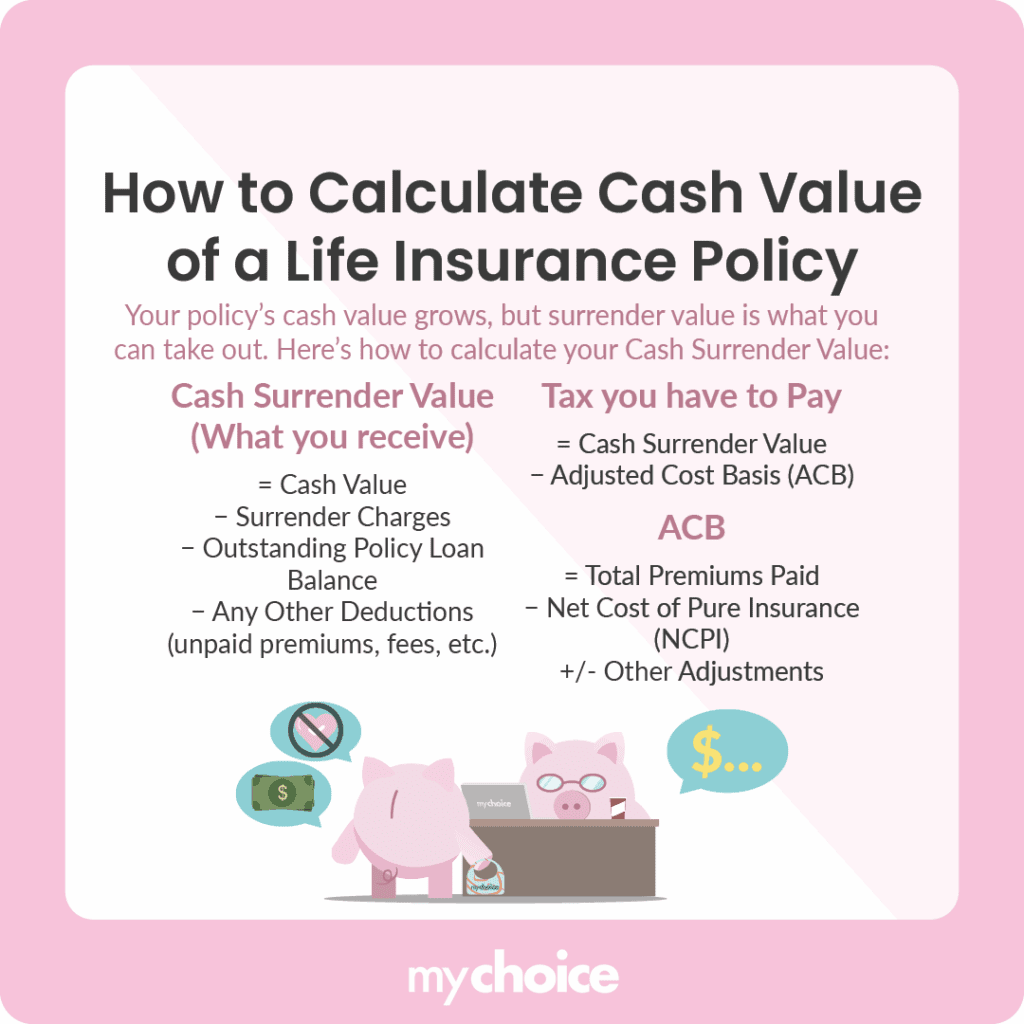
How to Calculate Cash Value of a Life Insurance Policy

How to Withdraw from The Cash Value

The cash value of a life insurance policy can be accessed by the policyholder during their lifetime, providing a versatile financial resource that can be used for various purposes. 

Policyholders can access the cash value of their life insurance in several ways:

Policy Loans:

This is when policyholders borrow against the cash value. These loans don’t require credit checks, and loan proceeds are not immediately taxable, but unpaid loans reduce the death benefit and can be used for any purpose, such as paying premiums or covering personal expenses.

These have to be paid back eventually, since these loans diminish the overall death benefit or cause the policy to lapse

Withdrawals:

In this case, you would be taking direct withdrawals from the cash surrender value, which may affect the death benefit and can trigger tax if above the adjusted cost basis. Withdrawals are generally taxable if they exceed the policy’s adjusted cost basis; amounts up to the adjusted cost basis may not trigger tax.

In some cases, these are called “partial surrenders” since you’re giving up the death benefit, but this is largely case-specific. Regardless, there’s usually a maximum amount you can withdraw from your policy.

Paying Premiums:

Another good use for the policy’s cash value is to fund future premium payments, potentially reducing out-of-pocket costs, but it may slow cash value growth. This can be an excellent strategy when you hit retirement age, since it keeps the policy in force while avoiding taking from your pension or retirement savings. 

Surrendering A Policy For Cash Value

Surrendering a policy allows access to cash surrender value, but you may face surrender charges and taxes on gains above the adjusted cost basis.

But if you’re past the point when surrendering your policy incurs large fees because of the plan’s age, you’re able to choose between a lump sum payment or incremental payments. However, some policies don’t allow for this level of flexibility and will have the terms laid out in your contract. 

Different Kinds of Life Insurance With Cash Value

Cash value components vary by policy type. Common permanent policies that include cash value are: whole life, universal life, indexed universal life, and variable universal life.

Variable universal life insurance allows cash value to be invested in sub-accounts. The cash value and potentially the death benefit can vary with investment performance.

As a general rule, this type of policy offers potential for higher returns but comes with greater risk compared to other types of cash value life insurance.

Indexed universal life insurance credits interest based on an index’s performance (S&P 500 or the S&P/TSX), but does not invest directly in the stock market.

This provides an opportunity for cash value growth based on market performance, with typically some level of protection against market losses.

Universal life insurance provides flexibility in premium payments and death benefits within limits. Cash value growth depends on interest rates or investment performance.

Whole life insurance offers a guaranteed death benefit and a guaranteed cash value growth formula set by the insurer.

Premiums are fixed for the life of the policy, providing stability and predictability. This makes it a good option for folks who want to “set it and forget it.” Its predictable nature also makes it a feasible option for people who just want to build a safety net later in life. 

In short, whole life insurance typically has higher premiums compared to other types of life insurance, but it offers the most certainty in terms of benefits and cash value accumulation.

Guaranteed issue life insurance is a form of whole life insurance that doesn’t need a medical exam or health questions, ensuring you can’t be denied coverage.

While it might build some cash value over time, the coverage amounts are typically modest, resulting in a relatively small cash value. This type of policy often comes with a graded death benefit, meaning if the insured person passes away within the first two or three years (unless due to an accident), the beneficiaries won’t receive the full payout.

Key Advice from MyChoice

  • Use cash value for short-term needs only when necessary. Borrowing reduces the cash value and death benefit, and unpaid loans accrue interest that further erodes value over time.
  • Factor in tax and fees before accessing the cash value. Cash value withdrawals or policy surrender may trigger taxes on gains and surrender fees, especially if done early.
  • Treat cash value as a living benefit, not a replacement investment. While you can access the cash value during your life, using it for lifestyle investments (like market investing) should be weighed against the loss of guaranteed protection and the cost of lost policy growth.

With over 7 years in the insurance industry, Matt focuses on home and life insurance, offering sharp analysis and insights on underwriting trends, coverage structures, and how market changes impact consumers.

Congratulations! You made it to the end!

Now, here is the easy part: complete your quote in under 2 minutes

Discover More About

March 6, 2026
Learn how rising multigenerational housing in Canada can create life insurance coverage gaps and why adult children may need their own policy.
February 20, 2026
Canada’s opioid crisis continues to reshape life insurance risk. Learn how sobriety timelines and underwriting rules affect your coverage options.
February 6, 2026
Canada’s obesity rates rose 10.9% since 2020. Learn how BMI affects life insurance eligibility, premiums, and why applying earlier can lock in lower rates.