








The Cost of Procrastinating on Buying Life Insurance

3 minutes can save you hundreds. Enter your postal code below and join thousands of Canadians saving on life insurance.

Secure. No Spam. No Fees.

Why You Can Trust MyChoice

MyChoice serves as an independent intermediary between you, financial institutions and licensed professionals without any additional charge to our users. In the interest of transparency, we disclose that we partner with some of the providers we write about – we also list many financial services without any financial gain. MyChoice does not operate a financial institution or brokerage and to ensure accuracy, our content is reviewed by licensed professionals. Our unique position means that we hold no recurring stake in your policy, ensuring our mission to help Canadians make better financial decisions is free of bias or discrimination. 

Last updated on October 15, 2025

3 minute read

MyChoice follows a strict content review process designed to ensure reliable and unbiased information.

The Cost of Delaying Buying Life Insurance at a Glance

  • Purchasing coverage early will lock in lower premiums and more favourable policy terms. Delaying this decision can result in considerably higher costs and limited choices later in life.
  • Many Canadians delay buying life insurance due to misconceptions about affordability and the belief that coverage isn’t necessary until later in life.
  • For 10-year term life insurance policies, premiums increase 25.01% for men and 30.43% for women between the ages of 30–39 and 40–49.
  • The biggest jump occurs later in life. Between the ages of 40–49 and 50–59, term-10 life insurance premiums surge 112.89% for men and 96.79% for women.
  • Longer-term policies experience even steeper increases. Term-20 premiums jump 52.72% for men and 56.09% for women between the ages of 30–39 and 40–49.
  • Many insurers limit or stop offering 30-year term policies after age 60, significantly reducing available coverage options.

Why People Procrastinate Buying Life Insurance

Life insurance can be a vital safety net for your family, covering essential expenses and outstanding debts after your passing. It helps ease the financial burden and provides stability when they need it most. Here are the top reasons why, despite this, many individuals still tend to push back on investing in this financial cushion:

The belief that they’re too young and healthy:

People assume that, while they’re still young and in good health, life insurance shouldn’t be their primary concern. As you age, health conditions may develop that can increase premiums or make qualifying for certain life insurance policies more difficult.

Cost concerns and financial constraints:

Some people may perceive the cost of life insurance as a barrier, even though it’s more affordable when purchased at a younger age. Economic uncertainty and fears of budget strain lead them to put off buying coverage.

Lack of life insurance knowledge:

With countless coverage options on the market, it can be difficult to determine the best choice without the right knowledge. You may find the array of policy types, coverage options, and underwriting criteria overwhelming.

The Consequences of Delaying To Buy Life Insurance

Deferring the decision to purchase life insurance can have lasting financial implications:
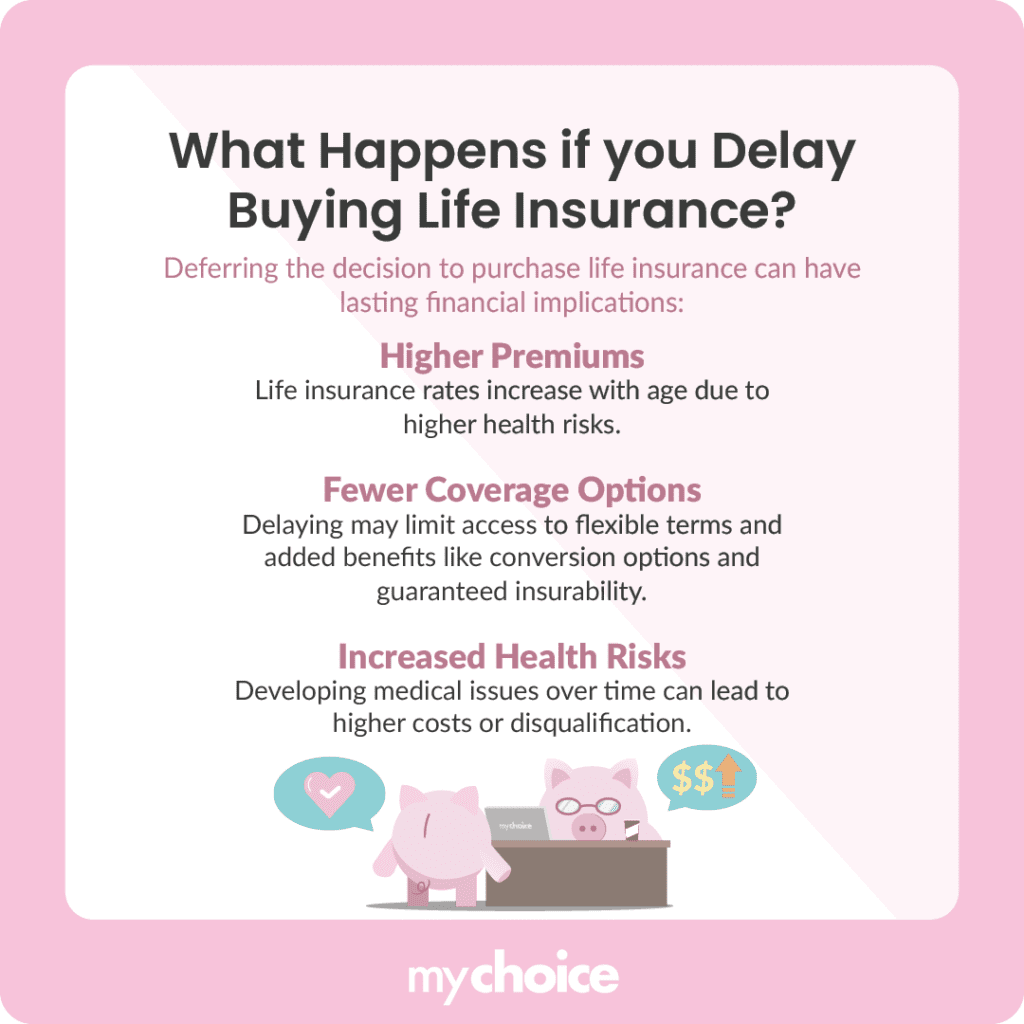
Increased premiums

As you age, life insurance rates typically rise due to heightened health risks and shorter life expectancies. A healthy 30-year-old might secure a $500,000 term life insurance policy for an estimated monthly premium that is significantly lower than what a similar applicant in their 50s would face.

Limited coverage options

Postponement may restrict access to policies with flexible terms and additional benefits. Conversion options, guaranteed insurability riders, and additional benefit riders are a few examples of the perks you could miss out on.

Health underwriting challenges

Over time, medical issues can develop that may lead to higher costs or even disqualification from certain plans. Early action can help you avoid higher premiums or coverage restrictions that may result from medical underwriting later in life and secure more favourable terms.

What Happens If You Buy Life Insurance Later

How Much Can Waiting To Buy Life Insurance Cost You In The Long Run?

Below is a summary of the average increase in life insurance policy costs from one age group to another. This is based on a $500,000 coverage policy for non-smoking policyholders in Ontario, categorized by gender. The policy premiums rise significantly with age, underlining the importance of getting life insurance while young.

Term 10 Monthly Premium Changes 

Age GroupAverage Premium
Increase (Men)
Average Premium
Increase (Women)
from 20-29 to 30-39+2.79%+4.69%
from 30-39 to 40-49+25.01%+30.43%
from 40-49 to 50-59+112.89%+96.79%
from 50-59 to 60-69+179.11%+174.63%
Source: MyChoice Quote Database, term-10 life insurance policies

Note: Securing a Term 10 policy in your 20s or 30s offers cost-effective coverage while you’re still young and healthy, whereas individuals in their 50s or older should evaluate their financial obligations and determine if a longer-term policy would be a better fit.

Term 20 Monthly Premium Changes

Age GroupAverage Premium
Increase (Men)
Average Premium
Increase (Women)
from 20-29 to 30-39+2.30%+7.47%
from 30-39 to 40-49+52.72%+56.09%
from 40-49 to 50-59+154.80%+137.87%
from 50-59 to 60-69+198.72%+212.11%
Source: MyChoice Quote Database, term-20 life insurance policies

Note: A Term 20 policy can offer a balance of affordability and coverage for those in their late 30s or early 40s, while those nearing retirement should reassess their financial needs and coverage requirements.

Term 30 Monthly Premium Changes

Age GroupAverage Premium
Increase (Men)
Average Premium
Increase (Women)
from 20-29 to 30-39+28.82%+32.34%
from 30-39 to 40-49+95.67%+98.23%
from 40-49 to 50-59+165.39%+150.48%
from 50-59 to 60-69N/AN/A
Source: MyChoice Quote Database, term-30 life insurance policies

Note: Securing a term life insurance policy can be difficult for those over 60 due to higher risk factors. If you’re under 40 with long-term financial commitments like a mortgage or children’s education, a 30-year term policy offers affordable protection. Older applicants may need to consider shorter-term or permanent options.

How To Get Started Today

Getting life insurance doesn’t have to be complicated. With the right approach, it can be a smooth process. Here are some practical steps to help you get started.

Assess your coverage needs

Start by evaluating your financial responsibilities, including debts, living expenses, and future obligations. Understanding your needs will guide you in choosing an appropriate policy.

Utilise comparison tools

Use life insurance rate comparison tools like MyChoice to explore different policy options. These tools provide a clear overview of available rates and coverage details, enabling you to make an informed decision.

Educate yourself on policy types

The right life insurance policy depends on factors like your budget, long-term goals, and coverage needs. Understanding the differences between term and permanent policies can help you make an informed choice that fits your situation.

Consult a professional

If you have questions or unique circumstances, consider seeking advice from a financial advisor. Professional guidance can help tailor a plan that best suits your needs and budget.

Key Advice From MyChoice

  • Choose a permanent life insurance policy for long-term financial planning with living benefits.
  • Consult a financial advisor to determine the most cost-effective option for your needs. They can help you choose the right policy based on your financial goals.
  • Compare policy fees, premiums, and other costs against its potential financial gains. If you already have an existing policy, review it regularly to use it optimally.
  • Borrow only what you can afford to repay. Regularly monitor the loan balance and ensure your policy doesn’t lapse.

With over 7 years in the insurance industry, Matt focuses on home and life insurance, offering sharp analysis and insights on underwriting trends, coverage structures, and how market changes impact consumers.

Congratulations! You made it to the end!

Now, here is the easy part: complete your quote in under 2 minutes

Discover More About

March 27, 2026
Learn how Medical Assistance in Dying (MAID) impacts life insurance in Canada, including claim eligibility and policy exclusions.
March 6, 2026
Learn how rising multigenerational housing in Canada can create life insurance coverage gaps and why adult children may need their own policy.
February 20, 2026
Canada’s opioid crisis continues to reshape life insurance risk. Learn how sobriety timelines and underwriting rules affect your coverage options.