









Wondering how a high-risk job or hobby impacts life insurance applications and underwriting?
When insurers review your application, they consider everything from specific job duties, experience, and location to safety practices, frequency, and personal history.
Can You Get Life Insurance With a Risky Job or Hobby?
It depends on the insurer and the evidence. Applicants may be offered coverage at standard terms, at a higher premium or with temporary or permanent extra terms. An insurer may also postpone or decline the application.
Applicants may have the same job title but may be offered different terms because they undertake different duties and have different exposures.
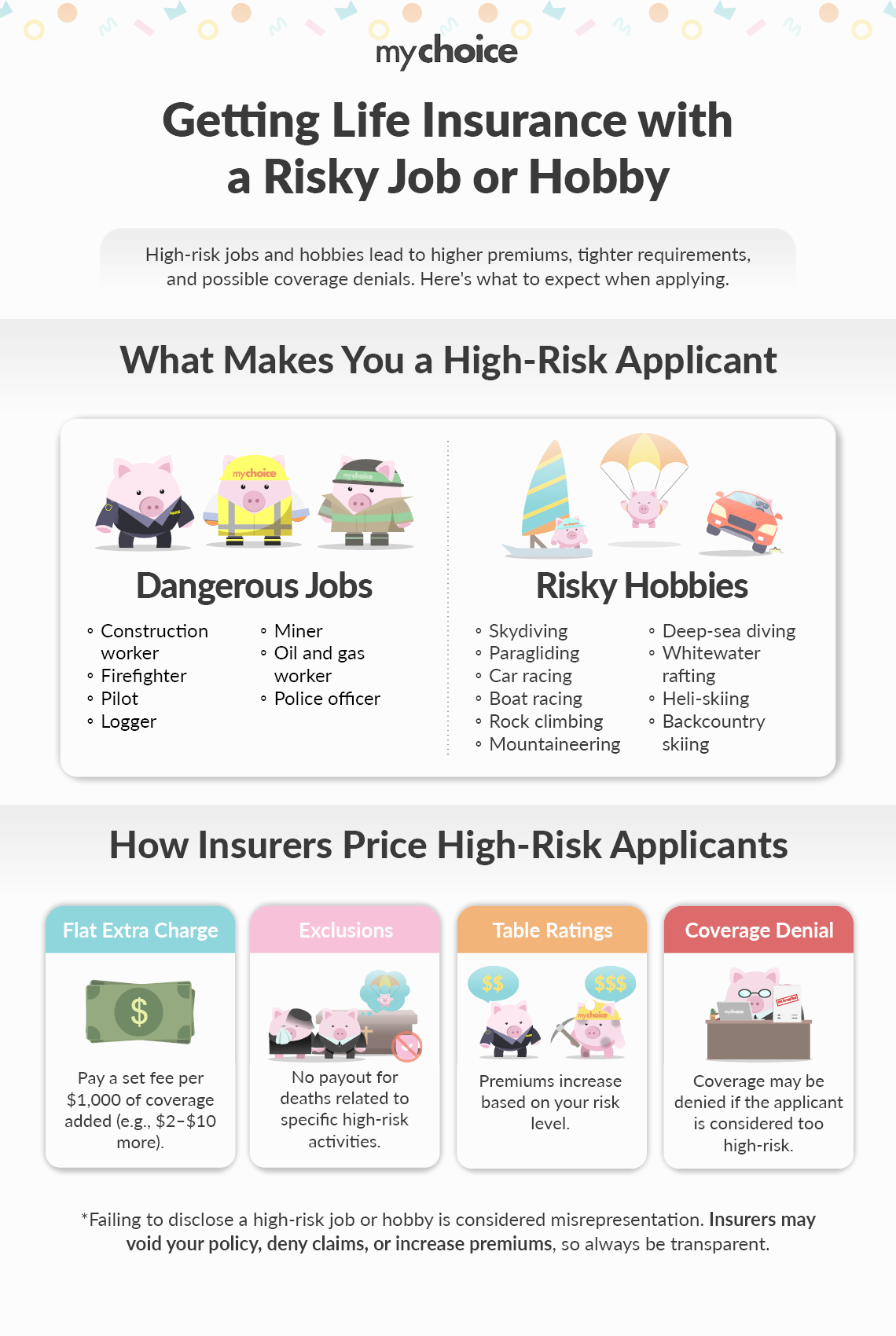
What do Insurers Consider a Dangerous Job?
Insurers consider a high-risk job to be one where there’s a higher likelihood of accidents, injuries, disability and death. If you fall into one of the following job categories, you’ll likely face higher life insurance premiums, tighter eligibility requirements and possible coverage denials.
High-risk or dangerous jobs include:
- Construction worker
- Firefighter
- Pilot
- Logger
- Miner
- Oil and gas worker
- Police officer
What do Insurers Consider a High-Risk Hobby?
A high-risk hobby is one that can lead to injury or death. The hobbies considered high risk by insurance companies are:
- Aviation: Piloting a plane, skydiving, paragliding, hang gliding
- Motorsports: Car, boat or snowmobile racing
- Adventure sports: Caving, bouldering, rock climbing, mountaineering, spelunking
- Water sports: Deep-sea diving, free diving, jet skiing, white water rafting
- Winter sports: Heli-skiing, backcountry skiing, snowboarding off-piste
- Any hobby involving elevated physical danger or extreme conditions.
How do Insurers Evaluate High-Risk Applicants?
During the underwriting process, insurers assess your level of risk. They do this by examining your medical history, your job, the types of hobbies you engage in and your lifestyle. Insurance representatives may require specific information from you after you apply for life insurance.
This might include:
- Your job duties
- Your work environment
- What safety protocols and practices are in place
- Your personal workplace safety and accident history
- The types of high-risk hobbies you participate in
- Your health and injury status
- Information about previous life insurance applications.
How Insurers Underwrite High-Risk Life Insurance Applications
Insurers typically charge a premium for high-risk occupation insurance.
- Flat extra charge: One option is to apply a flat extra rating, which is a set amount charged per $1,000 of coverage. For example, someone might pay $2 to $10.00 more per $1,000 of insurance than an average-risk applicant.
- Exclusions: Another option is to offer insurance but to include exclusions, such as excluding coverage for deaths related to specific high-risk activities.
- Table ratings: You may be asked to pay a premium that is increased by a certain percentage.
- Coverage denial: An insurer may decline an application if the risk is considered too high.
What Happens if You Don’t Disclose?
Failing to disclose a dangerous job or hobby is considered material misrepresentation by an insurer. Material misrepresentation means you provided false information or omitted key facts.
In this situation, an insurer can cancel or void your policy entirely or deny the claim, leaving your beneficiaries without a payout. If the misrepresentation is determined to be unintentional, an insurer may choose to refund some or all premiums paid.
In some situations, an insurer may adjust the policy terms or premiums if the undisclosed risk would have affected the original underwriting decision.
Life Insurance Options for High-Risk Applicants
It is possible to obtain life insurance coverage even if you work in a high-risk occupation.
- Certain insurers specialize in insuring people with high-risk professions, such as firefighters or oil and gas workers.
- When applying, it’s a good idea to provide as much safety information as possible about your workplace, such as professional qualifications and specific training, to secure the best rate.
- Term life insurance is often the cheapest life insurance option, providing coverage for a specific period such as 10, 20 or 30 years.
- Accidental death and dismemberment is a policy that you can buy separately from life insurance. It can be cheaper than life insurance but provides benefits for certain accidental injuries, dismemberment, or accidental death.