









Life insurance prices around the world are easy to list and rank, but hard to compare and judge. Different products, clients, risk classes, quote dates, exchange rates, and tax regimes can make an apples-to-apples comparison extraordinarily challenging and dramatically shift the rankings.
To help, our editorial team studied the Financial Consumer Agency of Canada’s insurance-shopping guide, FCAC’s life-insurance guide, FSRA’s explanation of life-insurance policy types and the Bank of Canada’s annual exchange-rate tables.
Methodology
We recommend interpreting direct comparisons of life insurance premiums across countries with a grain of salt. Life insurance products, underwriting practices, tax rules, healthcare systems and employer-sponsored benefits differ significantly across markets.
To improve comparability, MyChoice analyzed publicly available insurer quotes using a standardized applicant profile: a healthy 35-year-old male non-smoker with an office-based occupation purchasing a 20-year level term life insurance policy with a death benefit equivalent to CAD $500,000, no riders or optional benefits, and the closest available underwriting class.
Are Canadians Paying More for Life Insurance Than the Rest of the World?
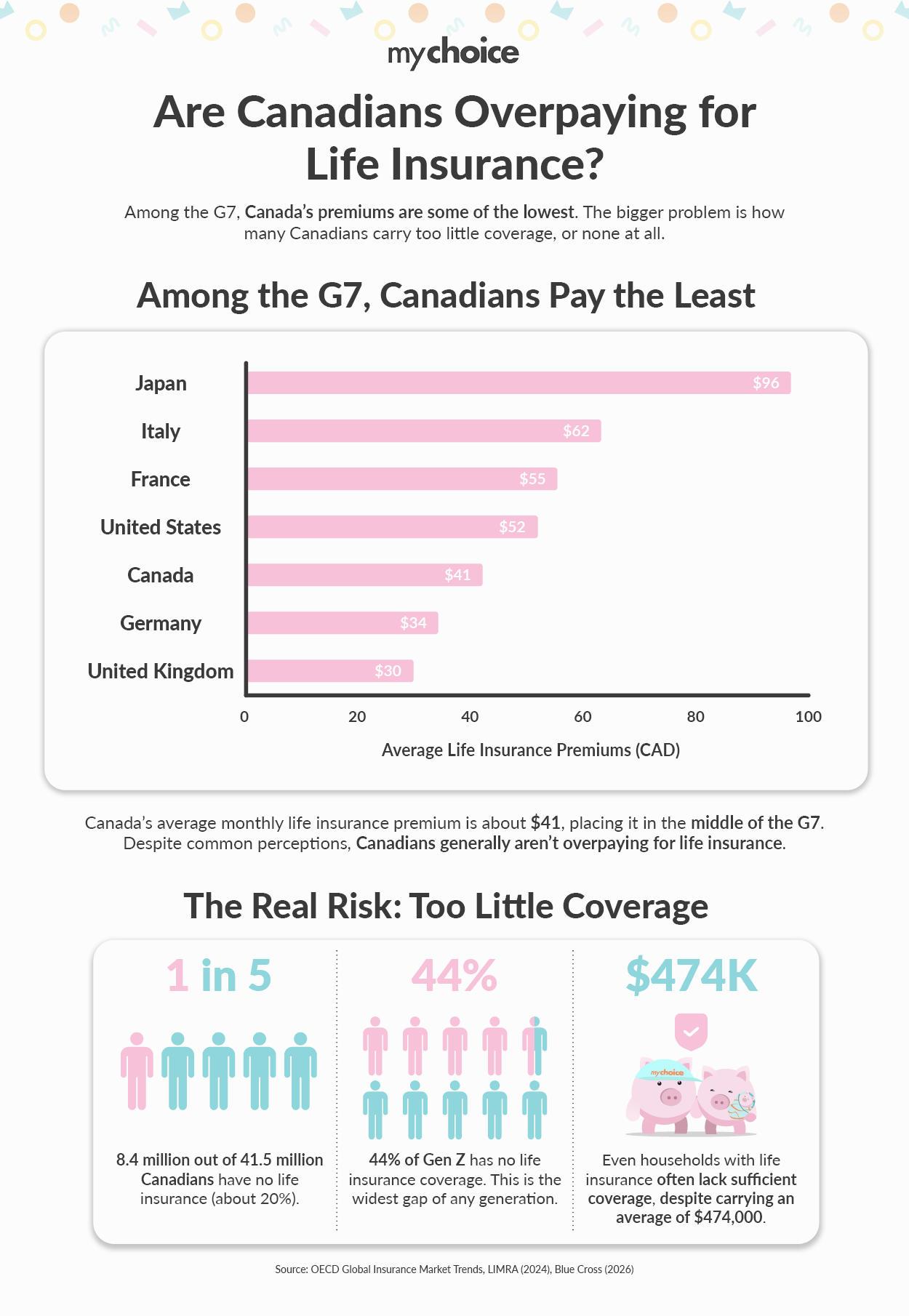
The answer is no. International comparisons suggest Canadian premiums are broadly in line with those in other major developed economies.
| Country | Monthly premium (CAD) |
|---|---|
| United Kingdom | $30 |
| Germany | $34 |
| Canada | $41 |
| United States | $52 |
| France | $55 |
| Italy | $62 |
| Japan | $96 |
Based on a 35-year-old male non-smoker purchasing a 20-year level term life insurance policy with $500,000 in coverage.
Canada ranks in the middle of the countries reviewed. The United Kingdom and Germany have the lowest estimated premiums, while Japan has the highest.
Read More: Compare Life Insurance Companies in Canada
Per Capita Spending on Life Insurance
Per capita life insurance spending, also known as insurance density, measures the amount spent on life insurance per person. It does not show what an individual policy costs.
| Country | Life insurance premium per capita (USD) |
|---|---|
| United Kingdom | $3,466 |
| France | $2,431 |
| Japan | $2,245 |
| United States | $2,136 |
| Italy | $1,878 |
| Canada | $1,759 |
| Germany | $1,106 |
Source: Swiss Re sigma 3/2024
Canadian per capita spending is below five of the countries shown and above Germany.
Canada’s Life Insurance Gap
A life insurance gap exists in Canada, meaning there is a difference between how much coverage Canadians have and how much they believe they need.
Some people assume their employer-sponsored life insurance will provide adequate coverage for their families. Others believe life insurance is more expensive than it is. Thirty-three per cent of Canadians overestimate premiums by more than 300%.
According to LIMRA, 8.4 million Canadian adults say they need life insurance or need more coverage.
Test Whether Your Own Policy Costs Too Much
- Determine how much insurance you need, who the policy is intended to protect and when the coverage expires.
- Review any coverage you already have. Employer-provided coverage may depend on continued employment, and continuation or conversion options may be limited when you change jobs.
- Obtain quotes from several insurers. Use the same health and smoking information for every quote, and find out whether each quote is preliminary or represents the insurer’s final offer.
- Compare the policy type, death benefit, term length, guaranteed premiums, renewal rates, conversion options, expiry dates, riders and exclusions. A lower initial premium may come with higher renewal rates or fewer options.
- Once the coverage amount, term and underwriting class are the same, compare the annual cost per $1,000 of coverage. Divide the annual premium by the number of thousands of dollars in the death benefit.
Read More: Use the Life Insurance Coverage Review Guide