









Life insurance needs evolve with age and changing financial responsibilities. When people first buy coverage, they may need to protect young children, ensure the mortgage can be paid off, cover their own or their spouse’s student loans, or provide a financial cushion while carrying significant debt.
But as time goes on and their children graduate from university, leave home and the mortgage is paid off, many people find they do not need as much life insurance as they did before.
That’s why if you’re in your 20s, 30s or 40s – or have concrete financial obligations that you know you need to meet – you might want to consider life insurance laddering.
What Is Life Insurance Laddering?
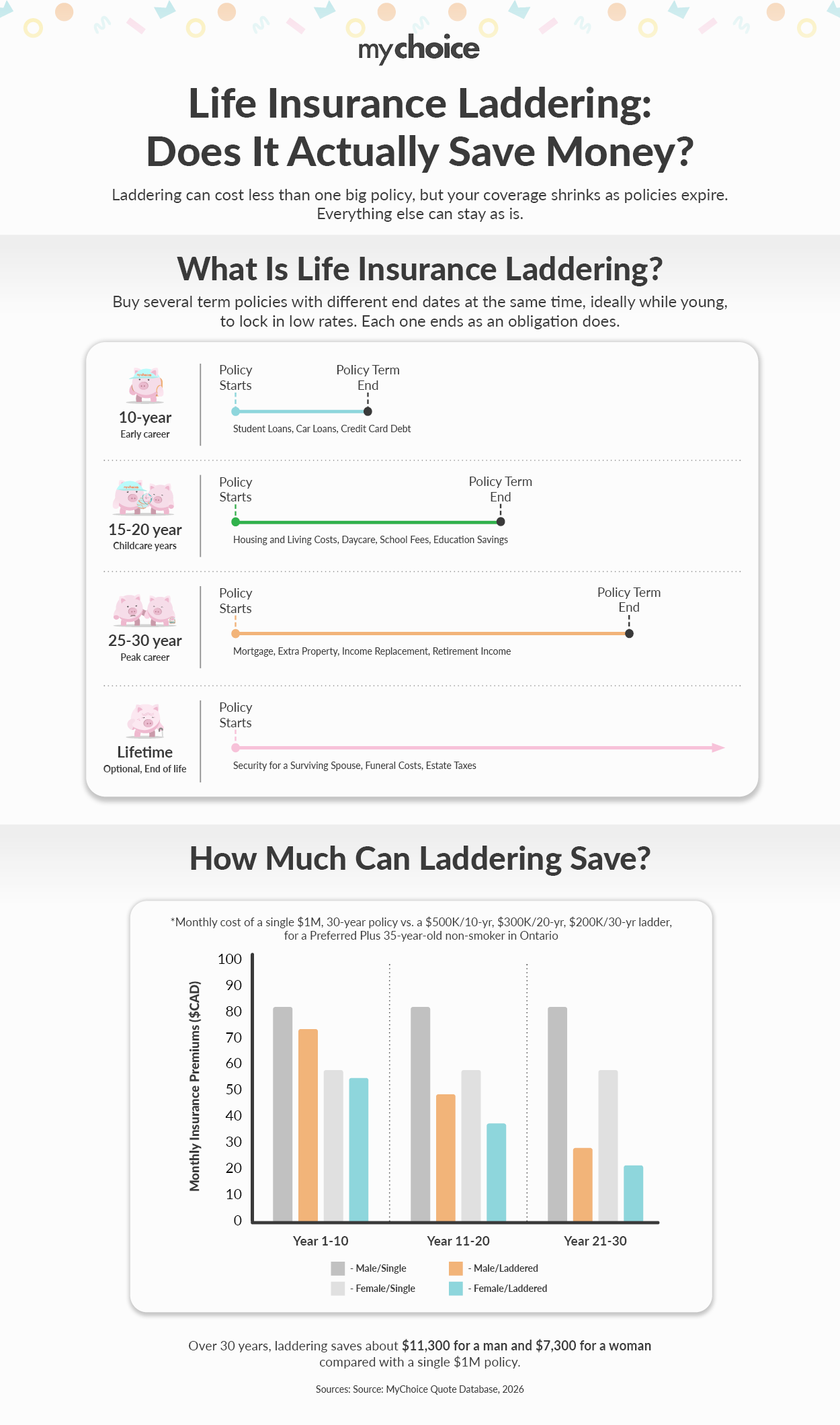
Laddering life insurance involves purchasing multiple policies with different end dates. These might be 10, 20 and 30-year term policies – the rungs of the ladder – along with a longer lifelong policy. Because you buy these policies at the same time, ideally when you’re as young as possible, you can lock in rates based on your current age and health.
At the same time, because each policy ends as your financial obligations decrease, your coverage will drop off and the amount you spend on life insurance will also fall over time. In this way, laddering life insurance will help you protect your family while possibly saving money over one long-term life insurance policy.
How Do I Use Life Insurance Laddering?
Life insurance laddering involves buying multiple term life insurance policies with different end dates that cover your financial obligations at each stage of your life.
- 10-year policy: Early career: Student loans, car loans, credit card debt.
- 15–20-year policy: The childcare years: Living expenses, housing costs, child expenses, daycare costs, school fees, college or university savings.
- 25–30-year policy: A long-term mortgage or second mortgage, recreational property or property for an adult child; income replacement when you’re at a senior level of your career; financial support for a surviving spouse approaching retirement.
- Lifetime coverage: Financial security for a surviving spouse during the end-of-life phase; funeral costs, estate taxes.
Does Life Insurance Laddering Actually Save Money?
It can, but it isn’t automatically less expensive. That’s because a single policy might cost more, but it will always provide you with the full coverage amount. Laddering life insurance generally means premiums go down but coverage also declines. Premiums are also generally different for males and females.
Our team at MyChoice compared the monthly premiums of 10-year, 20-year and 30-year life insurance terms using quotes collected in 2026, focusing on a profile of a 35-year-old non-smoker living in Ontario.
In this scenario, all three policies are purchased at the outset and the premiums remain the same during their terms.
| Policy | Coverage | Term | Male monthly premium | Female monthly premium |
|---|---|---|---|---|
| Policy #1 | $500,000 | 10 years | $22.04 | $15.75 |
| Policy #2 | $300,000 | 20 years | $21.95 | $16.92 |
| Policy #3 | $200,000 | 30 years | $27.72 | $20.88 |
| Total | $1,000,000 | $71.71 | $53.55 |
As this MyChoice chart shows, the premium difference can be significant when a ladder is compared with a single 30-year policy in the amount of $1 million. However, the ladder provides considerably less coverage after the first 10 years.
| Period | Male monthly cost | Female monthly cost | Total coverage |
|---|---|---|---|
| Years 1–10 | $71.71 | $53.55 | $1 million |
| Years 11–20 | $49.67 | $37.80 | $500,000 |
| Years 21–30 | $27.72 | $20.88 | $200,000 |
MyChoice Quote Analysis Shows Life Insurance Laddering Could Save $11,268 Over 30 Years
| Period | Coverage: Single vs. laddered | Single male | Laddered male | Male premium difference | Single female | Laddered female | Female premium difference |
|---|---|---|---|---|---|---|---|
| Years 1–10 | $1 million | $81 | $71.71 | $9.29 | $57.60 | $53.55 | $4.05 |
| Years 11–20 | $1 million vs. $500,000 | $81 | $49.67 | $31.33 | $57.60 | $37.80 | $19.80 |
| Years 21–30 | $1 million vs. $200,000 | $81 | $27.72 | $53.28 | $57.60 | $20.88 | $36.72 |
Over 30 years, a single 35-year-old male will spend $29,160 to maintain $1 million in coverage throughout, while a male who takes a laddered approach will spend $17,892 for coverage that declines from $1 million to $500,000 and then $200,000 before ending after year 30. The premium difference is $11,268 over 30 years.
A single female will spend $20,736 over the 30-year period for $1 million in coverage, while a female who takes a laddered approach will spend $13,467.60 for coverage that declines from $1 million to $500,000 and then $200,000 before ending after year 30. The premium difference is $7,268.40 over 30 years.
When Life Insurance Laddering Might Not Be Worthwhile
Laddering life insurance might not be suitable:
- If you have children or a spouse who requires lifelong care.
- You have substantial debts that you expect will increase over time.
- You predict the 30-year coverage period will not be long enough. Buying life insurance at that stage to extend your coverage could be very expensive.
- The premium difference between multiple term life policies and a permanent policy is minimal.
- You need a death benefit regardless of when you pass away.
Who Is Life Insurance Laddering Most Suitable For?
Life insurance laddering is most suitable when:
- You have young children.
- You have a mortgage.
- Premium savings are significant.
- Your financial picture will change, with obligations gradually declining rather than holding steady or increasing.
- You’re financially prepared for sharp declines in life insurance coverage.