








Canadian insurance may cover certain operations in the U.S., but it may not meet requirements for specific states, venues, employees, vehicles, products, locations, etc.
We’ve looked through the Insurance Bureau of Canada’s business-coverage guide along with information from the U.S. Small Business Administration’s launch guide, the U.S. Department of Labor’s directory of state workers’ compensation officials and the U.S. Federal Trade Commission’s data-breach response guide to write this guide. Use it to determine what kinds of risk you’re exposed to in the U.S. before requesting quotes.
Then review your Canadian policies to see where they may not meet U.S. requirements in the states where you expect to do business; check customer contracts; review regulations in the appropriate states; and have a plan for workers’ compensation, vehicle usage and data-breach laws.
What Insurance Does a Canadian Business Need to Expand Into the U.S.?
There is not one cross-border package. List each state that the business will operate in and what activities will be conducted in each state. Verify whether the Canadian insurance covers these activities, locations and jurisdictions. Factor in any requirements for local placement and any state-specific requirements before beginning operations in each state.
Providing a service from Canada is very different from employing people, storing products, using vehicles, having facilities, etc. Each one needs to be considered separately for insurance and registration.
Read More: Read About Business Insurance for a Canadian LLC
Why U.S. Expansion Changes Your Insurance Needs
Make sure that your broker points out the provisions dealing with the territory of coverage, including whether actions in the U.S. are covered, the provisions dealing with the manner in which defence costs are treated, limits, aggregates, punitive or exemplary damages where allowed, and whether you will be covered for services, not just products and completed operations.
Don’t accept assurances about “worldwide coverage”; you should be able to see it in black and white. Claims may be brought in countries or states not priced by the insurer. Forms may limit the jurisdictions or countries where claims may be brought and the governing law. Coverage for products or services not included on the original application may be questioned. Locations of operations may not be scheduled and therefore may not be covered.
There is no standard $5 million liability limit in the U.S. Determine the limit based on contractual requirements, the severity of a credible loss, assets and available umbrella limits. Then consider the aggregate limits and sublimits of the policy.
Read More: See How a Business Owner’s Policy Works
State-Specific Insurance Requirements to Confirm
- Check the secretary of state or equivalent state filing office for foreign qualification and registered-agent requirements.
- Contact the state or professional board about any licences for services, occupations or facilities.
- Contact the appropriate state official about workers’ compensation. The U.S. Department of Labor provides a state-by-state directory of contacts.
- Ask a properly licensed broker about automobile and general insurance requirements and any required filings.
Key Coverages You May Need to Consider
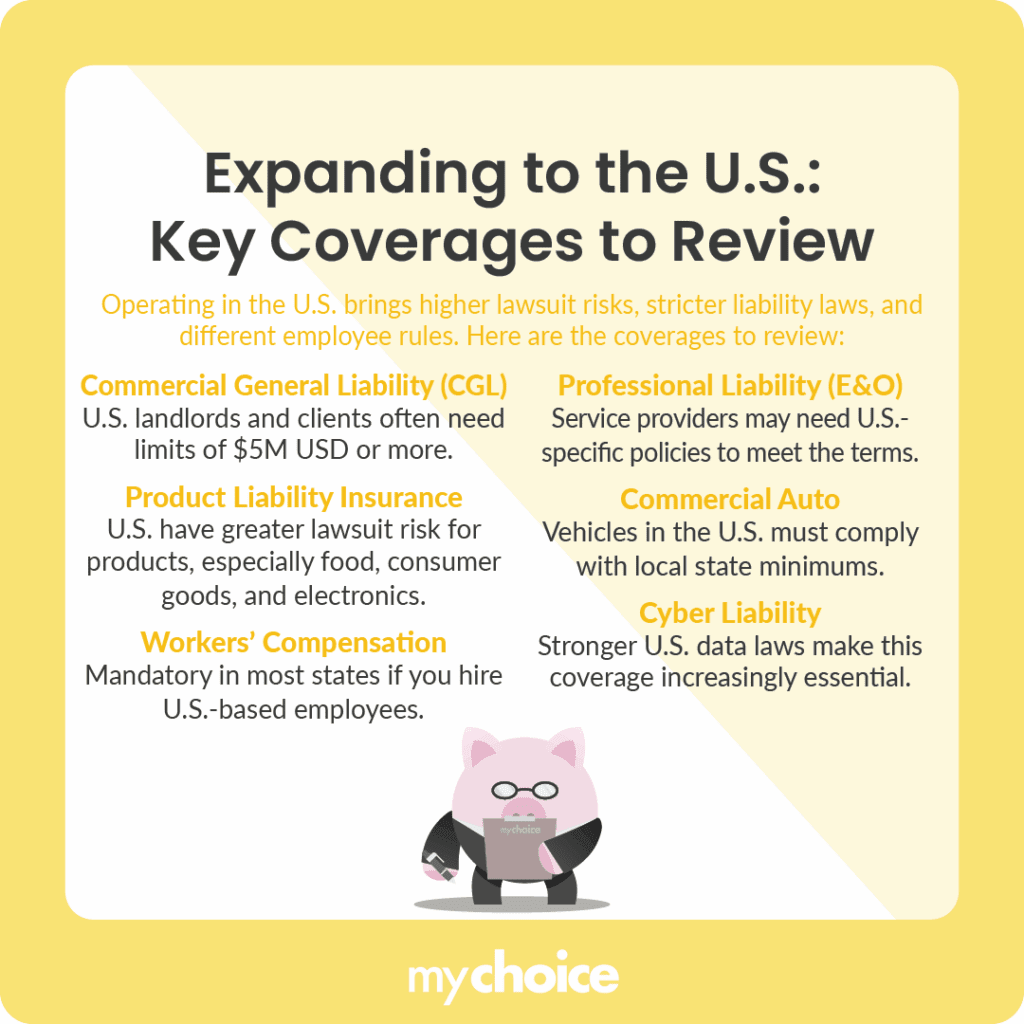
Even if you already have comprehensive coverage in Canada, operating in the U.S. often means higher limits, additional policies, and meeting specific state requirements.
Here are some of the main coverages you should review when entering the U.S. market:
Commercial General Liability (CGL)
U.S. clients and landlords often require higher limits that can go up to $5 million USD or even more.
Product Liability Insurance
If you’re selling goods in the U.S., product liability exposure can be significantly higher, especially in industries like food, consumer goods, or electronics.
Workers’ Compensation Insurance
This is mandatory in most states if you have U.S.-based employees. Each state has its own rules, so you’ll need to set up a policy that complies locally.
Professional Liability/Errors & Omissions (E&O)
If you provide professional services like IT consulting, engineering, or marketing, you may need U.S.-specific E&O coverage. American clients often have strict contract clauses about this.
Commercial Auto Insurance
If your vehicles operate in the U.S., you’ll need insurance that meets U.S. state minimums, which may differ from Canadian standards.
Cyber Liability Insurance
Given strict U.S. data laws (and the cost of breaches), cyber insurance is becoming a must-have for many Canadian businesses with U.S. customers.
Read More: Explore Business Insurance Options