










4.8
4.8/5
on Google and Facebook!

Public Liability Insurance in Canada

Get the right coverage for your business in just
a few quick and easy steps. Secure your rate today!

Secure. No Spam. No Fees.

Why You Can Trust MyChoice

MyChoice serves as an independent intermediary between you, financial institutions and licensed professionals without any additional charge to our users. In the interest of transparency, we disclose that we partner with some of the providers we write about – we also list many financial services without any financial gain. MyChoice does not operate a financial institution or brokerage and to ensure accuracy, our content is reviewed by licensed professionals. Our unique position means that we hold no recurring stake in your policy, ensuring our mission to help Canadians make better financial decisions is free of bias or discrimination. 

How to Compare Business Insurance Quotes with MyChoice

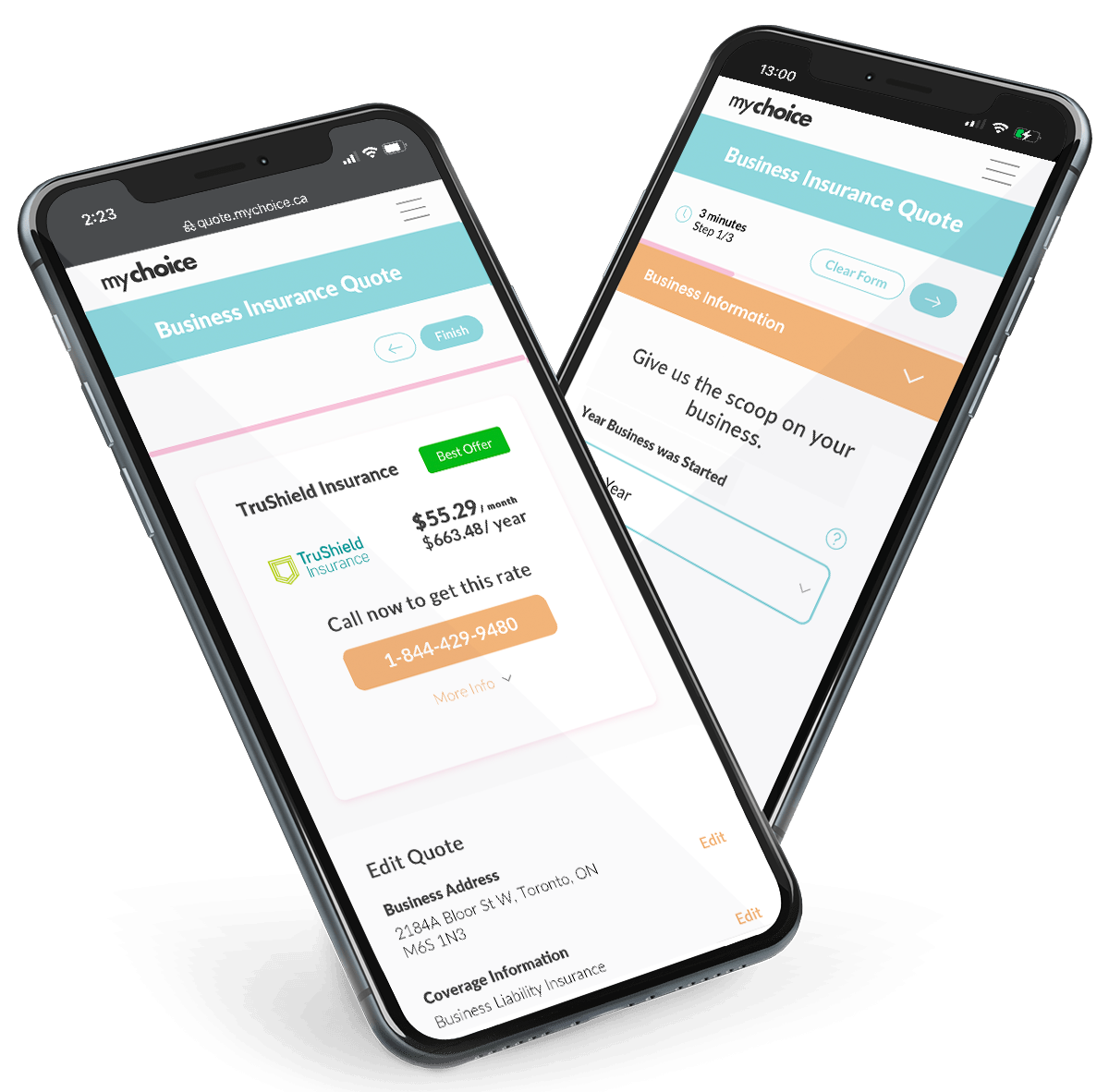
Comparing business insurance quotes with MyChoice is as simple as it gets:

Share Your Business Insurance Needs

Tell us what you want out of your business insurance.

Shop for the Best Deals​

Compare business insurance quotes from the best Canadian insurers.

Secure Your Rates​

Pick the best deal and lock your rates on our site.​

business insurance quote

Recent Quotes From Our Users

Monthly PremiumsDate & TimeQuote TypeAgeGenderCity
$91.08Dec 01, 2025, 05:36 PMAuto45MaleWhitby
$43.06Dec 01, 2025, 02:11 PMHome37MalePeterborough
$19.74Dec 01, 2025, 08:55 AMTenant40FemaleScarborough
$39.35Dec 01, 2025, 03:22 PMLife31MaleScarborough
0

Canadians

have compared rates and saved money over the last 24 hours
Secure. No Spam. No Fees.
Updated on November 26, 2025

6 minute read

Whether you run a small shop, manage a construction crew, or freelance as an event planner, accidents happen and can lead to costly legal trouble. Fortunately, public liability insurance can safeguard your business by covering expenses caused by such unfortunate mishaps. But how does it work, and how does it differ from other types of business insurance?

This guide will walk you through the essentials, from costs and coverage to when it’s required and how it compares to other insurance options.

Quick Facts About Public Liability Insurance in Canada

  • Public liability insurance protects your business if a member of the public is injured or their property is damaged due to your business activities.
  • It is typically included within a Commercial General Liability (CGL) policy but can also be purchased as standalone coverage for specific risks.
  • Most small businesses with a general liability policy start around $450 per year for a $2M limit, with premiums rising based on industry, size, claims history, and location.
  • Public liability insurance is not legally mandatory, but it is often required by landlords, event venues, municipalities, industry bodies, and corporate clients before contracts are approved.

How Public Liability Insurance Works in Canada

Public liability insurance is a subset of general liability insurance designed to protect you if someone from the public (e.g. a client, customer, or visitor) suffers injury or property damage because of your business activities.

It’s often part of a Commercial General Liability (CGL) policy, designed to protect against third-party claims that aren’t from your employees. It covers legal defence costs as well as settlement or court-ordered payouts. While it’s not legally required everywhere in Canada, many contracts, venues, or industry bodies make it mandatory as an added assurance.

How Much is Public Liability Insurance in Canada?

The cost of public liability insurance in Canada varies widely. For example, a small to medium-sized business with a general liability policy with a $2 million limit typically has a starting premium of around $450 per year. But this rate can start climbing based on its industry, size, location, and risk exposure

Let’s take a closer look at what influences your public liability insurance cost:

Industry risk level

High-risk sectors such as construction or retail generally pay more than low-risk fields like consulting or design.

Business size and revenue

More employees or higher revenue increase exposure and raise premiums.

Experience and claims history

Established businesses with clean records often enjoy lower rates, while past claims typically increase premiums.

Location

Insurance rates vary by location, as policies in urban centres or regions with higher risk factors often cost more.

Coverage limits

Choosing higher limits (e.g., $5M vs. $2M) will increase premiums.

Broker or insurer differences

Pricing models vary between insurers, so quotes can differ significantly even for similar coverage.

What Exactly Does Public Liability Cover/Not Cover?

There are some risks that a public liability insurance policy won’t cover. Here’s a quick reference table showing the core protections and common exclusions:

CoveredOften Excluded
Bodily injury to a third partyEmployee injury (covered by Workers’
Compensation)
Property damage to a third
party’s belongings
Professional errors or negligence in your work
(needs Professional Liability/E&O Insurance)
Legal defence costs if you’re
sued
Cyberattacks, data breaches (needs Cyber
Liability Insurance)
Medical expenses for injured
third parties
Damage to your own business property (needs
Commercial Property Insurance)
Settlements or court-ordered
damages
Intentional or criminal acts

Who Needs Public Liability Insurance in Canada?

While not every business is legally obligated to carry public liability insurance, it’s strongly recommended for anyone who:

Interacts with the public on-site:

Foot traffic increases the risk of slips, falls, and accidental damage.

Works at client sites or events:

You could accidentally damage property or cause injury while on location.

Runs a home-based business with client visits:

Accidents at your home could still lead to costly claims.

Operates in shared spaces or leases commercial property:

Landlords often require coverage to protect their own liability.

Hosts events, exhibitions, or workshops:

Large gatherings increase exposure to injury and property damage risks.

Even freelancers and sole proprietors can face lawsuits over accidents: without insurance, those legal and compensation costs come directly out of pocket.

Public Liability vs. Other Optional Coverages

Public liability is just one type of policy, and it doesn’t cover every potential risk. Here’s how it compares to other common business policies:

Coverage TypeWhat It CoversWhat’s ExcludedBest For
Public LiabilityThird-party bodily
injury and property
damage
Employee injury,
professional mistakes,
cyber risks
Businesses interacting
with the public
Professional Liability
(E&O)
Financial loss due to
professional advice or
service errors
Physical injuries,
property damage
Consultants,
accountants,
designers, IT
professionals
Commercial General
Liability (CGL)
Combines public
liability with product
liability and more
Professional errors,
cyber incidents
Most businesses that
need broader coverage
Cyber LiabilityLosses from
cyberattacks, data
breaches, and privacy
violations
Physical injuries,
property damage
Any business handling
sensitive data or
operating online

When is Public Liability Insurance Required by Law or Contracts?

In Canada, public liability insurance is not mandated at the federal level, which means there’s no nationwide law saying every business must have it. However, that doesn’t mean you can skip it. In fact, in many cases, it becomes a practical or contractual requirement depending on where you operate and what you do.

Here are common scenarios where you might need it:

Some provinces or cities require proof of public liability insurance for specific trades or activities. For example, certain construction trades in Ontario may need coverage to bid on public projects, and municipalities often require it for issuing permits for street festivals, markets, or public gatherings.

If you rent a storefront, office, or warehouse, the lease will often state that you must carry public liability and name the landlord as an “additional insured” to protect them as well.

Many larger companies and government entities won’t work with contractors, consultants, or vendors unless they have public liability insurance to protect them if something goes wrong.

Most venues will ask for proof of coverage before confirming your booking.

Professional or trade associations may require members to carry public liability insurance to maintain accreditation or licensing, especially in fields where public safety is a concern.

Even though it’s not a blanket legal requirement across Canada, public liability insurance often becomes a practical necessity if you want to operate smoothly, win contracts, or access certain spaces. Always check your specific industry and location requirements.

What to Ask Before You Buy Public Liability Insurance

Before you commit to a public liability policy, it’s worth having a detailed conversation with your broker or insurer. A little due diligence now can save you expensive headaches later.

Here’s what you should clarify:

What’s the exact coverage limit?

In Canada, standard limits are often $2 million or $5 million, but higher amounts may be necessary for certain industries, contracts, or events. Ask your broker whether your coverage meets the requirements of your clients, landlords, or provincial regulations,  and whether higher limits are affordable for you.

What’s excluded?

All insurance policies have exclusions. Common ones include professional errors, employee injuries, intentional damage, and cyber-related losses. If your work involves advice or digital security risks, you might need additional policies such as Professional Liability (E&O) or Cyber Liability coverage.

Is it part of a CGL policy or standalone?

Public liability is often bundled into a Commercial General Liability (CGL) policy, which also covers product liability and other risks. A standalone public liability policy may be cheaper, but it might not cover as much. Understanding which type you have will help you spot any coverage gaps.

Does it include product liability coverage?

If you manufacture, sell, or distribute products, you may need product liability protection in case a product causes harm. Sometimes it’s automatically included with CGL, but not always with standalone public liability.

What’s the deductible?

The deductible is the amount you’ll pay out of pocket before insurance kicks in. A higher deductible usually means lower premiums, but make sure it’s an amount you could comfortably pay in an emergency.

Are there restrictions based on location or event type?

Some policies only apply within Canada, while others extend internationally. Likewise, certain “high-risk” events (e.g., large concerts, construction work) may not be covered unless specifically added to your policy.

How are claims handled and how quickly?

Ask about the insurer’s claims process: how you file, average response times, and what documentation you’ll need. A good insurer should offer clear steps and reasonable timelines.

FAQs about Public Liability Insurance In Canada

Is public liability insurance mandatory in Canada?

No, public liability insurance isn’t mandatory in Canada. However, certain provinces, contracts, landlords, or venues may require it depending on your situation.

What’s the difference between public liability and general liability insurance?

Public liability focuses on injury or property damage to third parties. General liability (a.k.a. Commercial General Liability) is broader and includes product liability and other protections.

Can I buy a one-day public liability insurance policy?

Yes, you can buy one-day public liability insurance. Some insurers offer short-term or event-specific coverage for instances and parties such as event organizers, market vendors, and pop-up shops.

Does public liability insurance cover damage caused by employees?

Yes, public liability insurance covers damage caused by employees if it’s accidental and affects a third party. Employee injuries, however, are covered under workers’ compensation, not public liability.

Can freelancers or sole proprietors get public liability insurance?

Yes, freelancers or sole proprietors can get public liability insurance. Many insurers offer affordable policies tailored for individuals.

How do I prove I have public liability insurance to a client or venue?

You can prove you have public liability insurance to a client or venue by showing the Certificate of Insurance (COI) you received from your insurer or broker.

What’s the best insurer in Canada for public liability for small businesses?

There’s no one-size-fits-all “best” insurer in Canada for public liability for small businesses, as the best fit depends on your industry and needs. Compare quotes and offered coverage using MyChoice to find the right balance between protection levels and your budget.

Congratulations! You made it to the end!

Now, here is the easy part: complete your quote in under 2 minutes
Secure. No Spam. No Fees.

Discover More About

November 5, 2025
Small businesses in Canada are increasingly facing cyber threats. Learn about financial, legal, and reputational costs of data breaches and how to stay protected.
October 24, 2025
Learn how outsourcing can leave Canadian businesses exposed to insurance risks and learn how to cover contractors, data breaches, and misclassified workers.
October 17, 2025
Learn how commercial blanket coverage in Canada works, its benefits, types, and why more businesses use it to simplify insurance and reduce coverage gaps.