







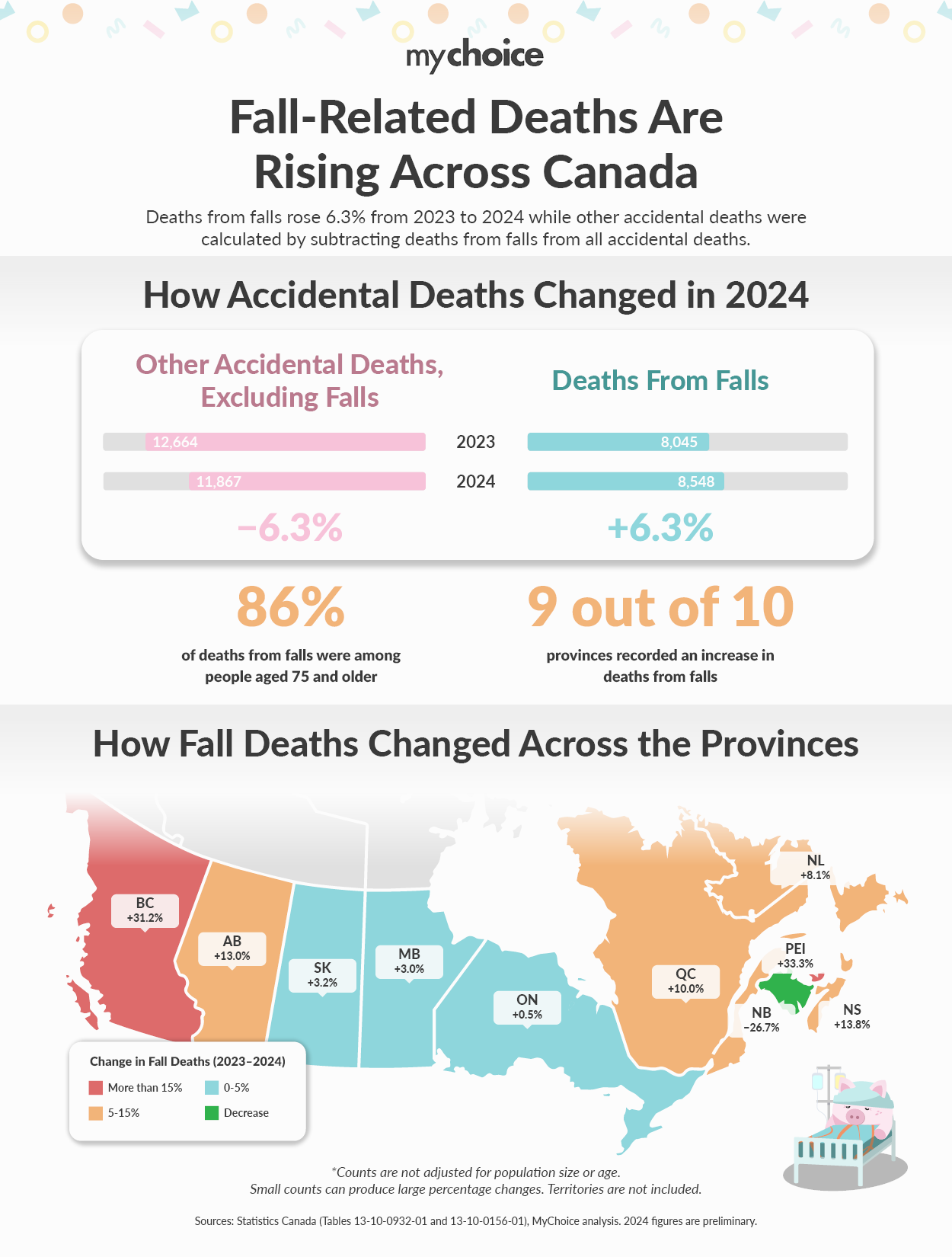
People aged 75 and older accounted for approximately 86% of deaths from falls, even as deaths from other accidents declined
For Canadian families helping an older parent live independently, small changes around the house can significantly improve the parent’s safety. Better lighting, secure handrails, and clear walkways can all help reduce potential fall hazards. November’s Fall Prevention Month encourages Canadian families to have these conversations and take steps to prevent injuries.
Ahead of this year’s awareness month, our team at MyChoice wanted to understand what the most recent data showed about this topic. Were deaths increasing? Which age groups were most affected? Was the same pattern appearing across the provinces? These were the questions our team asked before starting this study.
To understand how deaths from falls changed across Canada, we compared Statistics Canada’s mortality data for 2023 and 2024. We examined national and provincial death counts and age-adjusted rates, and then reviewed deaths from falls by age to identify the groups most affected.
The findings below give Canadian families a reason to talk about prevention and financial preparedness. Reducing fall hazards can improve safety, while reviewing existing life insurance and accident coverage can help families understand what financial support may be available after an accident or passing.
Key Findings From the Study
- Deaths from falls increased 6.3%, from 8,045 in 2023 to 8,548 in 2024.
- Deaths from other accidents combined declined 6.3%, while accidental deaths overall fell 1.4%.
- People aged 75 and older accounted for 7,338 deaths from falls, approximately 86% of the national total.
- Death counts from falls increased in nine provinces. New Brunswick was the only province to record a decline.
- The national age-standardized fall mortality rate increased approximately 2.5%, a smaller increase than the change in the number of deaths.
These findings describe a one-year change (2023 vs 2024), the most recent data available to our team when we conducted this study.
Older Canadians Accounted for Most Deaths From Falls
Canadians aged 85 and older are in the highest risk group. They accounted for 5,043 fall-related deaths in 2024, about 59% of the national total. People aged 75 to 84 accounted for another 2,295 deaths.
Together, those two age groups accounted for 7,338 deaths, approximately 86% of all deaths from falls.
The national increase was driven entirely by Canadians aged 75 and older. Deaths from falls actually declined among younger age groups, highlighting how heavily the trend is concentrated among older adults.
| Age group | Fall deaths in 2023 | Fall deaths in 2024* | Change |
|---|---|---|---|
| Under 65 | 465 | 430 | −35 |
| 65–74 | 758 | 780 | +22 |
| 75–84 | 2,097 | 2,295 | +198 |
| 85 and older | 4,725 | 5,043 | +318 |
| All ages | 8,045 | 8,548 | +503 |
Read More: How Life Insurance for Seniors Works
Deaths From Falls Increased in Nine Provinces
Quebec recorded the largest increase in the number of deaths from falls, rising by 247 to 2,721 incidents. British Columbia recorded 138 more deaths, bringing its total to 580.
New Brunswick was the only province where the recorded number declined, falling from 105 to 77.
| Province | Fall deaths in 2023 | Fall deaths in 2024* | Change |
|---|---|---|---|
| Alberta | 401 | 453 | +13.0% |
| British Columbia | 442 | 580 | +31.2% |
| Manitoba | 234 | 241 | +3.0% |
| New Brunswick | 105 | 77 | −26.7% |
| Newfoundland and Labrador | 37 | 40 | +8.1% |
| Nova Scotia | 354 | 403 | +13.8% |
| Ontario | 3,821 | 3,840 | +0.5% |
| Prince Edward Island | 15 | 20 | +33.3% |
| Quebec | 2,474 | 2,721 | +10.0% |
| Saskatchewan | 157 | 162 | +3.2% |
How Families Can Reduce Fall Hazards
November’s Fall Prevention Month offers an opportunity to review practical safety measures in your home.
The Public Health Agency of Canada recommends removing tripping hazards, improving balance and strength through exercise, and clearing snow and ice from public walkways.
Health Canada’s home safety guidance also recommends:
- Improving lighting, particularly around stairs and routes between bedrooms and bathrooms.
- Installing secure handrails and appropriate bathroom grab bars.
- Removing or securing loose rugs, cords, and other obstacles.
- Discussing medications that cause dizziness or sleepiness with a doctor or pharmacist.
What Life and Accident Insurance May Cover
Alongside prevention, families may want to review their existing financial plans, including life insurance and any accident coverage they might have.
Life insurance can help those left behind manage costs and financial challenges after someone passes away. Accident insurance offers limited protection for specific accidents and injuries.
“When looking at life insurance, think about the financial commitments your family would face, like a mortgage, shared debts, or support for a partner,” says Matthew Roberts, COO of MyChoice. “Then look at any accident coverage you already have and understand where it fits. Accident insurance is more limited, and a death classified as accidental in government data may not meet the definition in a particular policy.”
Families should check what the policies say, what is not covered, age rules, and if coverage changes when someone stops working or retires.
For more information, read MyChoice’s guide to accident insurance versus life insurance.